Friday, August 14, 2015

No. 40 Peter Milligan

First Prog: 216
Latest Prog: 1277, although he’s due to resurface with Prog 1950 very soon!

Total appearances: 207 and counting
-including Rogan Gosh from Revolver, but not including Skin, which should have run in Crisis but didn’t, ending up as a standalone graphic novel printed by another publisher.

Creator credits:
Sooner or Later; Bad Company; The Dead; Freaks; Tribal Memories; Shadows; Bix Barton; Hewligan’s Haircut; Rogan Gosh

Other writing credits:
Rogue Trooper (in a handful of annuals and specials)
A whole pile of Future Shocks
A single, and incredibly weird, Judge Dredd story (in a Mega-Special)

Notable character creations:
Micky Swift
Danny Franks
Kano
-and almost every other character from Bad Company
Fludd
Bix Barton and Michael Cane (no ‘I’ because he’s literally a cane, you see)
Hewligan and Scarlet O’Gasmeter
The God of leaning against hot radiators
Banal and bizarre in one breath.
Art by Jim McCarthy
Notable characteristics:
Wit; sarcasm; big ideas; poking fun at clever people, stupid people, stupid people pretending to be clever and indeed clever people pretending to be stupid; silly jokes; literary (and not-so literary) references; Having what appear to be versions of himself as the protagonist, and often not a very sympathetic one at that*

Milligan champions outsiders - because, frankly, there are no insiders.
Art by John Higgins

War of (t)wits
Art by Eric Bradbury

On Peter:
Peter Milligan taught me that it’s OK to be pretentious. It’s ok to explore high-minded concepts in the guise of an action comic (Bad Company), and it’s also OK to mock the very idea of high-mindedness in the guise of an avant garde art comic (Sooner or Later; Hewligan’s Haircut). He taught me that if and when writers name-drop famous philosophers, you’re not missing out on the joke if you haven’t heard of them – thinking you’re being clever for having heard of any given philosopher IS the joke.

Righteous anger coupled with wordplay
Art by Brendan McCarthy

And, for a writer with something of a reputation for being tricksy (The Dead; Rogan Gosh; Hewligan’s Haircut), he’s actually written a whole lot of straightforward narratives (Bad Company, obviously, but also Freaks; Tribal Memories; Shadows).

Going back to the beginning, Milligan sure had to put in a lot of hard graft. It’s long been the case that new writers had to break in by writing Future Shocks and other one-off stories with surprise endings. Milligan may have written more than almost anyone**, and didn’t get to write his first proper series for 5 years after his first saw print!

Newspapers that report on the future: a beautifully simple premise
Art by Jose Casanovas

Hailing a taxi on the De Niro planet - not gonna end well.
Art byJohn Higgins
Later Future Shock hopefuls may complain that Milligan got in early and used up a lot of simple ideas that play on expectations of who is the narrator / the alien / the robot / the clone and such. But the fact is these stories worked, and many still have a kick today. He also had the decency to cut them down to as little as one or two pages, as the twist dictated.

Biblical reference, there
Art by Brendan McCarthy
Most of his one-offs were pretty classic sci-fi. Not so for his first series, Sooner or Later. For me, this series is the ne plus ultra*** of late 80s pretentious ‘comics about real people’. Of course, it’s one of the most unreal comics ever. The first episode did have quite the slice-of-life feel to it, with professional layabout Mickey Swift getting up to not much, before falling through a plot contrivance into the far future. But as the narrator, he did, sort of, keep the focus on things like unemployment, fashion, taste in music and all the other good stuff that trendy comics of the late 80s were actually about. 


With the help of co-conspirator Brendan McCarthy, Milligan dreamed up a pretty fantastical future to go with the moaning. A delicious slice of weirdness like nothing else before or since. Given how well the pair work together, it’s a shame they only had one other series together for Tharg, and even that was for fringe comic Revolver. Rogan Gosh, very vaguely informed by the pair’s childhood in Indian-infused West London is incredibly beautiful and incredibly odd. Well worth seeking out.


The Todds - 2000AD's best-coiffed villains
Art by Brendan McCarthy
Referencing polo mints and Beatles songs.
Art by Jamie Hewlett
Swifty’s Return, with uber-art-comics bad boy Jamie Hewlett, was decidedly different and decidedly similar at the same time. See also Hewligan’s Haircut, which isn’t as clever or groundbreaking as the hype at the time suggested, but is still fun. Of course the best joke in it is the not-endorsement from hair-brand Vidal Sassoon that appears on the collected edition.


Long before then, Milligan had served Tharg his masterpiece, and a perennial contender for all-time best series ever: Bad Company. This was, originally, a Wagner-penned war story that was meant to run in a proto-Megazine. When that fell through, Milligan was given the series. He turned it into a straight-up 'war is hell' story that kept its debt to John Wagner by being a sort-of remake of Darkie’s Mob. Like that series, it is narrated through letters from a raw recruit who is something of an intellectual. Even more like the old Battle strip, lead character Kano is a scary man-beast with a secret past – one that connects him to the enemy – just like Darkie himself.

Kano's brain is not right
Art by Ewins & J. McCarthy

Previous 2000 AD thrills had tried to tease mysteries (Project Overkill; Return to Armageddon, kind of; Halo Jones II had a murder mystery of sorts) – but none pulled it off with the same aplomb. The secret of Kano’s black box was questioned early, but only answered in the last episode, and - for me, at any rate – managed to bring an answer that was both surprising and satisfying. That there were other secrets to come was an added bonus! (Predicting who would live and who would die was way harder than any 80s slasher/action films would achieve, too)
But it wasn’t just the plotting – if anything, it was the characters. Bad Company is especially fondly remembered for the motley collection of weirdoes and mutants that bicker and tease each other even as they die together. Kano aside, it's not entirely clear how they got to be quite so weird, but the theme is clear – to cope with the rigours of that kind of war, you've got to be pretty messed up.

Being able to cope with war is itself proof of madness
Art by Ewins/J. McCarthy

Sheeva and De Racine
Art by Ewins/J. McCarthy
Just to be annoying, Milligan then comes up with another perhaps less loved but no less fascinating crew of refined weirdoes for Bad Company II, and again for Bad Company 2000 (although with just 6 episodes, these didn't have a chance to breathe). He even managed, along the way, the come up with a final mission and 'how the war ends' story that was entirely satisfying. God, he's good.


So good, in fact, that the secret weapon of the wider story is the odd one out – Kano. This tale is something of a murder mystery, but it also has a lot of the feel of a western to it (one of the revisionist ones, like Unforgiven). It's also a proper science fiction story, with its setting on an alien planet where time occasionally flows backwards. And it's also a horror story – one of the really devastating ones where the horror is brought about by personal tragedy and grief, although also by monsters.


Somehow you don't believe Kano has found a happy ending.
Art by Ewins/J. McCarthy


Yup, it's definitely a tragedy.

In ambition, Kano might only be matched by much earlier work The Dead, which I keep failing to understand, but admire for actually being about life and death and what those might mean.

Fludd's quest gets off to a false start
Art by Massimo Belardinelli

Where Danny Franks is, on the whole, someone you root for, Milligan does a good line in irritating idiot protagonists, too. Carl Woolf, from Freaks, is one such. That he is narcissistic and ignorant sort of ends up being the point of the story (in which he is kidnapped by aliens), but it mostly serves to make the story funnier.  

Mushroom atoms, man.
Art by John Higgins
Tribal Memories, and even shorter series, is another such. It nods towards Brave New World with its theme of bringing an old world 'savage' into the future to be gawked at by pseudo-intellectuals who should know better. It's also pretty hard not to read into it a swipe at white people who trade on black culture 'cos they think it's cool.

Mohammed (dude at the back) is also the self-aware narrator.
Art by Riot
 Shadows, a longer series, gives it hero a chance to overcome her ignorance and prejudice and embrace the plight of the homeless/downtrodden. Then something weird happens with computers/the internet that I didn't entirely follow, but it was rather moving.

Do you remember when no one really knew what the internet was?
Art by Richard Elson
A withering look to match an intolerant attitude
Art by Jim McCarthy
Which leaves us with Milligan's final gift to 2000 AD, Bix Barton. Apparently the character/series is in part inspired by the person and work of Steve Ditko, comics legend and recluse. I don't know enough about Ditko to understand the references. Instead, Barton seems to me to be another Milligan protagonist who you root for and kind of despise at the same time. Bix Barton is a 'proper' Englishman from between the wars who is roused in the near future to deal with bizarre crimes and mysteries. He likes rugby, tea, and being horrible to people who don't share his values. He's nothing like them, but you can trace a line from Barton to Harry Kipling and Ampney Crucis if you wish.

Anyway, it works. Barton is witty with his mean quips; his trappings, including a flying car and a talking walking stick are delightful, and above all the ridiculous cases he confronts are diverting. Silly, yes, but still diverting. It's the kind of stuff that you can't really see fitting into any context, which is what make sit such a good fit for 2000 AD.

By this time, Milligan was already turning heads over in America with his trippy and confusing (but often also coherent) grown-up comics such as Enigma and Shade, the Changing Man. I strongly recommend his work on X-Force/X-Statix, too – one of the best teen superhero comics ever, especially if you love but also hate the X-Men. (And while I'm recommending things, do check out his pre-2000 AD work, too: Paradax and Johnny Nemo, for more likably unlikable protagonists)

But the good news is, he's coming back! A new series of Bad Company is already written and probably drawn by now. Just maybe it'll inspire Milligan to some new offering that could only have a home in the Galaxy's Greatest Comic.

The Smiths: very important band, apparently.
Art by Brendan McCarthy

More on Peter Milligan
There's a neat fanpage here
An old TV clip here, where he talks Bad Company with Brett Ewins
One of many recent pieces about his upcoming return, this one from Comics Alliance
-but really, disappointingly little out there, especially covering his 2000AD stuff.


Personal favourites:
Sooner or Later
Bad Company: every last goddamn frame of it
Bix Barton: Lovesick World; Nigel, the Napoleon of East Finchley
Future Shocks: The Man who was too clever; Bad Timing; Extra! Extra!; But is it art?; The Thought that counts (and probably lots of others I haven’t re-read in ages)
Tribal Memories
Rogan Gosh


*Actually, this is more prominent in his later work, I think. But I'd include as examples Mickey Swift; Danny Franks; Peter Finnigan (from Skreemer); Patrick Mulligan (from Marvel series Toxin)...
Bix Barton looks kinda like Milligan, at least his haircut.

**Yes, I’m sure one day soon I’ll scratch the itch to count that all up…

***I love being pretentious.

Saturday, August 8, 2015

No. 39 Dave Gibbons


First Prog: 1
Final Prog: (as strip artist) 310; (as writer) 687; (as cover artist) 1387

Total appearances: 210

Creator credits:
The Harlem Heroes*; Rogue Trooper; the War Machine

Other art credits:
Dan Dare
Ro-Busters
ABC Warriors
Judge Dredd
Various seminal one-offs


Notable character creations:

John ‘Giant’ Clay
Artie Gruber – one of 2000 AD’s best –designed villains, fondly remembered despite a handful of actual appearences
Charlie, hero of Northpool
-and, to a certain extent, the Terra-Meks that fought him
Rogue Trooper and his biochips
Norts and Southers of various flavours
Nu-Earth, a planet that is itself a character
Fr1day, the re-booted Rogue Trooper


Notable characteristics:
Fluid action, well defined backgrounds, clear expressions, fantastically clear storytelling


On Dave:
Once upon a time, Dave Gibbons would have been the number 1 artist on this prog-tallying exercise. He had work in practically every single issue for the first 3 years of 2000 AD, then pausing only to bang out the first and definitive episodes of Rogue Trooper, along with a handful of some of the best-loved short stories of all time.

It’s not at all surprising that a talent as prodigious as his found higher paid work in America, where he became one of the first 2000 AD artists to show up his contemporaries by doing superheroes better than anyone else since Jack Kirby**.

As if to prove his talent, when he came back for a brief run in the Prog some years later, it was as a writer, not an artist (although we did get this tantalizing sketch).

But let’s begin again at the beginning: Harlem Heroes. This was a sports story that was notable a) for being about a sport that never quite made any sense and b) for having an all-black cast. More to the point, each character had his own look and personality, so lots of bonus PC points right off the bat, although you get the distinct impression they were mostly interested in telling an OTT violent sports story than in scoring PC points. The Harlem Heroes themselves made for engaging characters, but the real draw was Gibbons’s dynamic art, showing the team flying, punching and above all kicking their way to glory. Having the opposing teams decked up in all manner of crazy (and terrifically un-PC) gear was a side bonus. 

Kick to the face!

Colourful teams!

For a sport that makes no sense, you can really feel the
joy of scoring a goal.
All words by Tom Tully

 Along the way, Gibbons dreamed up crazed cyborg revenge-fixated villain Artie Gruber. Everybody loves Artie Gruber (except perhaps Tharg, who hasn’t seen fit to bring the iconic villain back nearly often enough).


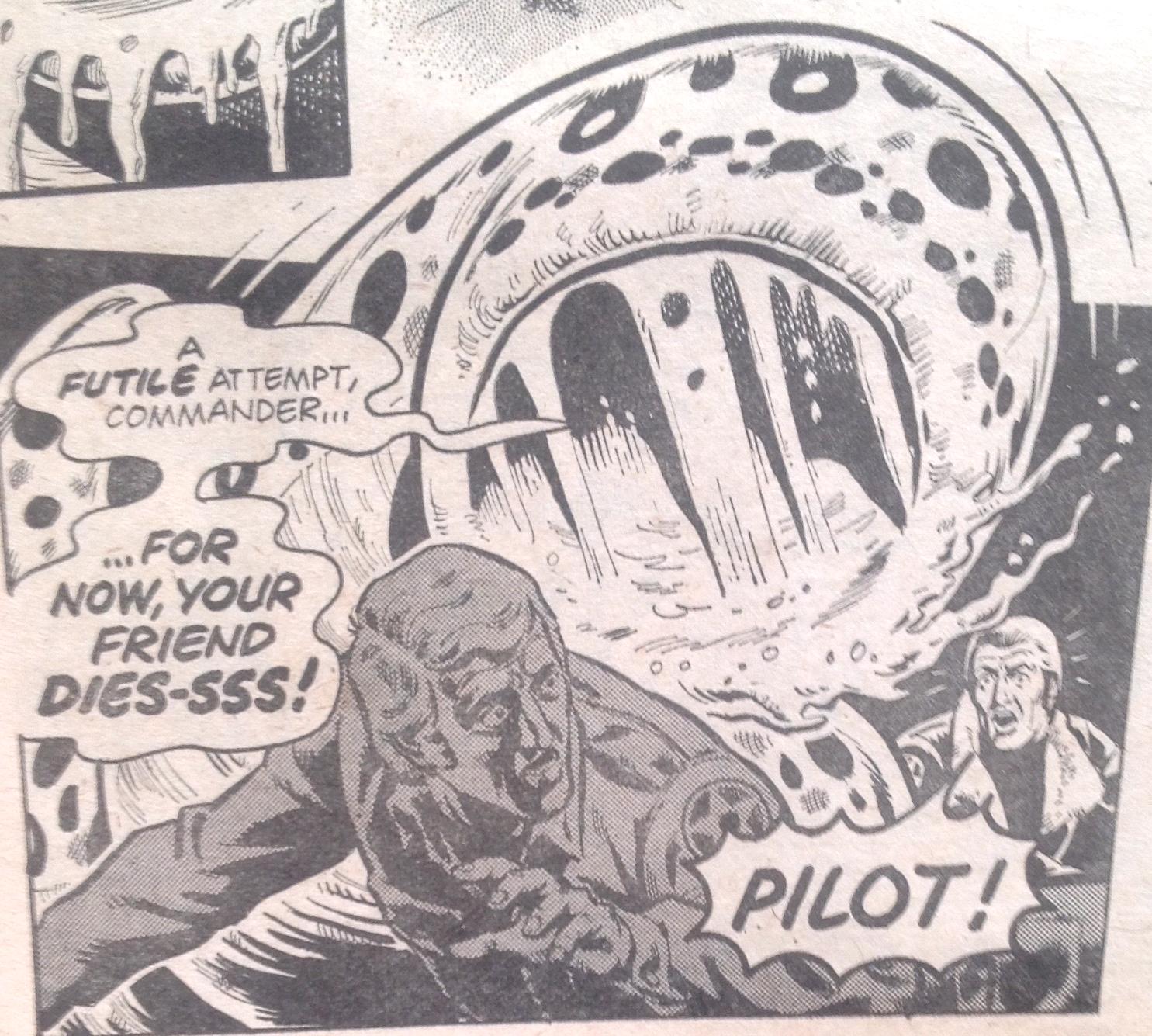
Gibbons soon swapped duties with fellow artist Massimo Belardinelli. The Italian put the Harlem Heroes on Motorbikes in Inferno, while the Englishman moved Dan Dare out of his glam rock future into a sort of blue collar Star Trek setting. Gibbons’s Dare was part James T Kirk and part Han Solo. His crew included Hitman, a man with a gun built into one of his hands, and Bear, a large Russian. Ah, the subtleties of early 2000 AD.

Raw emotion; palpable outrage
Words by Chris Lowder

Pilot's gonna get wormed...
Words by Chris Lowder

 
The first page of each Dare episode was on the cover for a while.
Words by Gerry Finley-Day
Gibbons made it work week in and week out for nearly two years, before the strip changed direction again, into more of a classic space adventure romp, with aliens aplenty, femmes fatale ( and something called the cosmic claw. I’ve barely read any original Dan Dare so I’ve no idea how it all compares.

Dare hung out with some rad-looking aliens, I'll give him that.
Words by Tom Tully

 In between bouts on Dan Dare, Gibbons teamed up with Pat Mills to create two famously tear-jerking, and indeed deeply political stories. The Ro-Busters found themselves sidelined as they watched a tussle between corporate greed and small-town hardship in the Terra-Meks. Mills and Gibbons wring every last tear out of the readership as run-down hero Charlie saves Northpool, and the adoring townsfolk sing ‘You’ll Never Walk Alone’. It’s like the John Williams score to a Steven Spielberg film – deeply unsubtle, absolutely effective.

Who's more evil? The man with his brain in a robot body, or the man with the pencil moustache?
Words by Pat Mills

Mek-Quake looks so hurt! Poor bastard.
Words by Pat Mills

Over in Ro-Busters spin-off ABC Warriors, Gibbons provided a single story, Cyboons, but once again it provided tears and politics, this time of a ‘colonists vs natives’ bent. Also the hilarious sight of an apeman groomed up as a 1950s swinger.

Hilarious, horrific, poignant and even political all in three panels.
Words by Pat Mills
 
Gibbons livened up a handful of twist in the tale offerings, most famously this one about a mayor who was also a robot who was also a wolfman, or something. I forget. Looks cool, though. 

Didn't see that coming.
Words by Gary Rice

But in the end, after helping lay the groundwork for 2000 AD as the best comic going  - a platform without which it would never have survived the death of newsprint comics in the mid-80s – Gibbons made his most lasting mark with Rogue Trooper. As detailed in Thrill-Power Overload**, Gibbons played a pretty huge part in helping to work out the basic set-up of the story, setting and characters. Super iconic stuff, from the constant black-hole visible in the Nu Earth skyline, to the truly horrific scenes of soldiers choking to death on the poison-filled atmosphere, to the simple, stark image of Rogue striding alone across battlefields, plagues by the memories of his fallen comrades.

Prog 241: a serious contender for best cover of all time


Choking down on gas: the worst way to die?
Gargle by Gerry Finley-Day

Using moody silhouettes to make a point
Words by Gerry Finley-Day
It’s no coincidence that Gibbons’s Rogue Trooper stories are the most emotional, the ones that really ram home the continued message about the horrors of war, and what it does to the people who fight them.

Interestingly, this was one angle almost entirely absent from Gibbons’s later re-working of Rogue Trooper, for his story the War Machine. The first of a glut of reboots (before the word ‘reboot’ even existed, as far as I know), this was one of the best. 
Art by Gibbons from a house ad. Kind of sums it up!

Being uncharitable, you could point to Gibbons the writer trading on the then-popular style of short-burst caption narration, a la Frank Miller in Wolverine, Dark Knight Returns and Sin City. The strip wears its themes on its sleeves so openly it’s kind of easy to mock – but this ignores the simpler truth that it’s actually a very successful war story that has, so far, stood the test of time.

Captions make comics
more serious.
Art by Will Simpson


While it probably wasn’t necessary to try to make the silliness of Helm, Gunnar and Bagman seem more realistic, it does work to show the GIs in training, and then going through the grim paces of soldiering as, functionally, brainwashed 12 year-old boys in the bodies of 20 year-old men. It also makes pretty simple but no less powerful observations about war as a tactic used by the rich and powerful to get richer and more powerful. The original Rogue Trooper, every now and then, touched upon the horrors of war, but always within the remit of being an action comic. Gibbons’s War Machine follows the classic cinematic axiom of remakes: be more realistic, be grittier. In some ways, it made the story less fun; in other ways, it resonated harder.

It’s also, not surprisingly, an act of scripting that allowed artist Will Simpson to breathe his own life into. His style couldn’t be further from Gibbons’s, but he works beautifully to make Gibbons’s point – war is hell.

Letting the artist do his thing with the gore and boredom of war.
Painting by Will Simpson


And then he was gone. Gone, but never forgotten.

If Gibbons dies soon this'll look really tasteless.


More on Dave Gibbons
Lew Stringer on Gibbons, with embedded video interview here.
You can read the first epsiode of Rogue Trooper here.
And don’t forget, Gibbons’s work on Dan Dare is finally getting a reprint later this year!

Personal favourites:
Harlem Heroes
Dan Dare:  in all honesty, I haven’t re-read any of these in so long I’d hesitate to pick one out, but the art is great
Ro-Busters: Murder on the Orient Express, the Terra-Meks
ABC Warriors: Cyboons
Judge Dredd: Mob Blitzers (his only episode, but who doesn’t love Lips Lazarus?)
Rogue Trooper: all of Gibbons’ run is gold standard stuff
ChronoCops


*This is a little complicated – another artist actually drew the first episode of Harlem Heroes, but was replaced quite early on by Gibbons, whose work is seen in most of the actual printed first episode. So it’s likely the costume and maybe character design was already in place before Gibbons came on board. But the general tone and world-building of the series has Gibbons’s stamp all over it.

**Obviously there are many other contenders for this claim, but none of them drew Watchmen, the definitive Superhero text of the modern age.

***I haven’t mentioned this book for ages. I can’t stress how great it is, and how much you should be reading that if you’re at all enjoying reading this.

Wednesday, August 5, 2015

No. 38 Kevin Walker


First Prog: 594 (or maybe the 1988 Winter Special – not sure which came first)
Final Prog: 1603 (It’d be great if he came back, but he’s pretty busy over in the US)

First Meg: 2.27 (aka issue 47)
Final Meg: 290

Total appearances: 213

Creator credits:
The Balls Brothers, Badlands, The Inspectre, Mercy Heights/Tor Cyan

Other art credits:
Strontium Dog
Rogue Trooper
Harlem Heroes
ABC Warriors
Anderson, Psi Division
Judge Dredd
A bunch of Future Shocks
-not to mention, he was a key concept artist on The Judge Dredd movie. Yes, that one.

Robots with lady parts: 2000 AD in the 90s.
Words by Pat Mills

Notable character creations:

Morrigun (for a time, the seventh ABC Warrior)
Rocky and Egbert Balls
The Inspectre
The cast of Mercy Heights
-but especially Tor Cyan
The Mandroid


Notable characteristics:
So evil he can't quite smile.
Words by David Bishop
He’s undergone a couple of pretty seismic style changes, so it’s hard to point to anything consistent beyond ‘bloody good’. I guess his characters tend to be on the stocky side, rather than being svelte. Certainly no stranger to comedy (most overtly in the Balls Brothers), but I find Walker’s basic tone to be quite moody and grim. Grimaces are not far from his characters faces.
 

On Kevin:
As mentioned above, 2000 AD readers have had the privilege of seeing Kevin Walker develop as an artist, watching him try out and hone new techniques. Outside of a Strontium Dog and a Ratty (yes, Fink Angel’s pet rat had its own story once*) story from two old specials, his first work was as an inker on the top of Steve Dillon’s pencils.

Walker stage 1
Words by Alan Grant

Walker stage 1: not afraid of aclassic pin-up shot
Words by Alan Grant

Presumably Dillon was partly there as a master of storytelling and basic panel layout / character positioning, while Walker could concentrate on honing his detail skills. As luck would have it, their first joint assignment was the rather astonishing Rogue Trooper story Cinnabar, the first of a handful of attempts to just go ahead and tell fun stories about Rogue and his biochip buddies without worrying about continuity.

Dillon without Walker

Dillon with Walker. Darker; more intense
Words by John Smith

As luck would then have it, the two were re-teamed for a shockingly long run of a revamp of Harlem Heroes. There’ll be more to say about this another time, but as editor Matt Smith recently wrote in a Megazine letters page, the art is well worth a second look. They may not be fondly remembered as characters, but by God they had requisite distinct looks and personalities, much down to Dillon and Walker. Ana, after a somewhat serious start, the artists began to embrace a certain ridiculousness, it seems. Check out the size of that gun!

A hint of Dillon, a ton of Walker
Words by Michael Fleisher

After a long apprenticeship as an inker, Walker promptly reinvented himself as a painter. Witness a gorgeously metallic run on ABC Warriors, and a Total Recall-esque Judge Anderson adventure on Mars. Both series indulged a very 2000 AD mix of deadly serious and even quite grim goings on with lashings of comedy.

Walker stage 2: That's what I call Mek-nificent
A perfectly posed comic moment
Words by Pat Mills


Anderson does Barbarella
Words by Alan Grant


Childhood's End: nothing like Total Recall as a story,
but the tone of the art was very reminiscent.
Love that film.
Words by Alan Grant
 
The underlying pencil work on these two series had a brief outing on one-off Antarctic Judge series Wynter,

Mercs in the snow
Words by Robbie Morrison
  before lending itself to full on world building and character design triumphs on Mercy Heights. It’s the same basic style as on Anderson: Childhood’s End but more refined, I think. Or, in other words, better. It’s not the most fondly remembered series, and for some good reasons, but the basic characters design from Tomlinson and especially Walker were perfect.

Walker stage 3.5: You can see the style developing, right?
  And then it was time for another reinvention. First, as a writer.** Walker hit upon the idea of a psychic tortured by the aftermath of the Apocalypse War. He designed a sinister look to match a classic pun with the Inspectre. Not much comedy in this series, with darkness and tension the order of the day - and actually rather well done. Able plotting and script assists from Jim Campbell (not to be confused with Jim Campbell), who later took over the series as writer with Walker’s blessing…

Walker in atmospheric mode
Words by Walker and Campbell
 
The Inspectre's signature look
Art by Charlie Gillespie; Words by Walker & Campbell
  
…who was back to the drawing table with his most radical shift yet. He emerged as a more traditional and hyper-detailed pen and ink artist on out and out comedy series the Balls Brothers. main change to my eyes was just how bright and cheerful it looked, although that may have had as much to do with poor printing processes hiding his paintwork in the early 90s.

Walker stage 4. Very different. Look at all that rubble! And so bright!
Words by John Wagner


Breaking panel to match breaking temper. Simple but effective.
Words by John Wagner

You can still see Walker’s chunky face design at work, but the overall feel is so different! Also it’s incredibly vibrant and just a delight to look at. Apparently, it took him ages to do, and then of course the readers didn’t like the series anyway (frankly it was just a bit too silly).

He returned to paints for a very short run of creator-owned series Badlands, something of a curio among 2000 AD stories but if you like luscious art and the mixture of western gunslingers trapped in the Lost World, well worth a look. In some ways it’s a little like a series of stunning paintings that happen to fit together as comics panels.

Dinosaurs belong in more comics
Words by John Wagner

 Time for Walker to change up again, using a similar style to Balls Brothers but a very different tone and texture. It’s this style that earned him perhaps the highest praise yet (maybe after his initial work on ABC Warriors), creating a stark and gritty Tor Cyan

Walker stage 6: Like Balls Brothers, but with more black.
Words by John Tomlinson
 …before working on a steady stream of key Judge Dredd micro-epics, from Sin City (aka Satan’s Island) to the much-beloved Mandroid, and the superb prologue to Origins. In fact, for an artist who is, in my head anyway, something of a go-to for important Dredd stories, he actually hasn’t drawn all that many. 

Walker's second Orlok story. Recognisably the same character, but such a different drawing technique.
Words by John Wagner

Walker's most recent 2000AD style. Look at all those panels! Storytelling par excellence.
Words by John Wagner
By the time he’d cemented a solid working partnership with writer John Wagner, he was busy getting steady work over the pond. Our loss, their gain, but at least his art is still on regular public display!

Kevin Walker: yet another definitive Dredd artist

Personal favourites:
Rogue Trooper: Cinnabar
ABC Warriors: Khronikles of Khaos; Roadkill
Anderson, Psi Division: Childhood’s End
The Inspectre: Requiem
Mercy Heights: Book 1
Judge Dredd: Mandroid; The Connection; Mutie Block

 
What's black, white and red and can't turn round in corridors?
A nun with a javelin through her head.
(OK, so it's not a nun, but the best visualisation I'm likely to encounter of a joke I love)

More on Kevin Walker
A cracking interview on the Thrill Cast, especially informative on his work for the Judge Dredd film (1995 variety)
Abaddon author Jonathan Green has some lovely art and general art conversation with him on his blog.


*Actually, the hero of the story is Ratty’s son, not Ratty himself.

**Chronologists will note that the Inspectre appeared some months before Mercy Heights, but that truth doesn’t fit the narrative I’ve sloppily constructed. And it may be the case that he created Mercy Heights first, it just went to print later?