Wednesday, June 17, 2015

No. 25 Colin MacNeil


First Prog: 508
Latest Prog: 1935 (currently on Judge Dredd: Blood of Emeralds)

First Meg: 1.01 (or 1)
Latest Meg: 342 - but he'll surely be back before long.

Total appearances: 292

Creator credits:
Shimura*, Maelstrom, Vanguard, Insurrection, Strange & Darke

Other art credits:
Ulysses Sweet (or Fruitcake & Veg, as it was known for MacNeil’s short outing on the character)
Judge Dredd
Strontium Dog / Tales from the DogHouse
Chopper
The Corps
Calhab Justice
Missionary Man
Satanus Unchained!
Devlin Waugh
Fiends of the Eastern Front

Notable character creations:
Judge Inspector Sadu
America Jara
America Beeny
Bennett Beeny
Mechanismo
Strange & Darke

Notable characteristics:
Entrance wounds and exit wounds. Stern faces. Tight lips. Filtrums. Wiry limbs.

Stern look: check
Long nose: check
Filtrum: check
Lips: no
Words by Robbie Morrison
Bullets don't really do this. But they should!
Words by John Wagner


On Colin:
If I’m honest, I didn’t like Colin MacNeil at first. He was the guy who did that one Strontium Dog that wasn’t proper-looking. He worked on that first extra-whiny Chopper solo story, where Chopper looked, to my eyes, kind of weird. Then he painted the next Chopper story that everyone loved so much but 11-year-old me didn’t really get. And then he killed Johnny Alpha.

Actually a damn fine Ezquerra impersonation job.
Words by Wagner and Grant

Ah, those gritted teeth.
Words by John Wagner


Gotta respect a man who draws a gigantic kneepad, mind.
Words by John Wagner
But after that came the Judge Dredd Megazine, and the story America. By this point I was all of 12 years old, and I’d never read anything quite so grown up – not in comics, and not, I think, in prose fiction either.** And as sophisticated and adult as the story was, it was MacNeil’s art that really made me sit up and take notice. Yes, the nudity was part of that, but I was especially struck by how chaste the nudity was – it came across like nudity as actual humans experience it in life, not as 80s action films present it to an ogling audience. And alongside this was the detail of America and Beeny’s somewhat scummy Block, their idiot friends, and the contrast with the rich isolation Beeny ends up with as a mega-rich singer.

Proper grown-up stuff.
Words by John Wagner

MacNeil’s next trick for the Megazine was to go in completely the opposite direction – the comedic ultra-violence of Mechanismo, which gifted readers with a mash-up of Judge Dredd and the Beano. By this point, it was love at fifth sight, and MacNeil has become one of my most favourite artists ever. His name on the credits is a guarantee of fun times and a steady hand, even when the script isn’t up to it (Vanguard, I’m looking at you…)

More tasteful nudity.
Words by John Wagner

What do you do with a robot frozen in mid-kill?
Scenario by John Wagner

By the time I tracked down a copy of the 1991 2000 AD Annual, many years later, it seemed perfectly reasonable that MacNeil should be the artist who got to pair up Judge Dredd and Johnny Alpha for the first time.

My research has revealed one fact that people may have suspected but hasn’t been discussed before, to my knowledge: Colin MacNeil is the king of the Judge Dredd Megazine. 112 issues feature MacNeil artwork on the inside or the cover (or both), as opposed to just 63 from the irrepressible Carlos Ezquerra, next on that particular list. More than that, he’s worked on most of the best stories, too: America, Mechanismo, Shimura, Malestrom (OK, I’m in a minority on liking that one), America II, Devlin Waugh: Red Tide, Fiends: Stalingrad, Insurrection I, II and III, Strange & Darke…
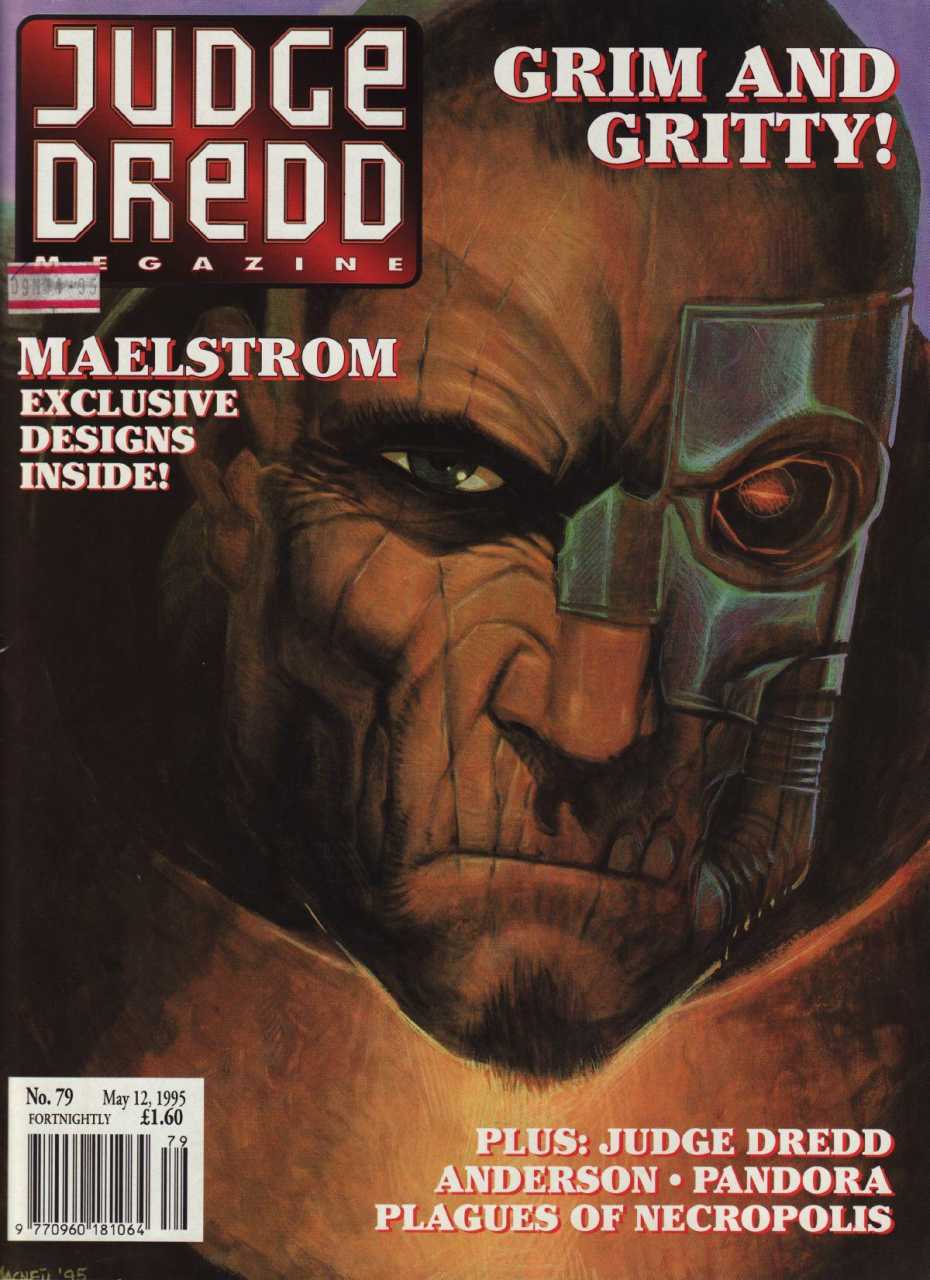
Many comics in the 90s were grim 'n' gritty.
But only the Megazine was ballsy enough to shout it from the cover!
Editorialising by David Bishop

In fact, you could argue that outside of his Judge Dredd work for the Prog, MacNeil has been far better served by the Megazine than by 2000 AD proper. Aside from Song of the Surfer, I’m not sure he’s had a universally acclaimed stone cold classic, in the way that he has with many a Meg series.

Did he cross the line? We'll never really know.
Scenario by John  Wagner

But what about the art itself? Well, MacNeil has used, and continues to use, a variety of different styles, but his basic drawing is a) great and b) always recognisable. He likes his figures wiry and sinewy – MacNeil’s version is surely the least muscled of all Dredds. His features are sharp, with well-defined noses, mouths and cheekbones. Mostly using a minimum of lines on the page to get this across.

MacNeil's first machine-man: Ulysses Sweet.
Basic pencil and ink
Words by Grant Morrison
Shimura: one of many hardmen.
Lavish pencil and ink
Words by Robbie Morrison


He never skimps on backgrounds, and he gained an early reputation (thanks in particular to Song of the Surfer) for being the master at drawing exit wounds. I guess it’s because of the little details in tiny bits of charred and torn flesh that hang half-off the actual holes, although I confess I didn’t notice that until I started reading about people’s love of his wound art.


Atmospheric paint
Words by John Smith

Shiny paint
Words by Gordon Rennie

Luscious black and white
Leaving room for Chris Blythe to fill with his magic colours.
Words by Robbie Morrison
MacNeil coloured by Len O'Grady - moody
Words by John Smith


He’s suffered from a curious problem of producing such epic work that he’s beaome something his own enemy at times. It’s absolutely not his fault that America II and Insurrection III suffer in comparison to the earlier books (which he also drew), as he was forced to use a different technique on them through ill-health. In their own right, these two works are excellently rendered, and would I think be roundly celebrated, but they just look less luscious than his own previous work on the same series.

 
MacNeil inks coloured by Alan Craddock - l;ess lush, still great.
Words by John Wagner

The fact is, although his figures and character designs are instantly recognisable, he’s a master of many different styles. MacNeil has proven his worth and then some just with pencils and inks – perhaps best seen in his black and white efforts, e.g. Maelstrom (again!) and Shimura: Outcast. He pushed through to greatness with the fully painted joy of America book 1 and a few other Dredds, and then found a new expression again with some sort of ‘painting with pencils’*** technique he used on Fiends and Insurrection. Blooming marvellous.

MacNeil has worked on many of the more serious/important Dredd stories, and of course on series with Robbie Morrison, so I’m not sure how much it’s his style and how much it’s what he’s been given, but he’s perhaps 2000 AD’s premiere artist for showing hard men struggling with emotion. Angry Chopper, Dredd, Hershey, Sadu, Shimura – the entire casts of Vanguard and Insurrection… But despite this, I still think of him as a comedy great. Maybe it’s the exit wounds thing - he’s had to conjure up some of the best OTT violence in the Prog, which always brings a smile. This is the sort of mix being a 2000 AD artist demands!

 
Super serious, deeply emotional
Words by John Wagner

Super gory, deeply hilarious
Words by Gordon Rennie


Personal favourites:
Judge Dredd: America; Mechanismo; Terror; Tour of Duty; Mega-City Confidential
Chopper: Song of the Surfer
Shimura: Outcast
Maelstrom
Insurrection: especially books 1 and 2 (but really all of it)
Strange & Darke


More on Colin MacNeil
If you haven’t checked it out already, MacNeil is the star interview of the very first 2000 ADThrillcast.
Before that, he was on episode 5 of the Megacast.
There's a print interview on author/journalist Wayne Simmons' blog.


*I’ve an idea that the MacNeil-drawn ‘Outcast’ was always meant to be the first Shimura tale, until editor David Bishop told Robbie Morrison to give readers a chance to get the know the character and world better. So I’m assuming that MacNeil (who certainly was the first artists to draw Hondo City and its Judges on Judge Dredd: Our Man in Hondo) may have drawn up some character designs for Shimura before Frank Quitely came on board. But I may be wrong wrong wrong! In which case, apologies to Frank Quitely.

**Well, I’d read a whole lot of Asterix, but didn’t realise until re-reading it as a teenager how grown up and sophisticated it actually was.

***I’m sure this isn’t what he was doing, but I’m struggling to describe what it looks like.

Friday, June 12, 2015

No. 24 Ian Edginton


First Prog: 1313
Latest Prog: 1934 New Thrill Helium has just started. Haven’t read it yet; am excited. (And he’s got plenty of other thrills to get back to as well, with ongoing epics including Brass Sun, Stickleback, Ampney Crucis and perhaps some mega cross-over that combines all these with Red Seas, Leviathan and who knows what…)

First Meg: 1.08 (or 8)
Second Meg: 4.16 (or 198)
Final Meg: 337. In fact, he’s only had 5 credits in the Judge Dredd Megazine, but it’s always possible he’ll be back, and I wouldn’t be at all surprised to see a creator-owned slot from him here. He’s one of Tharg’s busier droids when it comes to writing outside 2000AD (despite being in the Prog a heck of a lot!)

Total appearances: 345 and counting
-including Scarlet Traces, which was reprinted in the Megazine, but not including its follow-up, which wasn’t. But that was only 3 episodes long. The man has racked up a (deservedly) huge wealth of credits in his comparatively short stint as a writer for 2000 AD.

Creator credits:
The Red Seas, Interceptor, Leviathan, American Gothic, Stone Island, Detonator X, Ampney Crucis Investigates, Brass Sun, Helium

Other writing credits:
Judge Dredd
Rogue Trooper
One episode of ‘Strange Cases’, a pre-cursor to Tales from the Black Museum in the very early days of the Megainze.
- surprisingly, Edginton has not had any other future shock style writing credits.

Notable character creations:
Jack Dancer and his crew
-I’d also single out his handling of Isaac Newton as notable
-likewise his version of HG Wells in a trio (so far) of Dredd shorts
Stickleback and his crew, which is pointedly as bizarre a collection of individuals as Jack Dancer’s crew is ‘normal’.
Leviathan – the ship as much as anyone on it
Wren in particular, but the Brass Sun epic picks up great new characters with each world.


Notable characteristics:
Two words: world building. If there’s one thing Edginton loves, it’s conjuring up boundless fantasy lands full of wonders cobbled together from any possible fictional realm you care to name, and more than a few he’s pulled from his own head.

He’s also, and I mean this as a compliment, pretty Whedonesque in his manner of pulling the rug from under the reader by having the ‘wrong’ character save the day or behave in unexpected ways, be it heroically, traitorously or just plain oddly. And all laced with a modern-day wink towards the fantasy/SF/action tropes going on all around.

And he’s fond of putting colloquialisms into the mouths of his protagonists, with some attention paid to period setting. In each instance, this is fun. Taken over a body of work, it starts to get a bit repetitive. He’s definitely used up his quota of ‘Christ on a bike’s and ‘get your bicycle clips out, ‘cos it’s brown-trouser time’s.

Supernatural characters using everyday language.
Art by Steve Yeowell
On Ian:
Ian Edginton (not Edgington or Edington) pretty much hit the gate running. After a single Dreddworld episode in the early days of the Meg, he found work writing elsewhere, before returning in triumph with Scarlet Traces. This was intended for one of the earliest web-only comics publishers (Cool Beans), but ended up getting its first full airing in the Megazine. And blooming marvellous it was too. Who knows? If Cool Beans had succeeded, maybe Edginton would never had made it onto Tharg’s call sheet?
 
I assume the banner was added to fill space, but it just makes the strip even more Edginton-y.
Art by D'Israeli
Anyway, Scarlet Traces. I didn’t know what to expect at the time, and enjoyed it all the more for that. For the sake of not spoiling it for anyone, I won’t say what it’s about, but suffice to say that it’s chock full of Edginton tropes, not the least of which is its grounding in a fantastical late-Victorian setting, with specific ties to works of astounding fiction from the day. And art by D’Israeli, naturally.

Sinister secrets are about to be exposed...
Art by D'Israeli
Presumably off the back of that series, which I can only assume went down as well with other readers as it did with me, Edginton seemed to become Tharg’s go-to writer almost overnight for niche genre thrills that filled out 2000 AD’s publishing schedules year after year. Starting with the Red Seas, a pirate yarn that happened to be published a few months before Pirates of the Caribbean went ballisitc at the cinema*.
 
Pirates doing what pirates do. Swashbuckling by Steve Yeowell
You can tell that this was originally intended as a one-off romp. It was fun enough to merit a sequel (a decision that may or may not have been influenced by the success of the Pirates films*), which ended up, in my opinion, being even better. At some point the epic bug bit and Edginton used the setting to springboard into a proper long-running saga, mixing up longer and shorter stories and, most daringly, basing several of these around side characters and indeed entirely new characters.

Sir Isaac Newton stumbles on ancient treasures.
Art by Steve Yeowell
If I’m honest, outside of the first two books of the series I prefer the stuff with Isaac Newton to the bits with Dancer and his crew. Not least because, for whatever reason, I can never quite remember who his crewmates are. I can’t deny they have distinct looks and personalities, but perhaps because there’s so much else going on in each story, I never felt I got to know them.**

The point of this series, more than his other works, was to play around with a vast array of mythical creatures and ideas, from Arabian, Greek and Norse legends, to pick just three examples, with a huge nod to the film versions of those stories by Ray Harryhausen. This was super fun – although at times the story itself seemed a bit bogged down. I really must by the digital collections and read it in one go, as I expect it’ll be a lot more coherent in that fashion.

George Washington explains the theme of the Read Seas.
Art by Steve Yeowell

Of course, while this decade-long saga was running, Edginton was throwing out treats left and right. Interceptor was a complete opposite, sort of a series-length ‘Pulp Sci-Fi’ episode that pushed the Whedonisms to the fore.

Drawing attention to action cliches.
Art by Steve Pugh

Leviathan, his second collaboration with D’Israeli, was the point where I really sat up and took notice. I don’t suppose any idea in fiction is original any more, but this series was something well outside of my range of reading, and it blew me away with its setting, its plotting, its characters and basically everything about it. I was pretty sad when it came to an actual end after just 10 episodes, only to be cheered when a handful of one off ‘Tales of Leviathan’ surfaced.

The best 'action film cum political allegory set on a retro-futuristic mode of transport' until Snowpiercer.
Art by D'Israeli.
 And of course, the thing with Edginton is that he is wont to tie his stories together, however tangentially, through shared mythologies, and secret trans-dimensional cabals. So I may yet get to step aboard the Leviathan one day…

American Gothic, to be honest not really my cup of tea, was nonetheless a fun time playing around with vampires and cowboys; Stone Island started as a classic Brit prison drama, before exploding into Hellraiser-esque body horror. Absolutely my cup of tea. Detonator X, I have since come to realise, was a Kaiju movie homage – predating Pacific Rim by about 6 years, then. I suspect even if I’d known what ‘Kaiju’ meant*** at the time, and had any fondness for it, I still would’ve been cold on this. Too much cliché, not enough robot-fighting. I’m still bitter because I think it’s such a great title.

Cowboys and vampirs get gory in American Gothic.
Art by Mike Collins
Stickleback launched soon after with great fanfare, and with an all time great character design (both his look and his personality). Served by a contender for one the best covers of the decade, to boot. Something about the series strikes me as the most Edginton thing ever. Partly the Victorian London setting, but also the collection of motley characters with long terms plans, mysterious goals and shifting loyalties. All surrounded by a mix of obscure (to me, anyway) genre-fiction references and weirdies. I kind of want to love it more than I actually do.

Ancient secrets revealed.
Art by D'Israeli
Episode by episode, it’s mostly a treat. But I do struggle to work out exactly who is trying to do what and why. And I feel that the mystery surrounding who Stickleback himself actually is was supposed to have been resolved now, but I didn’t get it. On the other hand, the whole tone of this series is about double-crossing, secret backstory and twisted loyalties, so maybe its supposed to be a muddle. Frankly, I’m enjoying just letting it wash over me and drinking in the visuals. Edginton has found a perfect match in D’Israeli, who clearly relishes the challenge of the insane things he’s asked to depict.

But long, ongoing epic sagas have by now become Edginton’s forte. Sure, he’s thrown in a handful of always entertaining Dredds (‘High Spirits’, which brought back the exorcist judges for an outing, was especially great). 

What Exorcist Judges are for.
Art by Dave Taylor
 
Time travel crime woes for the many ages of  H G Sewell (not Welles).
Art by D'Israeli
But as well as Stickleback (5 books and counting), we now have Ampney Crucis Investigates… (also 5 books and I think it needs at least one more?), Brass Sun (3 books into what should be proper long run) and new thrill Helium – which I guess could be a Leviathan or could even be another Brass Sun – who knows?

Crucis, bolstered by delightful period paints from Simon Davis, isn’t quite as good as it should be. It’s kind of half-way between Bix Barton and Zenith, with plenty of humour but a serious ongoing plot. Zenith was notionally about a bratty popstar with superpowers, but was actually a long saga about extra-dimensional beasties invading Earth. Ampney Crucis is notionally about a foppish Bertie Wooster type with PTSD solving weird mysteries (a la Bix Barton, but actually set in the 1920s) – but turns out to be a long saga about extra-dimensional beasties invading the Earth. And, a bit like Zenith Phase III, I get awfully confused about which of at least two parallel Earths Crucis himself is actually on, and indeed if he was ever on ‘our’ Earth at all. Edginton manages to get more of Crucis into the story with his name on it, so that’s good.


Behind every gentleman is, of course, a gentleman's gentleman.
Art by Simon Davis

Brass Sun, though, feels like the culmination of Edginton’s journey through various settings, characters and ideas. It’s basically perfect. A glorious setting, compelling characters, and, finally, a straightforward plot that takes Wren from one world to the next in search of the keys to wind up the Universe (literally and, one suspects, metaphorically too). Newcomer INJ Culbard takes up the storytelling challenge, and does an admirable job of making it pacey and exciting. The themes and some indeed a lot of unpleasantness make it grown-up in content, but in tone this is the most Tintinesque story I’ve read in 20000AD, and a refreshing change that it, too.

Unabashed adventure on an airship.
Art by INJ Culbard
I’m guessing there is a finite number of worlds to explore within Brass Sun, but I want this to run and run!

Personal favourites:
Scarlet Traces
Judge Dredd: Tempus Fugitive / Time & Again / Times Squared; High Spirits
The Red Seas: Twilight of the Idols; Meanwhile…; …and with a bound he was free; the Chimes at Midnight
Leviathan
Stone Island
Ampney Crucis Investiagtes: Vile Bodies, End of the Pier Show, Entropy Tango
Brass Sun


More on Ian Edginton
The man is not shy of interviews; here's a short selection (mostly the ones focussed on his 2000 AD work):
Forbidden Planet (you'll have to scroll down to get o the 2000 AD stuff)
Artist Graeme Neil Reid interviews Edginton and D'Israeli together on his blog.

The mysterious no-face man, one of a few links across the Edgi-verse.
Art by Steve Yeowell


*2000AD has a long and proud tradition of paralleling the movies, from Harlem Heroes (Rollerball) to Skizz (E.T.) to Vector 13 (X-Files). That being the case, where’s our Mad Max rip-off, Tharg? You know it makes sense.

** It’s an unfair complaint to make, as I tend to find it irritating when creators turn their casts into raging stereotypes, e.g. the marines in the James Cameron’s Aliens, to poke a sacred cow.

***It means ‘rampaging monster movie’, i.e. Godzilla, but moreso the many sequels that involved ‘good’ giant monsters/robots fighting ‘bad’ giant monsters/robots. If you want to know more, I’d thoroughly recommend this restrospective on film blog Antagonie & Ecstasy.