Tuesday, July 21, 2015

No. 34 Brett Ewins


First Prog: 33 (as cover artist); 37 (as strip artist)
Final Prog: 1277

Total appearances: 227
- not including any of his work for Deadline magazine, which he co-founded and ran.*

Creator credits:
Bad Company

Other art credits:
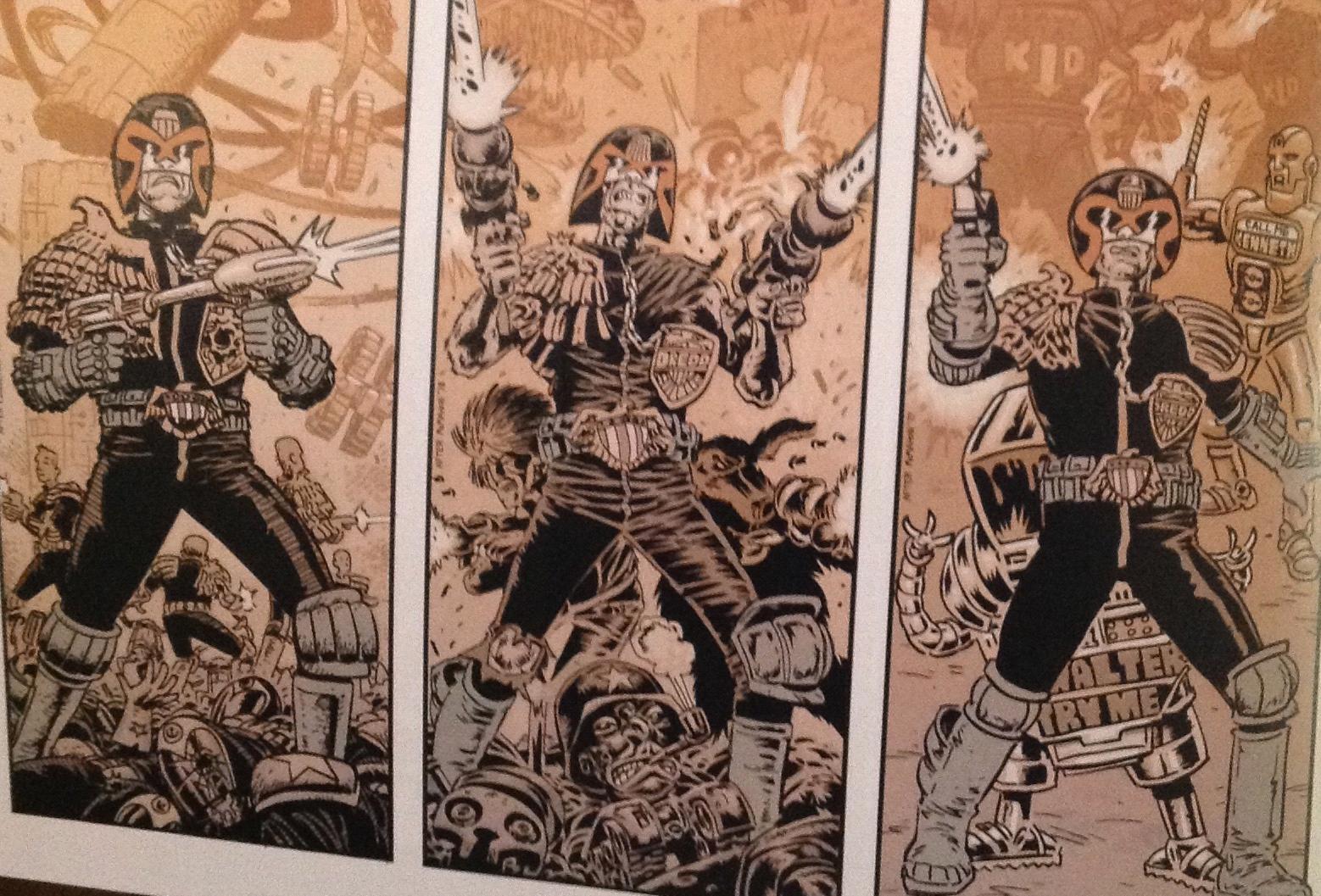
Judge Dredd
ABC Warriors
Rogue Trooper
Anderson, Psi Division
Universal Soldier
Kelly’s Eye
plenty of one-offs, including a bunch of Supercovers – an early experiment in which artists provided a sci-fi cover and a writer somewhere had to concoct a short story to match (at least I’ve always assumed it was that way around)


Notable character creations:
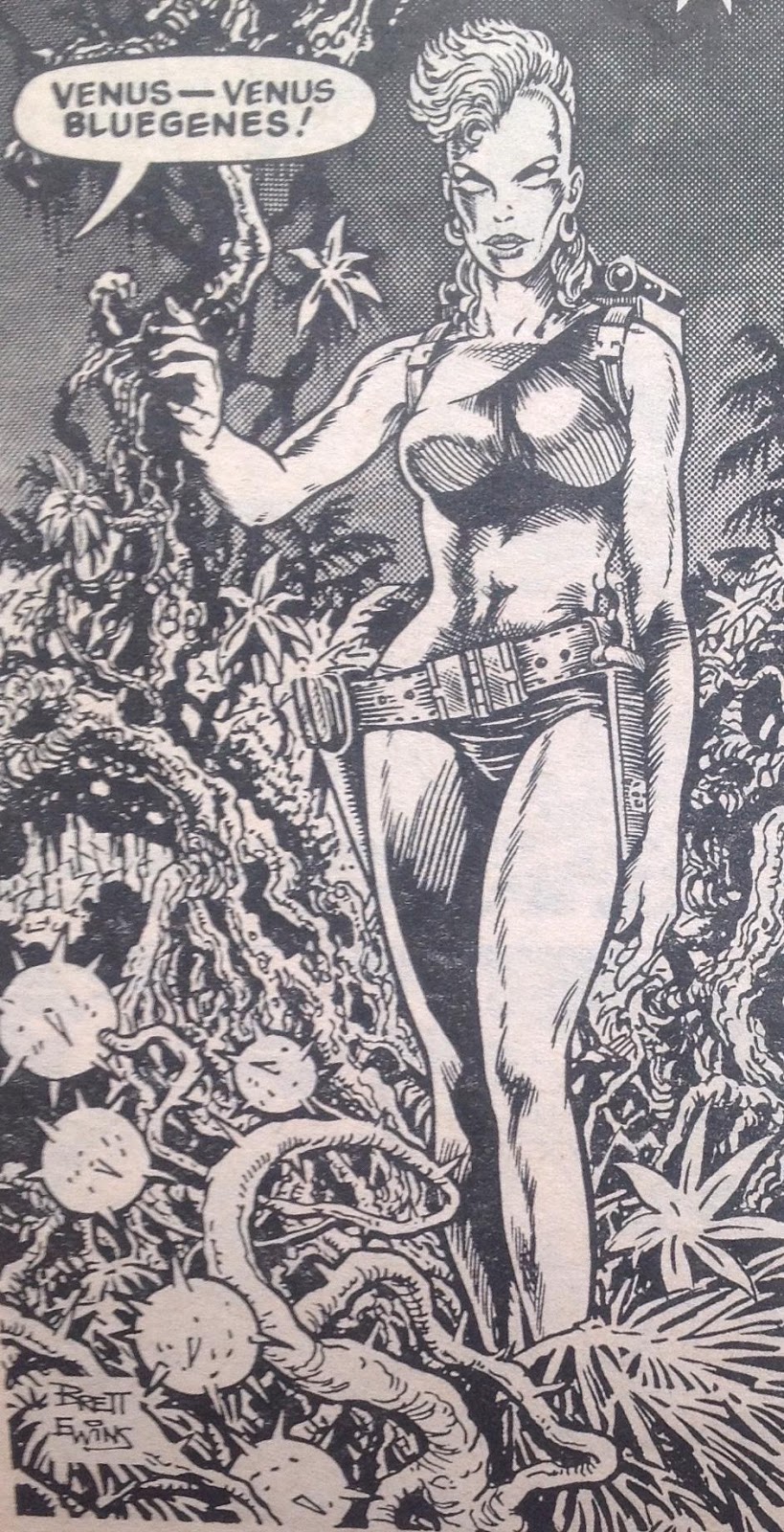
Venus Bluegenes
Major Magnum
Gargarax
Kano especially, but also Danny Franks, Thrax, the Krool and really the entire cast of Bad Company and Bad Company II

Notable characteristics:
Chunky boots; thick black lines; photocopying his own panels; punk-rock hairstyles; pointy noses; dynamic poses; guns with holes in the barrels and various appendages. Monocles.


Real men wear thick-soled boots
Words by Wagner & Grant
Bad men wear half-glasses and make hand steeples.
Words by Alan McKenzie

Sci-Fi guns just should have holes and lines all over them. Love it.
Words by Gerry Finley-Day


On Brett:
Brett Ewins drew characters to look the way 10-year-old me imagined stereotypical 2000 AD readers looked. Which is to say, slightly sneery, gruff, tall men (and the occasional woman) in their 20s / 30s, with long trench coats, spiky punk hair, who smoked cigarettes, drank whiskey from the bottle (maybe wrapped in a brown paper bag) and fully embraced the writings of Nietzsche, Camus and Sartre**. The sort of people I’d have been scared of meeting in real life, but quite liked reading about.

All hail Gargarax!
Groan by Wagner & Grant
I’m sure this says a lot more about me than it does Ewins! Part of the same feeling also put Ewins in that bracket of ‘artists whose work I most enjoyed copying’. His very stark outlines, especially when it came to hair, gave me confidence to think I could do it, too. Not that I had the imagination to produce the likes of Gargarax or the cast of Bad Company.

Getting back to the man himself, his story starts as part of the very first wave of new talent who pushed hard to get work with 2000 AD. Most of the creators involved in 1977 had come through the British comics establishment, or from European art agencies. Ewins, along with childhood friends Peter Milligan and Brendan McCarthy, were amongst the first of a new generation of creators to break into the comics mainstream via Tharg’s Future Shocks. Ewins and McCarthy then worked separately and together (inking and pencilling, maybe?) on some Dredds, in a style reminiscent of but not quite like the style either one settled into later.

My first vivid memory of Ewins in what I think of as his natural style comes from as Milligan-scripted Future Shock called The man who was too clever, which I read in a Best of 2000 AD Monthly reprint. Like a lot of classic 2000 AD, it’s a bit noir, a bit Bladerunner (first published some years before that film, mind you!), and features a smug but redoubtable protagonist.

Photocopies, dots and Kirby Krackle - it distilled Ewins.
Words by Peter Milligan
 There were already some of his trademark tricks at work here, such as filling backgrounds with Benday dots (I’m guessing some kind of tool/stencil for this, else it would have taken ages!), and photocopying certain panels to enlarge and re-use as part of a sequence. It’s at once pure comics but also very cinematic.

Rogue is ready for his close-up
Words by Gerry Finley-Day


Venus de Ewins
Words by Gerry Finley-Day
Ewins refined his style further when he started to get more regular work, first on Rogue Trooper, then on Dredd, (especially the Haunting of Sector House 9, one of my all-time faves) before being tapped to be the lead artist on Anderson, Psi Division. Presumably he landed that choice gig in part through his definitive rendering of the 2000 AD action babe™ when he created Venus Bluegenes…
 
This, and the Anderson work that followed, just skirt the edge of acceptable cheesecake, with a certain amount of male-gaze inspired posture offset by actual character coming through, and moreso both characters being proper action stars, not foils for a male hero (as so many women were in action films of the same era).

Ewins's heroes are always on the run
Words by Wagner & Grant

Anderson has curves and no time for pervs.
Words by Wagner & Grant
 If there was anything bad to say about Ewins’s work – and as a reader there wasn’t! - it was that he couldn’t quite seem to keep the pace, with too many gaps between Rogue and Dredd stories, and then needing some help finishing off that first Anderson story.

If this was the case, an ideal solution was found by the time he took on his career-defining series, Bad Company. This time, Ewins worked with his friend (and Brendan’s brother) Jim McCarthy, a partnership that lasted across three epic, full-length series of mayhem, joy and breathtaking artwork.

Prog 500, one I’m just old enough to remember coming out, was a proper big deal at the time. And new thrill Bad Company was one of its major selling points, especially as it was the only new Thrill in that issue. Tharg obviously had a lot of confidence in it, and it was not misplaced.

It’s hardly a new observation, but one of the great visual delights of is in how Danny Franks’s look changes over the series as he spends more and more time in different situations – a trick Ewins managed to continue in the generally pretty humdrum retread, Bad Company 2000

Step 1: normal hair

Step 2: vaguely realistic dreadlocks

Stage 3: Utterly stylized dreads

Stage 4: not even really hair any more.
And yes, it's deliberately white now.
(all words by Peter Milligan)

At least that series did see Ewins conjuring up a whole new team of crazy soldiers. We didn’t get to spend much time with them, but the character designs were great.

The new crew from 2002
Words by Peter Milligan

And then of course there’s the supporting cast, and not forgetting the big man himself, Kano, with his flat-top head and weird adjustable monocle. And the hallucinogenic delights of his Krool-inspired memory trips.


Tripping on Krool memories with Kano
Words by Peter Milligan
 
After the initial run of Bad Company, Ewins took a break from 2000 AD, presumably while he was putting Deadline together. Although he wasn’t absent from the Prog! His rendering of Tharg graced the Nerve Centre and all sorts of other periphery for several years.***

 
He resurfaced with a steady run of Progs from around 750-840 in a more refined style, using a slightly different line weight (I think?) and generally making his figures even more blocky and exaggerated. On Kano, a Bad Company story that feels like a spin-off solo series (although it is in theory a straight up continuation of the story), his figures are incredibly gangly and quite zombie-like, which really adds to the tone of that ghost story. Lovely stuff. 
Thrax returns
Word by Peter Milligan

Kano meets the Frankenstein Corps - sickly experiments who protend death and pain.
Words by Peter Milligan
 By contrast, his work on Universal Soldier and Kelly’s Eye was incredibly kinetic.

Noirish thrills with Kelly's Eye
words by Alan McKenzie

You can sort of tell that he didn’t have the strength at that time to go to town with the detail he once poured into his work, but he had the skill to frame the action so that the work felt at once child-like and artful, in a deliberately pop-kitsch way.****

Universal Solider saw him teamed with vibrant colourist Zac Sandler, and this doubled down on the popiness in a way that I really liked; shame we didn’t get any more of that. It could have brought a missing zest to Bad Company 2000, perhaps.

That's what I call living technicolor
Words by Alan McKenzie
 
As we now know, a long run of ill health forced Ewins away from the drawing board for too many years, and eventually to an early death - but his legacy on 2000 AD will live forever. May he rest in peace.


Personal favourites:
Rogue Trooper: Bagman Blues, Major Magnum, From Hell to Eternity
Judge Dredd: The Haunting of Sector House 9; Wally Squad; Hottie U; The Judge Downstairs
Anderson, Psi Division: The Four Dark Judges; The Possessed
Bad Company: all of it
Universal Soldier: The Indestructible Man
Kano (which I’m singling out as its own thing)
Future Shocks: The Man who was too clever

For some reason, Barney lists Ewins’ work on the Vertigo series Skreemer as part of his bio. I wouldn’t count it as part of his 2000 AD output, but it’s an excellent comic and a fantastic showcase for Ewins’ mid-period glory as an artist. Barney doesn’t list Johnny Nemo, which is much more 2000 ADish in tone, and also well worth seeking out.

A burst of classic punk rage
Words by Wagner & Grant

More on Brett Ewins
Brett's own website is a great resource
There are plenty of heartfelt tributes and obituaries out there.
Forbidden Planet International has a whole host of links to celebrations of Brett's life here.
The Art of Brett Ewins, a book, is available to buy. Do it!
And here's an old TV clip where Ewins and Milligan talk Bad Company.
(why that series hasn't been amde into a film I'll never understand. It could be SO GOOD)


*I didn’t read Deadline at the time, but it was advertised in 2000 AD, and reamins noteworthy for many thingsin particular influencing the direction of comics in the 1990s and beyond, and finding many new readers. From this Blog;s point of view, Deadline is especially noteworthy for providing a training ground for future 2000 AD contributors including Jamie Hewlett, Philip Bond, D’Israeli, Shaky 2000 and others.

**Bearing in mind that 10 year-old me had heard of all these dudes, knew they were philosophers, but knew nothing of the actual content of their thoughts. Still pretty hazy on that, actually, but there’s something about life generally being bleak, making your own rules, and definitely not putting up with other people’s shit.

***In a twist of irony, or perhaps a deliberate jibe, Ewins’s first Nerve Centre image was a direct copy of an earlier version by Mike McMahon. Ewins had, some years before, caused something of a stink when he was commissioned (by a fan, I guess?) to redraw a Judge Dredd panel that was actually a McMahon original…

Design by Robin Smith?

****I’m referring here specifically to Pop Art in the Roy Lichtenstein mould, which raises questions about art vs theft that I don’t want to go into here. What I mean to say is that Ewins of this period had a way with comics that reminds me of the sort of comic art that Lichenstein copied/adapted for his work, not least down to the limited backgrounds and lurid colour scheme. 

Friday, July 17, 2015

No. 33 D'Israeli


First Prog: (as colourist) 1133; (as writer/artist): 1207
(and before both of those, as an artist for a story each in Crisis and Revolver)
Latest Prog: 1940

First Meg: (as colourist) 3.50; (as artist) 4.01
Latest Meg: 345

Total appearances: 228 and counting
-including a number of colouring and lettering credits, and also including three series that ran in the Megazine originally published elsewhere. But not including his work from Deadline.
(if you didn’t include them, he’s still up at 211)

D'Israeli lends his vibrant colours to Richard Elson.Words by Dan Abnett


Creator credits:
Scarlet Traces, Leviathan, Lazarus Churchyard, XTNCT, Stickleback, the Vort, Ordinary, Helium

Other art/writing credits:
Judge Dredd
Low Life
a handful of one-offs

D'Israeli didn't create Dirty Frank, but he's made a massive mark on the character.
Words by Rob Williams


Notable character creations:
Lazarus Churchyard
Stickleback and his crew
The various dinosaurs of XTNCT
Mr. Overdrive

Look! It's the shark-headed businessman from Lowlife / Trifecta.Words by Rob Williams
 Notable characteristics:
innovation; chunky lines (except when there are no lines); sqaure jaws and fists; inscrutable, scrutable and sometimes meta-scrutable facial expressions


On D’Israeli:
(real name: Matt Brooker, in case you’re interested. It’s not like it’s a secret or anything. He’s used another pseudonym, Molly Eyre (geddit?), when writing Future Shocks, too.)
It’s always hard to gauge how people are perceived when all you have to go on are reader’s letters and the handful of people who regularly post on internet forums. But in my estimation, D’Israeli has gone from someone once thought of a highly stylized, slightly off-the-wall artist who did indie comics and the odd bit of work for 2000 AD to something of a legend with a string of hits to his name, and the pick of whatever he wants to do. I guess the change happened somewhere around the time he started alternating Stickleback with Low Life, his two longest-running series to date. Bolstered by two absolutely stunning covers for those two series.


It’s hard to remember now, perhaps, but not many years before that he’d produced one of 2000 AD’s more controversial covers.


Honestly, I’m not a fan of the image of Dredd on this cover – but I am a massive fan of artists who go to town on reinventing Dredd’s look, a long-standing 2000 AD tradition. And this to me is a key part of the enduring appeal of D’Israeli. He plays around. He tries things out. He puts a lot of bloody effort in. It’s certainly no surprise top me that his first work in 2000 AD was a set of Future Shocks that he wrote, drew and lettered all by himself – putting him into a very rarefied creator niche indeed.*

Spoilers, I guess...
 
Pretty much a solid comics professional by this point, his underlying style was already established. And I get the idea that it’s not one liked by everybody. It is on the cartoony end of what 2000 AD tends to produce, and it’s definitely much more European than American (probably one reason why I like it!). And maybe because Tharg couldn’t be sure how it would go down with readers, poor D’Israeli had to rely on a couple of coincidences before he got a proper foothold in 2000AD.

I say coincidence, it could all have been part of some grand plan. But what happened was that the Judge Dredd Megazine launched volume 4, with no little fanfare, and a whopping great page count. If the Megazine had a golden age, volume 4 is a solid contender. Anyway, part of the draw was a reprinting of the series Lazarus Churchyard, an earlyish work by D’Israeli, written by Warren Ellis. The central character is a several-hundred year old man whose body has been rebuilt out of a sort of living plastic, and by God is D’Israeli’s style ever perfect for depicting that. Kind of angular and organic at the same time; the skin sort of hangs off Churchyard’s bony frame while long strands of lank hair bounce and flail around it.**

It may not have come through in the description above, but Lazarus Churchyard is mostly a comedy.
Words by Warren Ellis

Then, very shortly after that run finished, Scarlet Traces secured a berth in the Megazine.
Less than a year later D’Israeli had all new material commissioned, seeing Leviathan in the Prog, and XTNCT in the Meg almost at the same time. He’d climbed the first few rungs of the fan-favourite ladder. Not to mention showing that a blocky, cartoony style doesn’t preclude an ability to convey gritty action, pure horror or creepy weirdness.

Check those expressions!
Words by Paul Cornell

Bad things are afoot on board the Leviathan.
Words by Ian Edginton
Stickleback to some extent was in the same vein, story-wise, but right from the start readers were grabbed by the change in art. I’ve no idea what D’Israeli is doing differently on a technical level with this series (I believe he works digitally on everything – maybe the underlying drawing is the same?), but damned it doesn’t match the mood. I think it's a lot to do with not drawing any outlines. It’s also noteworthy to me that his art here can look so different while the style and design for the figures remains inherently the same as ever. And, yes, cementing his status as the new king of Victorian/Edwardian-era SF comics (deposing Bryan Talbot, I guess?).

Masterful technique. Still utterly recognisable style.


With that invention on display, he climbed yet more rungs on the ladder. But for my money he reached the top when Rob Williams nabbed him to work on Low Life: Creation. Yet more artistic invention, and it didn’t hurt that it was in service to an incredibly clever story. It also didn’t hurt that D’Israeli’s style is a perfect match for the character of Dirty Frank (while, curiously, it’s also not especially suited to Aimee Nixon). Subsequent Low Life outings pushed the same boundaries of character and city design, and have been some of the most fun strips ever run in the comic, if you ask me. The same collaboration also yielded Ordinary, another delight but with a very different tone. 


What a clever way to show two people standing in the rain.
Words by Rob Williams.

D’Is does great Mega City 1. He’d actually shown this earlier in a handful of Judge Dredds. He’s one of those artists who really brings out the feel of the city and the citizens that often end up being the best part of any given Dredd story. I’ve got a real soft spot for his version of Nosferatu, an occasional recurring vampire-esque monster.

How to feel sorry for a vampire spider.
Words by John Wagner
 
And here’s a bit of fun he had mixing Dredd with time travel.

Homaging Ezquerra, McMahon and, finally McMahon doing Ezquerra.

D'Israeli's distinctive style was used to good effect to hide the true identity of a character in one-off scary planet story The Vort. In some ways, thes tyle was so different from what had gone before that I found the story somewhat jarring, but there's the usual lovely monster design along the way, and some very vibrant orange, red and pink hues to lend the world of the Vort its own personality.

The Vort is out to get you.
Words by G. Powell (aka...)
Alongside his character designs and innovation, one aspect that always sticks out for me is D’Israeli’s willingness to draw big, complicated, magnificent architecture. The cityscape of Mega City One, for sure. Leviathan in all its glory, not to mention its engine rooms. Depicting the entire city of Luna-1 rising from the ground, ready to journey into space. I like to imagine him raising an eyebrow when he reads scripts with these kinds of panel descriptions, than rubbing hands with glee as he gets to work drawing them up.

Master of spectacle
Words by Rob Williams
 
It’s too soon to start using superlatives, but so far his latest thrill, Helium, plays to all the man’s strengths. Period (sort of) setting. Designing new cities, fashions and machines. Characters whose faces say one thing and imply another. And some good old-fashioned thumping, too.

A woman in Tintin's trousers pastes one on a man with Tintin's hair. Fun times.
Words by Ian Edginton

It’s been something of a slow road to the top for D’Israeli, but here’s hoping he stays there for a good long time.
 
Personal favourites:
Scarlet Traces
Leviathan
XTNCT
Stickleback: London’s Burning; Number of the Beast
Low Life: everything he’s done on this series, but Creation and Saudade were especial peaks.
Ordinary
Helium
Future Shocks:  metamorphic invaders

I can't for the life of me remember what story this is from,
but it's delightful how definitively D'Israeli it is.
  
More on D'Israeli:
You gotta start with D'Blog of 'Israeli
His first appearance on Covers uncovered
and stepping beyond 2000AD, here's an interview about his work on Lovecraft


*I think Steves Dillon and Parkhouse have achieved this feat as well, and of course Bob Byrne and Cat Sullivan. Anyone else?

** The stories themselves are intriguing if not mind-blowing, but if you like Ellis or the sort of strips that ran in Crisis/Revolver, I’d definitely recommend Lazarus Churchyard

Monday, July 13, 2015

No. 32 Garth Ennis


First Prog: 700 (but prior to that, Crisis 15)
Final Prog: 1280

First Meg: 1.01
Final Meg: 206

Total appearances: 245
-including his strips for Crisis and, more controversially, the episodes of Preacher reprinted in the Megazine*

Creator credits:
Troubled Souls; True Faith; Time Flies, Sleeze ‘n’ Ryder; The Corps

Ennis's characters: deeply earnest, or utterly glib.
Art by Carlos Ezquerra

Other writing credits:
Judge Dredd
Chopper
Strontium Dogs (not Strontium Dog) / The Gronk
a handful of one-offs for Crisis

Notable character creations:
Bertie Sharp
Trace Bullet
Recurring Dredd villains Marty Zpok and Jonni Kiss

Emerald City and the first Judge Joyce
Wally Squad Judge Lola Palmtree

Notable characteristics:
Ennis has gone on to be famous for many a stylistic trope in his American comics work that it’s hard to separate out his 2000 AD stuff sometimes. But I think it’s safe to say he’s always had a predilection for male camaraderie, cheap sex-based jokes, religion / god-bothering, movie references (especially action films of the 70s and 80s), outsiders and, of course, the comedic potential of ultraviolence. Not sure how often he brought up buggery until he began on Preacher, though.

 
An Ennis speciality: finding bloody uses for household objects.
Art by Steve Dillon

On Garth:
Ennis has something of an odd position in 2000 AD. On the one hand, he was part of a wave of hot new talent that wrote funny / slice of life comics for Crisis. On the other hand, he didn’t carry this across to create funny / slice of life comics for 2000 AD. Well, he tried it once with comedy series Time Flies, but frankly this just wasn’t very funny.

Telling us the joke is bad isn't always enoguh to redeem yourself.
Art by Philip Bond
Instead, he was tapped early on to take over from John Wagner as the regular writer on Dredd, as well as taking over Chopper for the Megazine, and also continuing the world of Strontium Dogs post-Johnny Alpha. These were all far better than Time Flies.**

 
Pertaining to comedy, but not actually funny.
Art by Philip Bond
You'll have to buy it second hand.
In interviews, Ennis is pretty down on his 2000 AD output, but he’s too hard on himself. He didn’t rack up more than 200 episodes in a prolific 3-year stint because he had no talent! His first published work, Troubled Souls, was much praised in Tharg’s Nerve Centre, who also pushed the reprint collection pretty hard. Ennis thinks so ill of it he managed to secure the rights and refuses to reprint it. You can certainly tell it’s an early work, but it’s not terrible. It’s actually kind of charming in lots of ways – for those who don’t know, it’s about young men (and women) in Belfast getting pissed and playing pranks on each other and generally avoiding stereotypical storylines about the Troubles until, of course, the same stereotypical terrorism / family honour stuff creeps in. 


True Faith, his second project in Crisis, was brilliant, and remains one of my favourite of his stories. It’s nothing like Preacher, but there’s a lot of the DNA of Preacher in it. Obviously the main plot is about angry men ailing against God, devoutly faithful people and what this kind of faith can do to them - although the real meat is the acutely-observed everyday stuff. It’s also an early outlet for Ennis to explore the horror and banality of violence – something that went on to inform most of his Dredd output, although for the most part that was played purely for laughs, where True Faith plays it for shock value and not a little bit of actual intelligent point-making, as well as for laughs. Highly recommended.

People sitting around talking: it shouldn't be good comics, but Garth Ennis makes it work.
Art by Warren Pleece
 Ennis today is a writer known very much for writing original stories using his own characters and ideas. He didn’t do much of this for 2000 AD, one imagines partly because he was offered Dredd, so didn’t have much time left over, but I can’t help but think he was canny enough not to want to hand over rights to his original creations. Good for him!

It’s certainly the case that his work with existing characters on 2000 AD far outshone his original ideas. I’ve already made the joke twice, but Time Flies, technically his first published work in the comic, was a trendy comedy that had charm but not wit, and much of that charm came from artist Philip Bond’s way with facial expressions. Honestly, breaking down the characters and situations it kind of works as a sketch show – with a hit rate of about 1 good joke to 5 bad ones - but the characters were perhaps a bit too broad. Time Flies II was advertised a few weeks after the first one finished, but didn’t appear for something like six years – partly because the artist didn’t want to draw it, and partly because the editor didn’t want to print it. Arguably, it was funnier than the first, and if nothing else it produced this delightful panel from one-time wonder John Beeston:

 
It's right out of a Jeunet/Caro film.
Art by John Beeston

By complete contrast, Ennis exploded onto Judge Dredd with Death Aid, essentially predicated on the same broad humour as Time Flies but for whatever reason it worked. Charity events are as solid a target for satire today as they were 25 years ago, I guess. World War II flying aces, not so much. More to the point, the story also dared to pick up a dangling Wagner/Grant plot thread from years earlier.

Who doesn't love a killer with a smile?
Art by Carlos Ezquerra

Actually, it wasn’t so much a dangling plot thread, more an old story that Ennis (and no doubt many other readers) remembered fondly and thought worth another look – the Hunter’s Club. Ennis used this trick a few more times – A Magic Place being the best example, but also bringing back seldom-mentioned Judges Perrier and Dekker (if only to kill them off rather cheaply), but even having a go with classic villains Judge Death and PJ Maybe. One could argue that this sort of thing, while crowd-pleasing (I enjoyed it, anyway) is a bit lazy, but I think he did it respectfully enough. More importantly, he didn’t actually do it very often, setting a trend for future Dredd writers who would go on to mine the strip’s history sometimes, but not too often. And, to be fair, he wrote a good year’s worth of all-original Dredd material, inventing his own villains with them. Some of them armed with multi-purpose potato guns.

There's also a 'mash' setting...
Art by Steve Dillon

Ennis’s other main Dredd trick, again borrowed from Wagner and Grant, was to take something out of pop culture and throw it into a Mega City setting. Honestly, I think these were often his weaker stories, even as they could be some of Wagner& Grant’s best e.g. Twin Blocks wasn’t as funny as The Secret Diary of Adrian Cockroach. Probably the most fun Ennis had in this vein was with two stories about Marty Zpok, murderous rockist, although the music and TV references are very of the 90s. Artist Dermot Power did an extraordinary job of predicting the existence of actor Michael Shannon, though, who’d be perfect in that role. 

Ennis is an equal opportunities satirist - the poptimist idiots
Zpok kills are genuinely annoying, but Ennis reserves his true bile for Zpok himself.
Art by Dermot Power
 
All in all, Ennis’s Dredds were good enough to get him the chance to write two separate epics: Judgement Day (with an e) and Helter Skelter. Neither of which are the best of Dredd, but both of which provide fannish glee. Judgement Day remains an exemplary cross-over, combining Judge Dredd and Johnny Alpha. 


Who's the hardest?
Art by Carlos Ezquerra

If you ignore the overall plot and just enjoy these two going through the classic motions of fighting each other then working together, it puts many a superhero crossover to shame, even the Dredd/Batman stuff. Helter Skelter saw Dredd tackle villains from his own and wider 2000 AD history, but this tine the nostalgia factor couldn’t make up for the lack of excitement inherent in the story.

Over in Strontium Dogs, Ennis was trying something very different – being serious. Monsters was, in essence, another story about angry young men hanging about in bars, and felt nothing like any old Strontium Dog story. Phenomenal art and mutant design from Steve Pugh lifts the material, but even without that it’s another interesting look into the young disenfranchised mind, a continued concern for Ennis. Bringing back the Gronk as a short-tempered gun-toting revenge seeker pushed back into the world of comedy, and somehow paved the way for Ennis to bring in some pretty horrific imagery as Gronk and Feral hunt for the body of Johnny Alpha. 

In an Ennis comic, sooner or later everyone meets their maker.
Art by Nigel Dobbyn
 
Ennis can do heartfelt, too.
Art by Nigel Dobbyn

Johnny Alpha in a flesh-made hell. In context, this is John Smith level horror.
Art by Nigel Dobbyn
I have no idea if he, or indeed Tharg or subsequent writer Peter Hogan had any idea where the story was supposed to be going, but it was never less than solid comics.

Defiantly not solid comics, but rather experimental comedy weirdness, was Sleeze ‘N’ Ryder, Ennis’s idea of how to get a spin-off story out of the world of Dredd. At the time, I found it to be almost entirely indulgent, a bit gross, and not very funny. Nick Percival was very much finding his feet as an artist, too. But on re-reads it holds up rather well, with the two lead characters playing off each other nicely. Also, 1980s Arnie quotes never get old, apparently. Where other weird comics of the 90s were pretentious as hell, this is just plain goofy, and all the more enjoyable for that.


Ultraviolence in comics = reliable laughs

Ennis’s second Dreddworld spin-off, the Corps, comes across as the man writing on autopilot. It’s competent, joke heavy, and properly violent. Basically, it’s a lot like much of Ennis’s subsequent work for the US market, although it might just be even less subtle. I mean to say, it liberally uses Tarantino-esque tropes and has its lead character actually called Tarantino. If you’re in the mood, though, the commitment to hardman characters and grimacing is pretty funny.

Men of violence with erudite conversation: Tarantino in a nutshell.
Art by Paul Marshall and Colin MacNeil

 Soon after this, Nick Percival stepped up his game about 20 levels to paint Ennis’s last major Dredd work for many years with Goodnight Kiss. A much more sombre affair, it pushed Dredd’s own hardman status pretty far, while also probing at that favourite weak spot, innocent victims of Mega-City One’s harsh mutant laws. It was a good note to bow out on.

Guess who gets the kiss-off?
Art by Nick Percival
For someone who has gone on to international and long-lasting fame and glory, Ennis’s legacy as a 2000 AD writer isn’t all that strong. Partly it’s because he was still learning his trade on the page, following a weekly publication schedule, don’t forget! But also I think he was hurt by setting a trend he didn’t necessarily mean to. Ennis’s Dredd was very much Wagner’s Dredd, only he liked to push the violence, the image of Dredd as ultra hard, and the overt bullying nature of the Judge system perhaps a bit more - certainly with less subtlety. The likes of Millar, Morrison and others who handled Judge Dredd next took this specific baton and ran with it, looking for pure comedy without reinforcing the underlying idea. Not Ennis’s fault, but I think he has been somewhat tarred with the same brush.

Harsh sentencing: a little goes a long way.
Art by Ian Gibson

And so, on to Preacher, a story I first encountered in the Judge Dredd Megazine, and which I believed to be original material for that publication. Obviously I was wrong, but who cares? It remains one of the all-time great comic series, and dash it all if it wasn’t the product of two minds steeped in 2000 AD, both as readers and creators. With time, its juvenile qualities stick out more, as also the shock value diminishes, but the sheer number of classic characters live on, and the overall storyline is kinda great. How very 2000 AD to have a hero with a superpower who only ever uses that power once every 10 issues or less, and even then, as often as not in service to some kind of horrible joke.

Ennis has become one of many creators who hasn’t come back to 2000 AD in a long time – but in his case, I get the impression it’s as much because he’d want to find the right project for the comic as for any more selfish reason.

Garth Ennis: like Judge Dredd, he's a safe pair of hands.
Art by Brett Ewins
 
Personal favourites:
True Faith
Strontium Dogs: Monsters
Judge Dredd: Death Aid, School Bully, A Clockwork Pineapple, Rough guide to Suicide, A Magic Place, Raider, Judgement Day, The Taking of Sector 123, The Kinda Dead Man, A Man named Greener, Monkey on my Back
Sleeze ‘N’ Ryder

More on Garth Ennis
An interview from the Irish Times that focusses on his early work 
Chatting to David Bishop for Thrill Power Overload (twice)
An essay by the man himself about 2000 AD on Bleeding Cool
And a chat with Molch-R on the Thrill-Cast


*which only adds 25 to his total count.

**I will say that his decision to use short-lived pop sensations Bros as recurring characters in Time Flies has actually aged rather well.