Tuesday, January 12, 2016

No. 56 Graham Rolfe


First Prog: 1274
Final Prog: 1405

First Meg: 4.11 (aka 193)
Final Meg: 227

Total appearances: 172
- as design droid, with credits for 5 covers (mostly working with other artists)

On Graham:
Tharg’s design droids are often pretty low key. Rolfe was part of the new guard, arriving fairly soon after the Rebellion take-over (as far as I can tell). He did the usual job of creating a new look for the intro and outro pages,

Rolfe's outgoing design for 2000AD's Nerve Centre
(Tharg pic by Kevin Walker, I'd guess)

Rolfe's incoming re-design for the Megazine editorial page
tinkering with the odd logo here and there, 

The Megazine logo gets a minor revamp as it takes on normal human numbering.
Virtually ever single cover will slightly overlap the text.
Art on this cover by Greg Staples


An even more minor revamp for the cover of 2000AD. Keep that logo out of the way of the cover design!
Cover photo by Malcolm Hulme; design by Rolfe.


This cover credited to Rolfe himself, no doubt using a touch of Carl Critchlow here,
and a hint of Vesalius there.


and presumably doing the ever vital job of keeping everything working, no doubt at a time when the mechanics of the job were a real mix of old school hand-painted art that arrived by post on giant boards, alongside new-fangled TIFFs, PDFs and who knows what other now-defunct file extensions.

It’s hard to say if Rolfe was around long enough to nurture nay top new art talents, but he surely was a mentor of sorts to one Simon ‘Pye’ Parr, who began life as the Production droid working with Rolfe, before taking over as Designer-in-charge.

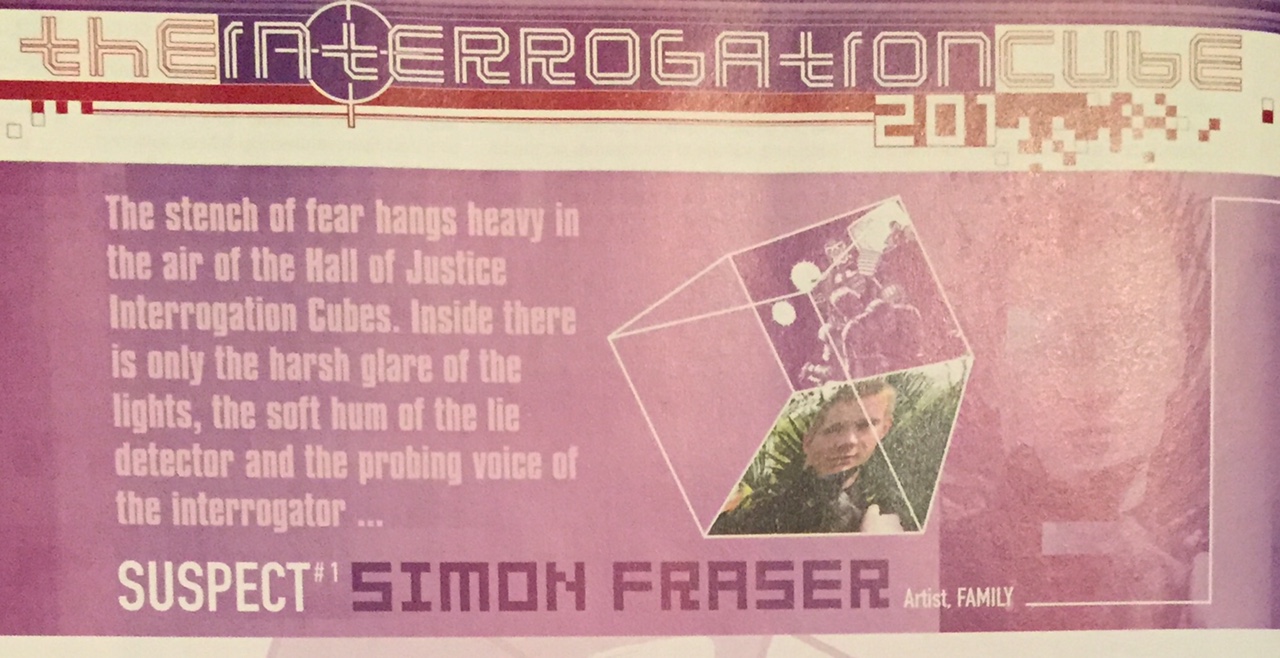
'The Interrogation cube', a short-lived interview feature for the Megazine; designed by Rolfe


Rolfe's witty design touch helped fill the space around reprints of thrills from yesteryear
when the Prog was short and square.
 
A short entry this time, to celebrate one of the comic’s quietest contributors.

And no, I couldn’t find anything about him on the internet, either.


Rolfe also introduced the short-lived use of photo-credits for the editorial/design team.
 
While we’re on the subject of quiet but essential contributors, tip your hat to...

Hero No. 56 ½
Kathryn Symes

-credited as repro Droid on a vast stack of Progs and Megs (as per the credit box above!), but in recent years chiefly responsible for the awesome array of collections, reprints and such. Yes, that’s her photo up there next to Messrs Rolfe and Parr. I’ve no idea how many individual Progs/Megs she had a role in bringing to our eyes, but I’m guessing its lots across 13 years – especially on the Megazine front, as presumably she has a large hand in putting together the files for the reprints bagged with the Megazine, if not with the new material that is nowadays supplied in digital formats.

And talking of reprints, let’s also pause to salute...

Hero No. 56 ¾
Keith Richardson

-who apparently worked his way up over a decade ago from Ad-space droid to Head of Reprints/Collections. One gets the impression he’s also something of the office whipping-boy for the rest of the team, because there’s always got to be a Burt.

Robo-Keef touts his wares
(Photo from CBR)

I really don’t have anything sensible to say in celebration of these two veterans, except thanks for the hard work, and for putting so much effort into the increasingly bountiful and beautiful collections of the best comics ever.

Instead, I’ll provide a link to the Thrill-Cast episode from 25th November 2015, in which both Kat-Scan and Robo-Keef are interviewed.

And here's a CBR TV video of Keith and Matt Smith talking through some essential graphic novels. 

Now, where to fit in an entry for Molch-R..?

Wednesday, January 6, 2016

No. 55 Alan Hebden


First Prog: 27
Final Prog: 551

Total appearances: 176
including his epics from StarLord and Tornado, but not his works from Battle or the Eagle.

Creator credits:
Death Planet; Mind Wars; Holocaust!; The Angry Planet; Meltdown Man; The Amazing Maze Dumoir

Trademark crazy space operatics.
Art by Ian Gibson
Who could forget Ding Dong Dooley?
Art by Massimo Belardinelli

  
Other writing credits:
MACH One
Mean Team
Lots and lots of one-off twisty tales

Notable character creations:
Lorna Varn (well I remember her)
Arlen and Ardeni Lakam, the telepathic twins from Mind Wars
Nick Stone and the yugees from Meltdown Man
Maze Dumoir (although she was perhaps a bit too amazing for her own good)
Dare I say Bloo Baloo?


Notable characteristics:
Fun. Epic storylines. Powerful women - in both the literal sense of wielding lots of power, but also the more nebulous/contentious sense of meaning prominent female characters who push forward a storyline and generally don’t take any guff from the other characters. Embracing of Sci-Fi staple ideas and running with them. Deeply unpretentious.

Space ladies with guns
Art by Lopez


On Alan:
Hebden was one of the first of a new wave of writers who became a 2000AD regular after the first crop of stories started to come to an end. My UK comics chronology is not too hot, but I’m pretty sure Hebden was already a regular writer for a bunch of war comics, most notably creating Major Eazy and El Mestizo with Carlos Ezquerra.*

Would you trust this woman?
Art by Lopez
Like almost every new writer since, Hebden’s first job was a couple of Future Shocks (some of the first ever, in fact). Unlike almost every new writer since, he then immediately moved into a couple of full series. (Of course, it’s not so unusual since he’d established credentials on other comics). Running pretty much concurrently was the much-maligned Death Planet in 2000AD, and the almost-forgotten Mind Wars and Holocaust in Star Lord.

Death Planet used to be Tharg’s go-to series for shame, at least until the Space Girls. Miraculously, it has actually been reprinted twice since then, and no longer seems to be quite so hated. It is clunky, to be sure, and possibly suffers from packing too much into a mere 9 parts. I also wonder if it suffers from being in the wrong medium – its set up of a ragtag bunch of naïve heroes up against an evil slaver and her empire is more the makings of a cult TV show than a short comic.


But it will forever be notable, surely, for being the first time that 2000AD passed the Bechdel Test.**

Two women, talking to each other, not about a man. Never mind the genre cliches.
Art by Lopez
In fact, this wasn’t even Hebden’s first time pushing women protagonists. Several Progs earlier, he scripted MACH woman, about, you guessed it, a woman with compu-puncture hyper-powers. (Sadly she wasn’t dubbed WACH). Even more unusual than that, the woman remains a hero throughout, and does not turn out to be a traitor in the final act, as with basically every other female in 2000AD (see Strontium Dog and Rogue Trooper for plentiful examples).

Meet Agent Tanya: Russian Spy, or hero in waiting?
Art by Lozano/Canos

Again on the powerful women theme, Arlen Lakam from the 22-part mega-epic Mind Wars is a psychic with enough power to destroy the Galaxy. This is a series that is crying out for a reprint (assuming the rights are available). It’s pretty much Star Wars (right down to the title!) but with both twins using their psychic powers to get in and out of trouble with the evil empire / the heroic rebellion. With spaceships, laser battles, and manly men of dubious morals.

Don't mess with the Lakam twins
Art by Jesus Redondo
 
An act of betrayal!
Art by Jesus Redondo


Holocaust, also in Star Lord, was a more down to Earth tale of alien invasion, very much in the Hebden mode of breakneck plotting, cliffhangers galore, and stakes both so high and so low they end up being fun rather than tense. 

Don't worry, Hebden sometimes follows the formula of
'nice woman turns out to be evil', too.
Art by Horacio Lalia
I only wish I had the opportunity to read Hebden’s Mars colony epic The Angry Planet, which ran in Tornado soon after Mind Wars wrapped up.

The ne plus ultra*** of all this epic sci-fi storytelling is Hebden’s lasting masterpiece, Meltdown Man. I wasn’t old enough to read 2000AD at the time, but I can only imagine what it must have felt like to see a story unfold that literally saw a new episode each week for an entire year. A story, unlike Dredd or Rogue Trooper or even Nemesis the Warlock that was always building up to a climax, rather than telling one-off tales within a certain setting. Other stories have had more episodes, but none has had quite the epic, continuous narrative feel as this. It’s the DVD box set equivalent for 1982.

World-building, Hebden style. Meet hero Nick Stone, villain Leeshar, and the Yujees caught in the middle.
Art by Massimo Belardinelli


That's what I call a one-liner.
Art by Belardinelli
And he is, too.
Art still by
Belardinelli
It’s especially impressive when you remember that Hebden was almost certainly making the whole thing up episode by episode as he went along, in the usual style of the time. Presumably he had an end in mind (good guy wins, bad guys loses, with a twist of some kind), but it’s all so deliciously coherent, with an endless stream of fun, Belardinelli-designed characters along the way. Meltdown Man is not complicated, but it’s a fully realised world with well-drawn characters, clear motivations, with plenty of jokes and surprises along the way. Basically, the sort of straight forward good storytelling that just works.

From then on, Hebden was most often seen in the credits box for a seemingly inexhaustible supply of Future Shocks, Time Twisters and other one offs – and indeed the occasional 2-offs. As ever, it's mostly unpretentious, generally quite clever, and often with some arresting images and ideas along the way...

Art by Zacarra


Art by John Higgins


Hebden casually invents Wikipedia!
Art by Cliff Robinson


A good old fashioned crotchety mad scientist
Art by Jesus Redondo


The Amazing Maze Dumoir was a fun spy caper that is a little too proud of itself for having the hyper-competent James Bond type be a woman, not a man. 

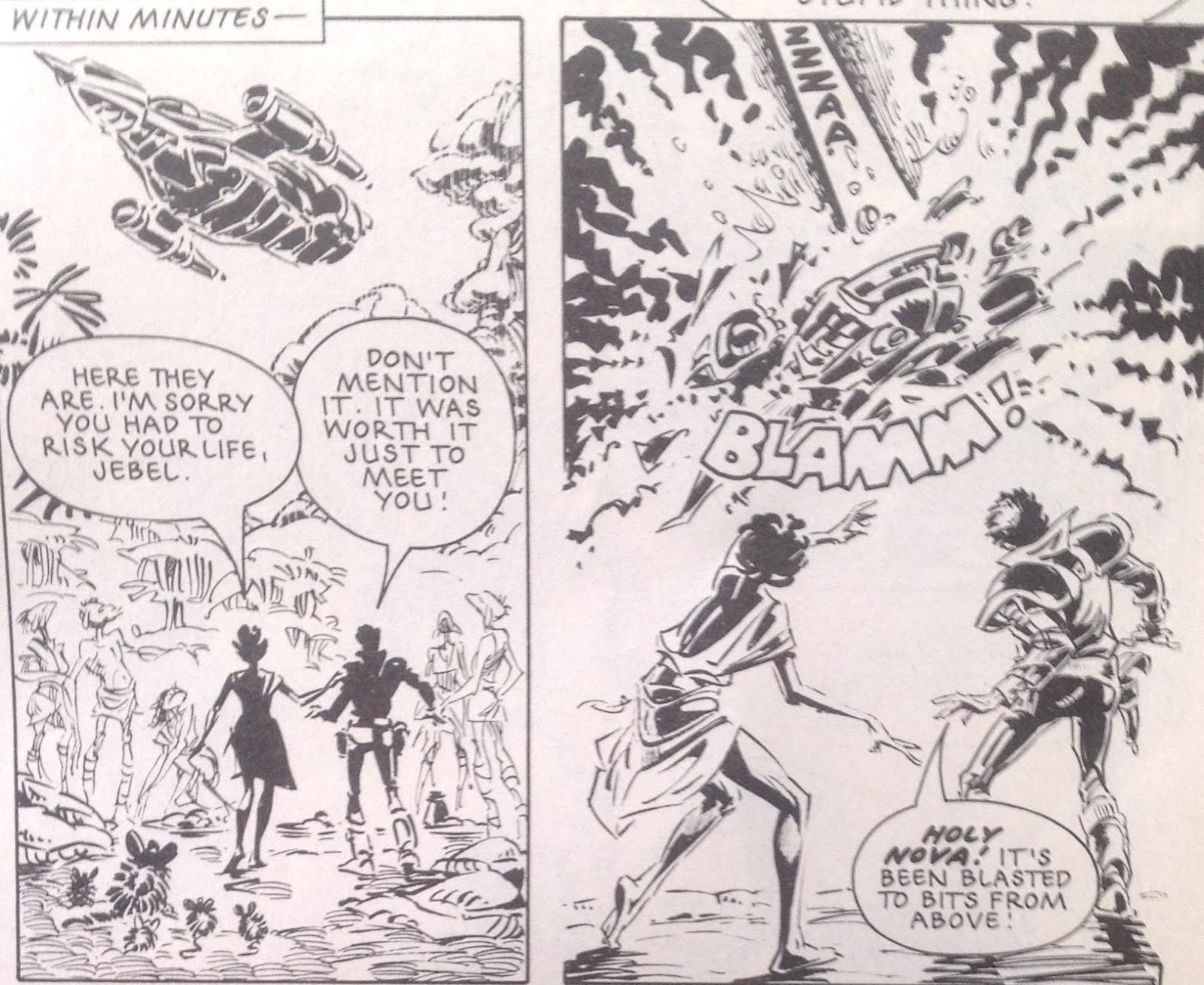
'Holy Nova' wins you a shot if you're playing a Hebden drinking game.
Art by Ian Gibson


The rather excellent Psi-Testers, by contrast, was a dark tale of warring telepaths that may or may not owe a debt to Scanners.

A delightful misfit hero
Art by Mike Dorey (an unsung hero if ever there was one...)


Hebden’s final effort for the Prog was book 2 of the Mean Team, in which the death-sports team have a fantasy adventure. Rather like how the Hunger Games is just less fun to read when the characters are not actually participating in a game, the Mean Team just isn’t as good outside of the Death Bowl. There’s no less imagination from Hebden, mind, and as always plenty of incident, cliffhangers and new characters thrown in. And plenty of violence. Let down by a weird double-ending that was both triumphant and nihilistic at the same time, which I suppose is different!

"Now it's your turn, evil incarnate!"
Art by Massimo Belardinelli


The mega-sad ending...

 I suspect the real problem was that the story ran at a time when 2000AD was rapidly catering to an audience that had grown up with the comic. Hebden, like Gerry Finley-Day before him, found himself off Tharg’s rota, but with steady work on 2000 AD’s younger sibling, the Eagle. Perhaps the mass-killing in the last panel was a heartfelt two finger salute to Tharg?


Art by Jesus Redondo


More on Alan Hebden:
A delightful review of Mind Wars.
Embarrassingly, this is the first time I've encountered the UK Comics Wikia. I expect it has entries for everyone on this blog!

Personal favourites:
MACH One: Mach woman
Death Planet (I didn’t say it was that good, but for some reason I like it anyway)
Mind Wars
The Angry Planet (what I’ve read of it, anyway)
Meltdown Man
Psi Testers


*Lovingly homaged by Gordon Rennie (& Ezquerra again) for the Megazine many years later.

**Other comics that pass the test...

***Hebden may not be pretentious, but that’s not going to stop me from using Latin phrases when I want to.

Wednesday, December 23, 2015

No. 54 Kelvin Gosnell


First Prog: 1
Final Prog: 404

Total appearances: 181
- including 90 as a script droid, and 91 as sub-editor / editor

Creator credits:
Project: Overkill
The Lawless Touch (from Tornado)
-and he had not a small hand in the very creation of both 2000 AD and StarLord

-and perhaps it’s he who coined the word drokk?
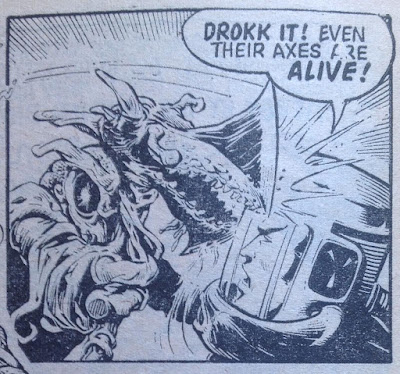
Dare utters the word 'drokk' many times in his frist series.
Art by Massimo Belardinelli

Other writing credits:
Judge Dredd
Flesh
Blackhawk
adaptations of Harry Harrison’s the Stainless Steel Rat
Lots and lots of one-off twisty tales

Notable character creations:
Joe Black
Johnny Lawless (he must be notable - he got his own introductory cover!)

Art by Barry Mitchell


Notable characteristics:
Selfish, money-grabbing, lazy heroes. Setting up challenges in his plots that the heroes solve through a combination of quick wits, bluffing and good old fashioned luck.


On Kelvin:
Pat Mills, godfather and mastermind of 2000AD, has always been quick to apportion credit to Kelvin Gosnell for coming up with the idea of doing a Sci-Fi action comic for boys. Specifically, it appears he spotted in advance that Star Wars was going to be massive, and that people were going to want more of that sort of thing. Executives were persuaded, Mills was cajoled into bringing the comic to actual life, and thus AD2000 was born.

 
The originsl dummy cover for the comic that would go on to become, of course, 2000AD
Art by ? Designer Doug Church, maybe?

Perhaps as a reward for all this, Mills got Gosnell on board as the scripter for the first run of the new adventures of Dan Dare, the most Star Wars-like of the first wave of strips in the comic. And Gosnell then took over from Mills as the editor on the comic for the bulk of its first year, covering Progs 17-85. He only stopped because he had ambitions to copy and improve upon the 20000 AD model by setting up and then editing all 22 issues of StarLord – the comic that birthed Strontium Dog and Ro-Busters.

Was the run of 22 issues of StarLord better than Progs 64-85?
Art on this cover by Ramon Sola

So unquestionably, Gosnell was a key player in the foundation and early success of our favourite comic. I struggle to speak to his editorial style, but I guess he’d have been involved in decisions such as trying out a new style for Dan Dare, and choosing when / how to finish off Invasion, and MACH One, making room for the likes of RoboHunter.

He also deserves a measure of credit for helping out the early comics career of Alan Grant, who started off as Gosnell’s sub-editor, then worked with him to carry Blackhawk over from Tornado (where he was a straight-up historical action hero) to 2000AD, where he became a way-out space gladiator. The way Grant ells, his, Gosnell gave him both practical advice and perhaps even confidence to turn his hand to writing a comic script. See also Judge Dredd: Aggro Dome, co-written by the pair, and a hugely rare non-Wagner Dredd story that you absolutely can’t tell isn’t by John Wagner, it fits the series so well.

Was the script for this born during the tempestuos time sof the IPC strike?
Art by Mike McMahon
From that point on, Gosnell’s credits move exclusively to the script droid box. He never quite hit it off with a whole new series, aside from his masterful adaptations of three Stainless Steel Rat novels, but his many one-offs were always delightful, and the tone he uses suggests that it was as much his worldview as anyone else’s that informed the nascent 2000 AD.

Let’s look into that a bit more, shall we? I suggested that the first Dan Dare run is the most Star Wars-y thing to appear in 2000AD.* But this is only inasmuch as it features spaceships, space pirates and space battles with alien weirdoes. Overall, Dan Dare isn’t remotely like Star Wars in tone. What it is is a showcase for Gosnell’s fondness for sneering, no-nonsense gruff action heroics, coupled with alarmingly over the top escapades that often involve harsh moral choices. Dare, the good guy, is a sweary, anti-authoritarian dude right from the start. Very specifically, this is the signal to us readers that we’re going to be on his side. He does things his way, doesn’t worry overmuch about the consequences, and he definitely won’t take a telling.

Dare don't care.
Art by Massimo Belardinelli

 Pat Mills concocted and wrote the opening episodes of most of the very early series in 2000AD, including Dan Dare, but Gosnell will have helped him out. He clearly has an affinity for this kind of ‘stick it to the man’ character that Mills was so keen to be the template hero for the comic, so I can’t help but imagine he and Mills had a fair amount of constructive back and forth on this sort of thing.

Gosnell was also called upon to write several of the middle episodes of Flesh book 1. Again, the tone of this strip is to root for the ‘heroes’ who are actively ignoring the orders of their superiors. This time it’s a bit more obvious that there are morally sound reasons for doing so, but it’s the laconic ‘I’m right and you’re wrong’ attitude that informs the likes of Earl Regan. I also imagine that what Gosnell was really into were the episodes that focus on dino-based carnage, complete with the screams of dying children brats.

Choose your way to die - giant spiders of hungry Tyrannosaurs.
And kudos to Gosnell for being aware of fur-covered theropods as a real thing.
Art by Ramon Sola (and don't tell me you can't see some Henry Flint DNA in there)

He was also one of a handful of writers to have a go at scripting some very early Judge Dredd episodes, back when that series was still trying to find its feet before John Wagner took over. He had a pretty great handle on the basics of coming up with inventive future crimes, coupled with the dirtbags who commit such crimes.

The Gosnell character archetype is the lithe but dependable man’s man who knows how to do stuff for himself, doesn’t waste time on emotions – unless it’s anger or greed – and is pretty handy with his fists. Yup, it’s 70s action heroes all the way.

Earl Reagan is a man's man.
Art by Boix, I think? Or else more glorious Sola

And so we get Captain Kenny Harris, pilot extraordinaire and eventual hero who busts the evils of Project: Overkill wide open. It’s not the most fondly remembered of stories, perhaps, but I think it’s one of the better one-off long stories to have run. Indeed, I wonder if it was Gosnell as editor who first approved the idea of running 7-12 episode long stories that were never meant to be part of a new, endless strip. Always something of a risk if you end up with a 12-week run of a weak story (*cough*Colony Earth!; Dry Run; Trash etc), but more often than not these have been a dependable source of exciting new and original stories for 2000AD.

Project: Overkill is a mountain?
Art by Jesus Redondo

Any, back to Kenny Harris. Ostensibly an upright chap, he’s mostly motivated by a sense of annoyance that he can’t remember what happened, and that his name as a good pilot has been maligned. Yes, he wants to be sure that his passengers are all safe, but you can sort of tell that it’s more personal than that.

Kenny Harris wants answers, goddamit!
Art by Ian Gibson

Gosnell's heros also have a strong sense of right and wrong.
Art by Jesus Redondo

It turns out that there’s a popular character from the world of pulp SF novels who fits Gosnell to a tee – slippery Jim DiGriz, the Stainless Steel Rat. DiGriz is a thief, but an enormously honourable one, who goes to great lengths to only steal from peopple who can afford it, or who, arguably, deserve a comeuppance or two. In the first story, he's coerced into becomeing an agent for the equivalent of an interplanetary FBI, and spends the rest of his adventures carrying out clever missions to take down scumbags (starting with psycho-killer Angelina, who becomes his wife). DiGriz is all about quick wits, sharp tongues, and being handy in a fight.

Harrison's original prose isn't too far from this terse style, actually.
Art by Carlos Ezquerra


Angelina DiGriz - 2000AD's deadliest female?
Art by Carlos Ezquerra

Gosnell must have put a fair bit of effort into securing the rights from author Harry Harrison to adapt his series for comics. He certainly put a lot of effort into writing the scripts – the three books Gosnell adapted are amongst the very best novel-to-comics works I’ve ever read.

This is how to turn prose into comics, folks
Art by Carlos Ezquerra

Vast swathes of credit to series artist Carlos Ezquerra, of course, and indeed to Harrison, who knows his way around an exciting, page-turning adventure that lends itself to the pacing needs of a comic.

But yes, if there’s one thing I’ll value from Gosnell above anything else, it’s the Stainless Steel Rat series. So glad Rebellion managed to put out a collected volume! So sad to think that there are another 8 or so books that could, in theory, get the same treatment from Gosnell/Ezquerra, but presumably at this point never will.

One of DiGriz's more loathsome villains is about to get his comeuppance
Art by Carlos Ezquerra

This leaves us with Gosnell’s other major contribution, Tharg’s Future Shocks! History may or may not record if any one person had the brainwave to insert these single-episode twisty tales into the staple line-up of 2000AD stories, but since Gosnell was editor when they first went in, he’ll get some of that credit. Writer Steve Moore likely deserves the biggest cheer for showing everyone else how its done – although, frankly, the vast majority of the early Future Shocks were not so great.

Gosnell himself wrote plenty, including I think the very first ‘man trapped in a virtual reality prison’ story. You know, the story that Tharg specifically tells all submissions pile hopeful NOT to use!

Art by Colin Wilson


Other clichés perpetrated by Gosnell include the old
‘things are the way they are because alien beings are playing games’…
Art by Kevin O'Neill

I’m being unkind, because Gosnell wrote some pretty great one-off tales, too, not least a series of short stories featuring Joe Black, perhaps the first Future Shock protagonist to (almost) earn himself his own series. A classic Gosnell rogue, Black has to use a combination of wits, luck and basic mechanics skills to get what he wants out of life – peace, quiet and the promise of enough cash to buy a beer.

Black wins by cheating.
Art by John Higgins
 
More on Kelvin Gosnell:
There's only a passing mention of Kelvin Gosnell himself in here, but this is a lengthy piece by Pat Mills about the genesis of Dan Dare's appearance in 2000AD
I believe it's noe out of print, but if you can get hold of a copy of Beyond 2000AD by Hibernia Press, you'll find some words from the man himself

Personal favourites:
Judge Dredd: The New You; Aggro Dome
Project: Overkill
The Stainless Steel Rat
Joe Black: Trial and Error; Horn of Plenty; the Hume Factor
The Art of Advertising

Art by Garry Leach

 
*Later, post-Gosnell Dan Dare was more similar to Star Trek. And in the decades since, other strips such as, hell, Junker or even Ace Trucking Co were a bit more Star Wars-y, for the smuggling side of things, and I guess Insurrection for the ‘rebels vs evil Empire’ type stuff.