Friday, September 9, 2016

No. 81 Chris Weston


First Prog: 596
Latest Prog: 1889 (+ a magnificent poster in the 2016 Sci-Fi Special)

First Meg: 214
Latest Meg: 325 (on the cover); 222 (interior strip)

Total appearances: 110
-including bonus points for a couple of strips he has written and drawn himself.
And let’s hope he’s back again soon, too! I’ve a feeling he might be.

Creator Credits:
Indigo Prime
Canon Fodder

And Weston's/Millar's version of Mycroft Holmes:
by far the nastiest piece of character design I'd ever laid eyes on at the time.
Words by Mark Millar
 
Other art credits:
Judge Dredd
Rogue Trooper (both Fr1day and not)
Robo Hunter
Nemesis the Warlock
Downlode Tales (but not Sinister Dexter)
Nikolai Dante
A handful of one-offs

Notable character creations:
Barry Kuerten
Winwood and Cord
Canon Fodder

Standard issue (?) bowlhead haircut on Judge Kuerten.
Impish manifestation of evil impulses optional.
Words by John Wagner

Notable characteristics:
Super-tight artwork. Wild, fantastical and frankly disturbed imagination. Gurning, grimacing faces. Something of a plastic feel to skin. No fear of bright colours and a commitment to clarity. All the foreground, background and mid-ground detail you could ever ask for. Being super chatty.*

Presumably the writer's instruction (if any - this was for a text story), was simply 'draw a collection of weirdies'. If that's your panel description, you've gotta jhope it's someonw of Chris Weston's calibre at the other end.
Context by John Smith
 
On Chris:
Weston has a pretty classic 2000AD narrative: budding young artist gets a couple of future shocks, a handful of Dredds, proves to be a unique voice with a lot of talent, if a bit ropey in places. Lands a full serial, nails it, becomes instant legend, develops some stunning covers and a new super memorable character, gradually disappears from the Prog to work for US publishers, with a neat sideline in film concept art and storyboarding, then comes back to Tharg intermittently, each time a little better than before.

I mean, it’s British comics careers made straight, right?

But there are some key differences to pull out. I mean, I guess tastes always vary but I can’t see anyone denying what an astonishing draughtsman Weston is. His style is basically that of a covers artist, composing magnificent single images – yes, not a million miles from one B. Bolland or C. Robinson – but somehow he makes that style work for every panel of a strip, without sacrificing the storytelling.

And he’s done his fair share of cracking covers, too.


It helps that Weston has another trick up his sleeve – having a pretty solid writing instinct, as seen specifically in a few one-off tales that he’s written as well as drawn. But it’s also no secret that he had quite a big hand in the storifying of what might be his fondest-remembered 2000AD series, Killing Time.

This back cover poster/trailer got me so excited for the series; you don't even know.

It’s no coincidence that this is one of the most penetrable efforts from John Smith, and coming during a period in which he was being pretty elliptical with the likes of Revere or Danzig’s Inferno.

And let’s not ignore Weston’s key affinity for picking a very particular moment in time in his panels, chiefly in terms of facial expressions.

Winwood's face goes from sombre concern to intellectual delight to plaful curiosity. Cord remains impassive.
Why are the purple? Well gosh, hy not? It marks them as ethereal, for one very good thing.
Words by John Smith
Canon Fodder - the cahracter - is perhaps a special case, as he’s meant to be a dull-witted blowhard, and the series itself is meant to be outrageous and over the top, but even within that, Weston pulls no punches with the facial contortions of our man. There’s also, to my mind, a passing resemblance to ex Prime Minister David Cameron. Something about the puffed up jowls and general pained expression of confusion backed by self-righteousness.**

Canon's mouth at full rictus
Words by Kek-W


Features set to maximum contempt
Words by Kek-W


And Weston's version of Friday gurned his way through a bunch of covers, too...

How Tharg restrained himself from a strapline that said 'pucker up!' I'll never know.
Bonus points for background gurnage


This is the pose Donald Trump pulls to psyche himself up every morning.

Weston’s work isn’t photo realistic in the same way as folk like Arthur Ranson or Clint Langley, but it is pretty real. I imagine he spends a fair bit of time pulling faces in the mirror. But his best trick is matching up those faces to a specific emotion, or to a single phrase in the speech balloons (which may or may not be rewritten after the fact to suit better!).

There's so much going on behind those two faces I can ahrdly stand it. Weston is perhaps 2000AD's most overtly sexual artist, or at least, he brings that out in me for whatever reason.
Words by John Smith
 
And my God, the details!

One of Weston's earliest pieces for Tharg, and although you can tell he's not quite there yet, he's certainly not skimping when is comes to costume texture, background machinery or, of course, a vat-full of worms.
Words by Alan Grant

 Time for a potted history:

Full imagination on display right from the get-go with his early Future Shocks.

Actually, this might well be from a later Indigo Prime episode; I can't remember

 Seeing out the original Rogue Trooper:

Blending photo-relaism (ish) with dynamic action
Words by Steve Dillon
 

Babies that look like babies - not a trick many comics artists can manage
words by Steve Dillon


A mean but playful streak evident on Dredd.

Weston is on record as hating his work here, but I love it. You can really feel that machine press pushing into the dude's face. And those lips on Judge Kuerten - horrible!
Words by John Wagner


There's that plastic-looking flesh again. And another hit of sexual frisson.
Words by John Wagner


Instant superstar status with horror classic Killing Time.

Let's enjoy the colurs, shall we? You may recall, this was the era of fully painted whatnot, and other artists being colured in by professional colourists in the early days of that craft. Weston did it all himself, and it wasn;t like anything else. And yes, there's a lot of red in these panels for a reason.
Words by John Smith

Despite the affinity on gore and outlandish set dressing, not quite working on Nemesis the Warlock, and definitely not really working on RoboHunter.

Full marks for rendering Torquemada as a rather squalid little torturer; but sadly only half marks for Nemesis. I know it's folling existing models, but he's too fleshy and humanoid for my taste.
Words by Pat Mills


Nothing wrong here with the craxy killer robot designs, it's just a curious tonal iteration of RoboHunter.
Words by John Smith
Giving Friday, the new Rogue Trooper, a much needed kick up the arse, for the all the good it did the character. I suppose it helped move the whole thing away from the soul-searching of the War Machine, which had destroyed any hope for Michael Fleisher’s boy’s own romps.

Weston's Rogue is made of muscle and anger.
Words by Fleisher/McKenzie/Tomlinson


Weston's version of Rogue Trooper, cool original flavour.

Making everyone laugh with Canon Fodder – and it’s perhaps only around this point that his style seemed to settle down. For all the glories that had gone before, you could sort of see that he was learning and refining his trade. Nerve-wracking for the artist, no doubt, but often fascinating for the reader.

In some ways a rather broad and obvious joke but Weston helps sell it
with more neat character designs and facial expressions.
Words by Mark Millar


'Nuff said.

Vibrant fun on Sinister Dexter, a series that, perhaps more than any other, relies heavily on artists who can conjure up fully-relaized and idiosyncratic characters and sets.

A slight development in style, somehow a bit looser to allow for a greater sense of motion.
No letting up on the detailed costume and hair designs, of course! Or the bright colours.
Words by Dan Abnett
 

Since then, he’s been too busy for full serials, but Weston has scattered the Progs with one offs every now and then. Most recently, with some he’s written himself, showing that the comedic but mean streak is part of his writing as well as his art.

Weston's personal vision of Hell?
Words by Chris Weston


Yes, he's making a joke about how much he didn't like the 1995 Judge Dredd film.
On the far right, he's also, I think, scoring a lovely homage to Ron Smith, the great unsung Dredd artist

Most recently, he delivered this poster in the 2016 Sci Fi Special. There’s something different about it – it’s more painterly, without that plastic feel, and looks like it took bloiody ages to create!

Deserves to be seen at full size!
 
Let’s have some more from the man with the deviant mind, please.


More on Chris Weston:
He blogs
A neat interview on Sneaky Mag
A three day special on Covers Uncovered
-but I'm somewhat surprised not to find anything more recent.


Just a hint of Weston's full vision of Heaven and Hell
Go read Canon Fodder if you want to see how he drew God and the Devil,
two visual reveals up there with the best of anything Tharg has offered.
 
Personal favourites:
Judge Dredd: Crazy Barry, Little Mo; The Great Little U-Front disaster; Six; The Heart is a lonely Klegghunter
Indigo Prime: The original Future Shock; Killing Time
Rogue Trooper: Enfleshings
Canon Fodder: for the art, the whole bleedin’ lot.
Downlode Tales: City on Fire
Future Shocks: The Godfish; Green Pedestrian Palm; Counts as one choice


*I’ve never met Chris Weston, but I did once sit in the same train carriage as him on the way home from a Bristol comic con many years ago. He was sat next to Matt Smith, and regaled him with anecdotes and opinions for the entire journey. The typically taciturn Smith got about four words in edgeways. I had a blast earwigging. – like a great comics podcast, about three years before they actually existed.

**Sorry, that’s almost getting a too political for this blog.

Wednesday, September 7, 2016

No. 80 Igor Goldkind; No. 80½ Michael Molcher


Igor Goldkind

First Prog: 701 (in the Hype box); 774 as script droid
Final Prog: 888

First Meg: 2.27 (or 47 in normal numbers)
Final Meg: 2.40 (or 60 in normal numbers)

Total appearances: 111
-including his run of promotion pieces that ran in Tharg’s input pages for most of the 700s. Which is kinda cheating.* Actual creator credits total: 31

Creator Credits:
The Clown

Art by Robert Bliss


Other writing credits:
Judge Hershey
Strontium Dogs
A handful of one-offs, inlcuding in Crisis and Revolver

Notable character creations:
The Clown (and his pony)
Special Agent Joe Brummer (not the most original but somehow very memorable)


Notable characteristics:
Pop culture references, with little distinction made between the mainstream and the obscure. Being pretentious, but also being self-mocking about being pretentious. Using caption boxes to seed atmosphere. Trying hard.

Yes, this is riffing on arty comics of the day, chiefly Sandman. The words are also, strangely, true.
Art by Greg Staples
 
On Igor:
Igor Goldkind’s career with Tharg began in the PR department. He may have been the first person designated with this specific job, as far as I know – and it’s for this role I suspect he is best remembered by the sort of Squaxx who care about what goes on behind the scenes. 

Goes by I-Groid or IG-Roid.
Art by Paul Marshall (I think?)
Beyond 2000AD, Goldkind is given credit in all sorts of places for pushing the term ‘Graphic Novel’ as a marketing term deliberately designed to get booksellers to stock comics, and non-comics readers to actually buy and read comics.

One could spend a lot of time talking about the term, and all the good and bad going on within it semantically. But the main thing to note is that it worked. Booksellers and ‘serious’ publishers did and do use it, and buying readers still respond to it – at least, the sort of readers who don’t read weekly or monthly comics. Not as much as perhaps people once thought they would in the late 80s, but on balance the creation of ‘graphic novels’ as a marketing term has done a lot of good to promote comics as adult-worthy literature in the English speaking world.

None of which has anything to do with 2000AD! Except that it may well have been Goldkind who filled up many a page of the Prog with ads for collected editions of stories that originally ran in Crisis, obviously aimed at older readers. In turn, he was surely a big part of the push that aged 2000AD from being aimed at 8-12 year olds and instead for 12-25 year olds (and let’s ignore the fact that we’re all** pushing that delightful 30-60 demographic nowadays…).

All of which is funny, given that when Goldkind’s own voice started hitting the Prog from 700, it was anything but grown up.

A classic taste of IG-Roid-ian rambling.
Art at the top I think by Dave D'Antiquis just for some flavour.

Until that point, Tharg’s Nerve Centre had been an outlet for tiny nuggets of Thargian wisdom, then as now devoted to a mix of self-aggrandising and trailing upcoming series. But most of the page was devoted to reader art and letters. Come the Goldkind/Burton/McKenzie era, and it all changed to a brace of pages known as ‘Output’ – Tharg to us, and ‘Input’ – us to Tharg.

To fill up all that extra space on the Output page, enter IG-Roid (Goldkind’s droid persona), and lots of prattling on about all the many pies Tharg had his fingers in, and just how good all those pies were, and why you should rush out to buy them.

The early, experimental phase of this change saw IG-Roid throwing his sense of humour and playfulness onto the page, with decidedly mixed results. But so what? These paragraphs were likely read by few then and remembered by even fewer now. But I appreciate the effort, and the fact that he was going for something other than being a snivelling droid minion, as was the standard trope up until then.

Based on this actual printed work, IG-Roid comes across as a character from a slightly more grown up children’s comic, but never looking down on the content of the day, which veered wildly from the basically for children stuff (Harlem Heroes, Junker) to the super trendy stuff (Time Flies, Hewligan’s Haircut) to the actual grown up stuff (Shamballa, Button Man). I believe Goldkind gets as much ‘blame’ as anyone for courting the trendy NME-type crowd of the late 80s/early 90s, which some quarters mark as the beginning of the bad times for 2000AD. I can well believe he did court that crowd, but I don’t suppose it hurt the comic nearly as much as the change in distribution channels that was beyond Tharg’s control. Mind you, I’ve no idea if it made any difference to bringing in a new crowd to the comic’s pages, either. PR – if it was a science, everyone could do it.

So much for the uninformed idle speculation. What about Goldkind the comics scribe? Well, he had two proper cracks at ongoing series, again with mixed results. 2000AD got The Clown, and The Megazine got the first serious attempt to get a Judge Hershey strip to work in its own right.

I love the Clown, although I’ve a strong suspicion most people don’t. In the first place, it’s the luscious artwork that draws me in, from the mysterious Robert Bliss. A name that sits so perfectly with this image of the titular murderous clown.

I just love how the 'Bliss' tag functions as a bit of comics emanata as well as the artist's signature.
NB the Clown in the story is not nearly as sadistic as the image suggests.

I understand that killer clowns are something of a cliché – although I don’t know how far back that actually stretches. But I have no problem with this idea being basically another monster, such as vampire, werewolves and zombies. But for this tale, Goldkind was deliberately embracing clichés and trying to push beyond them. Nominal ‘hero’ Special Agent Joe Brummer was - to my eyes - clearly a riff on Dale Cooper from Twin Peaks, then big on TV, for example – only Goldkind pushed the character’s nature as a collection of foibles, and almost no actual personality, to the limits. 

Brummer has very particular tastes.
Art by Robert Bliss


Very particular tastes. And a good line in deadpan.
Art still by Robert Bliss

Apparently the whole thing is intended as a satire of Sandman. Either I haven’t read enough of that series, or else it’s just too oblique a satire for me. 

I'm guessing this is a Gaiman pastiche.
Art by Bliss. And it really adds a lot.

Personally, I enjoyed it plenty on the surface reading of a weirdo Clown who wants revenge on the bad dudes that killed his pony.

Let’s talk about the titular Clown. He’s both a hero and a villain, in the classic 2000AD vein. Yes, he is murderous, but the target of his murder absolutely deserve what they get. Otherwise, the dude just wants to be a proper good clown and make children smile. And that’s the full extent of who the Clown is. It’s almost Millsian in its 2000AD purity.

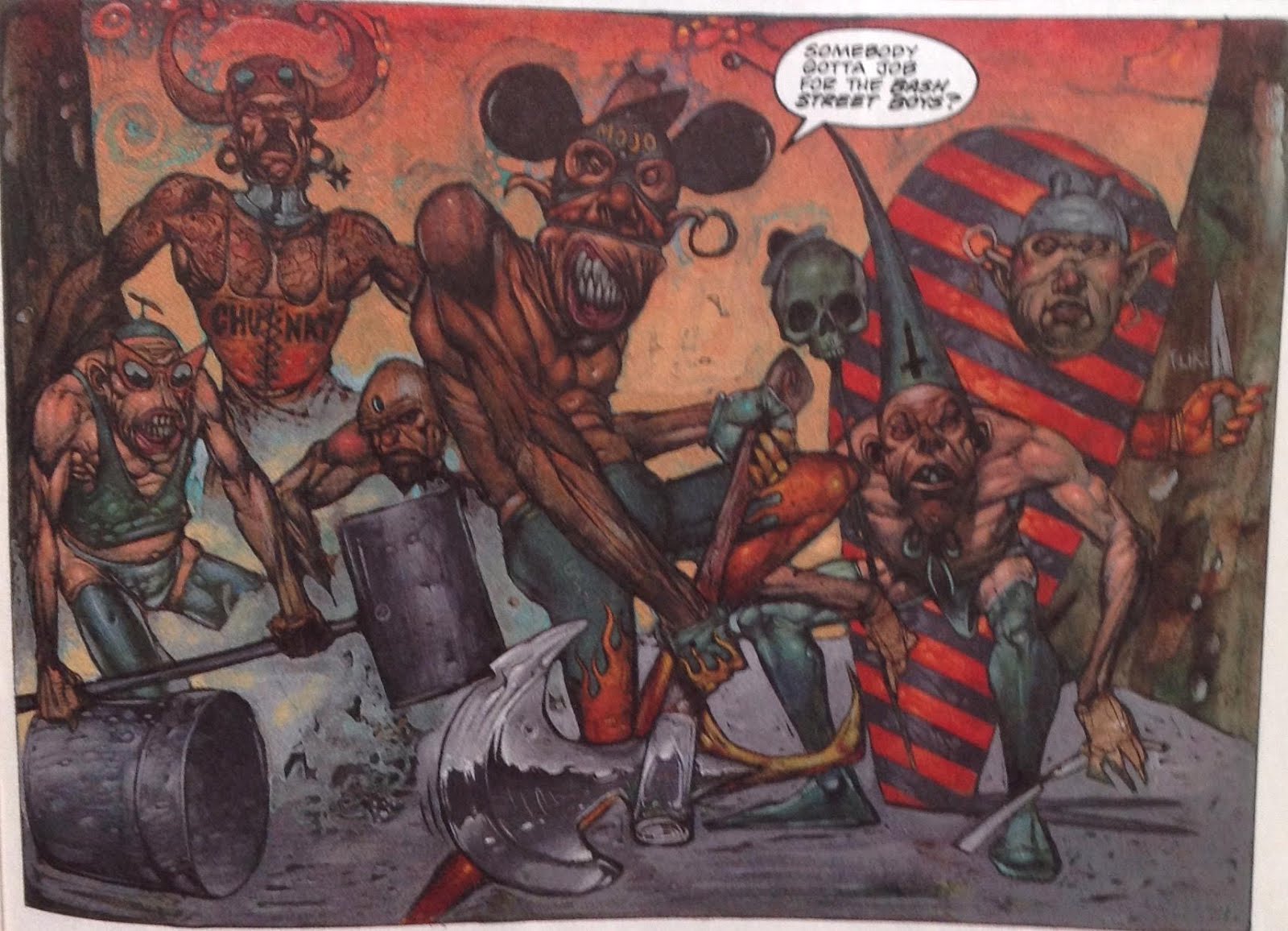
Sure, some of the jokes don’t land, or are perhaps a bit too broad. Then there’s this bizarre reference to the Bash St Kids:

Well, I guess they do look a bit like what a gang of ne'er-do-well school children might grow into.
Art by, yup, Mr Bliss.

One can’t help but think neither Bliss nor Goldkind had actually read the actual Bash St Kids, they just had some vague idea. Mind you, great pic.

Series 2, on the other hand, was pretty much pure balls. Shorn of his defining murder story, the Clown himself doesn’t have enough to do, or rather, doesn’t have enough to do to bring smiles to my face. Bringing in aliens, who can be defeated only by the power of laughter, is a silly enough idea to suit the story, but not funny enough. Agent Brummer doesn’t get to do much more than repeat his jokes from the first series, and repetition alone isn’t funny the second time (although it usually is the third, fourth and fifth time; see for example Sinister Dexter). Still some cracking artwork, and in comics that's more than half the battle, of course.

Why so straight, dialogue? Why not layer on the arthouse narration again?
Art by Greg Staples, I think, who took over early on in Book II.
 

You said it, mate.
Art definitely by Bliss, this time.

Judge Hershey wasn’t funny at all. And in a way, this was the strip’s defining feature. I can’t remember if Goldkind was the first person to try writing a solo Hershey tale, but he certainly has a good crack at trying to make it work beyond being a Judge Dredd story with a different Judge as the main character. And the way he does that is through the tone of the story – it’s a bit creepy (in large part thanks to excellent work from Kevin Cullen), and it is in no way funny, unlike 99.9% of all Judge Dredd tales.

Judges killing prostitutes - not funny.
Art by Kevin Cullen

Arguably it veered slightly too far into being pretentious. A trick he had tried with the Clown, where it was played for laughs, while here it’s portrayed instead as ‘well, why shouldn’t stories about Mega City Judges be a bit grown up and literary’. And he has a point, although I would say the two stories he wrote we not that good.

The Harlequin was the villain, but he had a pretty valid point. Getting Hershey to question her perception of the system is a great way into a solo series for the character.
Art by Kevin Cullen

What the two series did attempt was a peek into Hershey’s life off-duty, which includes such activities as going to the theatre. Again, why not? She’s got an intellectual side, and you can’t just have her sitting at home polishing her gun and obsessing over law manuals, a la Joe Dredd. I’m kind of sad that we didn’t get more of Goldkind’s Hershey, as it could’ve been fun to develop this side of Mega City one life, especially off-duty Judges who aren’t being criminals or Wally Squad nutters.

Well, she's never entirely off duty.
Art by Kevin Cullen
There was of course an actual story with a plot to cover, too. I don’t remember the details all these years on, but I do remember them being perfectly OK, with a hint of too much pretension. (This probably isn’t the right word, as it is inherently derogatory. But I like a bit of pretension, me. As in, spicing a straight up crime tale with a bit of poetry and metaphor.)

For full-on pretentious pretension, I can only imagine Goldkind’s work for Crisis is worth a read, but I haven’t had the opportunity.

But in the end, that was it: two series of Clown, two of Hershey, the latter at least with the promise of more that could have been pretty good. So it goes.


More on Igor Goldkkind:
His own website
I had some fun reading his Wikipedia entry
And a review on Down the Tubes of his most recent work, Is SHE Available – an ambitious poetry-based project (or at least, so it appears?) that shows Goldkind still has the kind of clout that draws some rather high end collaborators, including 2000AD-ers Glenn Fabry and Rian Hughes.

Personal favourites:
Judge Hershey: the Harlequin’s Dance
The Clown: Book I

Art by Greg Staples

And, speaking of PR legends, let's move from a figure of some controversy to a much-beloved droid of today:

Heroes of 2000 A.D. No. 80½
Michael Molcher

First Prog: not sure there’s a specific ‘first Prog’ for this behind-the-scenes hero, but his text piece in Prog 1526 is as good a place to start as any.
Latest Prog: see above – no set number, but he’s still going strong and hopefully will for a long time!***

Molch-R's droid persona;
as rendered by Pye Parr
First Meg: 246 (creator interview)
Latest Meg: 345 (creator obituary)

Total appearances: 59 – if you count up his articles and text pieces.
One the one hand, this doesn’t fit into the count anyway as I haven’t included interview appearance for any of the creators involved.
On the other hand, the man has such a constant presence on Twitter, the forums and all over the internet shouting loudly about 2000AD that it feels as if he deserves a far higher count.

On Michael:
PR, eh? What could be less punk and spirit of 1977 than that? Well Molch-R makes it work, somehow. Sure, he’s shilling product, but he manages to do it in a way that feels in keeping with said product. Not in the sense of promoting class war or turning ideas on their heads or exploring sci-fi concepts, but in the sense of embracing the joy of solid entertainment.

Maybe it’s the moustache and monocle that he doesn’t actually wear, but seems like he is wearing anyway. And above all it’s the way that he so clearly loves 2000AD. Much like me, he gives the impression of basically liking pretty much everything 2000AD has ever done, and really liking quite a lot of it – apart from the stuff he downright loves to pieces.

As I understand it, he started out as a journalist and scored some early work from 2000AD/ the Megazine with a bunch of creator interviews. Based on his book series, it seems he has access to just about everyone, and no one is shy of talking to him. Being well-liked is an underrated gift. He then moved into Tharg / Rebellion’s full-time PR guru, and has even taken on an assistant, I believe.

Since then, he’s pretty much become 2000AD’s most high-profile real-life character, in terms of daily/weekly presence. Sure, one is never too far away from a Pat Mills written screed or on-screen rant, but Molch-R seemingly never rests, always ready with a cheery message, or dragging a reluctant Cyber-Matt into the pod booth. Or, when he’s not doing the talking, seeding stealth publicity campaigns to get the blood flowing.

Artwork by Pye Parr, teased in sequence across four weeks back when
no one had any reason to suspect we'd see the Dark Judges again
 
Given that I’ve been reading 2000AD basically every week since 1991, and since about 2005 have been pretty regularly hitting up the 2000AD forums, it’s kind of wonderful that the comic has still managed to deliver delights and surprises that I haven’t spoiled for myself, whether it’s twist endings of stories, that we didn’t even know had a twist to come at the end, or the sudden reappearance of long-dormant characters, or the outrageous mindbomb of Trifecta. It’s not as if there wasn’t publicity, but it was just handled so well that it piqued excitement without diluting the fun. I guess the maxim is ever, ‘quality speaks for itself’.

Keep going, that man!

Continued credits include:

The weekly Thrill Mail, always bursting at the seams with both things to buy, things to remember, and things to read/watch.
The 2000AD Thrillcast, never less than essential.
- but I can’t help singling out the 3-part epic interview with John Wagner, which was delightfully candid, informative and made it feel as if the two were genuinely having a lovely chat that someone happened to have recorded. Would that all interview-based podcasts achieved this balance.
-and, more recently, I loved the roundtable he set up as a paean to the work of Arthur Ranson. 
The 2000AD ABCs. I imagine there’s quite a bit more effort than it appears to make these short snippets. I’m super excited that he’s really going for EVERYTHING, not just the stuff that has been collected and reprinted. Occasional alphabet-order slips only add to the excitement, as you never know when something missed might get slipped in later.

Molch-R hosting an episode of the 2000AD ABCs
Video production credits - unknown to me, sorry!
In a delightful coincidence, the latest video as I upload this post is about The Clown.

And let’s not ignore the work that goes into maintaining 2000AD’s Twitter feed
And Tumblr
(presumably with the help of various colleagues/minions)

More on Michael Molcher:
His Twitter


*Partly I just wanted an excuse to cover this colourful character before too long, but mostly it seemed the best way to introduce Molch-R onto the honour roll, a true contemporary hero of 2000AD.

**OK, not all. I’m pretty sure there’s a healthy chunk of child/tween/teen readers out there, who may or may not mostly be made up of children of lifelong 2000AD readers.

***Quite apart from anything else, he’s only half-way through the ‘C’s on the 2000AD ABC, so he’s got as long way to go if he’s going to see it all the way through to Zombo. (Or possibly hot new thrill, Zzyzyxx the Last Betelgeusian, coming to a Prog in 2019)