Thursday, March 9, 2017

No. 98 Eva de la Cruz


First Prog: 1360
Latest Prog: 1956

First Meg: 246 (new material); 218 (on Metro Dredd reprints)
Latest Meg: 382


Total appearances: 91
-including 15 epsiodes of Metro Dredd reprinted in the Megazine, but not a handful of Metro Dredds that weren’t
(and I bet my count here is a little low as I didn't pay proper attention to colourists way back when I first started compiling the list. Sorry, colourists!)

Words by Matt Smith (I think)
Art by Inaki Miranda
Colour credits:
Judge Dredd
Road Warrior
Dead Signal
The 86ers
Judge Anderson
Sinister Dexter
Havn - just started in the Meg the day after I posted this!
Various one-offs and Thr3llers


Notable characteristics:
Obviously there are exceptions in her work, but there’s an awful lot of indigo and violet, and indeed some deep reds and pinks. She also often adds a sheen to everything that puts me in mind of animated films more than comics, and it’s no bad thing. Often adds depth, for one thing. 

Child-friendly ultra violence, with an anime sheen
Art by Inaki Miranda; Context by Gordon Rennie


Reassuring deep blue
Art by Jesus Redondo; Words by Robert Murphy
On Eva:
Eva came to the House of Tharg in a package deal with artist (and, I believe, life partner) Inaki Miranda. Their work together is pretty darned glorious, and although I can see why Tharg hasn’t used Miranda too often – his style skews quite a bit to the younger end of 2000AD’s core readership, and his exaggerated version of Dredd in particular feels very young – de la Cruz had picked up steady work paired with a range of artists (chiefly PJ Holden), and bringing her own recognisable colouring style along.

It’s very rich, is what it is. Sumptuous. Lends itself to epic grandeur, summed up by her work – with Miranda, not coincidentally I’m sure - on one of the best of Tharg’s Thr3llers, the Ghostship Mathematica:

Sophisticated anime; grogeous layers of green slime on the ship there.
Art by Inaki Miranda; Words by David Baillie

But before that there was Dredd, with a high-profile job doing the Dredd cartoon strip that ran in Metro back when the idea of a free daily newspaper on the tube was a novelty.

Working on actual Judge Dredd in the Megazine was a definite step up for all concerned, and de la Cruz soon found herself as one of Tharg’s go-to colourists for a wide range of jobs.


Dig that crazy lilac!


Between the artist and colourist, that's some funky work getting the relflection / see-through trick going with the windows. Did you know, this is an exmaple of quanutm mechanics in action?
Artby Inaki Miranda; Words by Gordon Rennie

I’m no expert on coloring  -I can barely open up a file in Photoshop, let alone do anything to an image – but I do find de la Cruz’s style much more noticeable than, say, Gary Caldwell. She really seems to go for it with the mood stuff, and isn’t afraid to let the colours dominate the way a scene feels, letting lighting dictate the colour of clothes, buildings and such.

She’s also pretty big on bright lights unapologetically being bright lights.

I love HQ scenes with loads of strip lights. I'm old fashioned enough that it still reads as well futuristic.
Art by Inaki Miranda; Words by Gordon Rennie


If you can look past the extraordinary volley of blood and brains, those are some BRIGHT lights.
Art by Leigh Gallagher; Words by Al Ewing


Her work with Miranda does have a very particular quality that isn't quite the same when she's colouring other folks. Mostly she seems to play it starighter, with less of the cartoon shine. But there's always that commitment to enhancing the mood by emphasiing one hue over all others.

Why yes, the colour for murder and protistution IS red.
Art by Vince Locke; Words by John Wagner


If there's one way to try to sum up Dead Signal, it's that the protagioist uses the brioghtest possible pink ray gun.
Art by PJ Holden; Words by Al Ewing


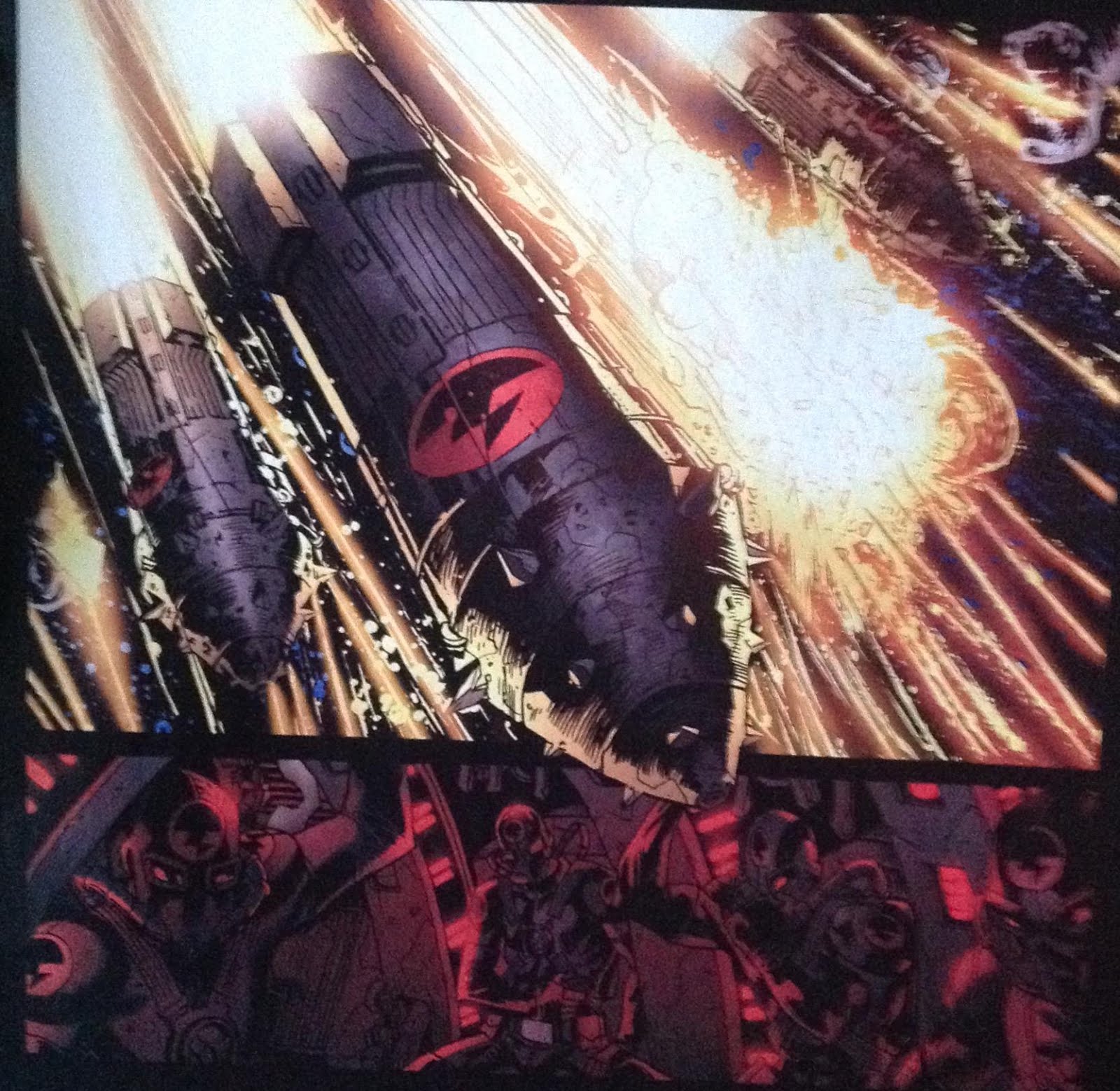
More but darker red for impending death by giant missiles
Art by PJ Holden; Context by Arthur Wyatt


Modern comedy noir is, by contrast, black, yellow and orange
Art by Patrick Goddard; Words by Dan Abnett


F;ashbacks to the Acadmey of law are grey. OBVS.
Art by Steve Yeowell; Words by Alan Grant
She's been with Tharg for nigh on 10 years at this point, and long may she continue to appear!


More on Eva de la Cruz:
Good luck finding anything; all I got is
www.evasartblog.blogspot.com
 -the link still exists, anyway, althoguh the site itself might be defunct now?

A meta-colouring joke, in which the protagonists go back home from yellow/orange hues to de la Cruz's preferred blue.
Art by Patrick Goddard; Words by Dan Abnett


Personal favourites:
Judge Dredd: Dog Soldiers; The Family Man
Road Warrior
Dead Signal
Thatrg’s Thrillers: Ghostship Mathematica; Rewind
Tales from the Black Museum: Dead Man’s Gun

Friday, March 3, 2017

No. 97 Charlie Adlard


First Prog: 950
Latest Prog: 1535

First Meg: 1.18
Latest Meg: 2.36 (aka 56)

Total appearances: 92
-not including that one Daily Star Dredd he did, or his issues of Lawman of the Future

Adlard's first zombie?
Context by John Wagner


Art credits:
Armitage
Judge Hershey
Rogue Trooper (Friday era)
Nikolai Dante
Judge Dredd
Savage
a episode of Pulp Sci-Fi

Notable character creations:
Bill Savage was hardly new, but Adlard did get to reinvent him for a new age.
Judge Logan was a new character introduced by Adlard, but not exactly a ‘creation’ as he’s based on the late Stewart Perkins, a real-life person (and 2000AD fan) who truly earned his way into the fictional world of Mega City One.

Meet Judge Logan
Words by John Wagner


Notable characteristics:
As with many an artist who started in the early 90s, Adlard jumped through a few styles before settling into a groove. So there was Adlard the painter, somewhat indebted to Sean Phillips,

You can see Adlard's eyes already in this early effort
Words by Alan Grant


then black-and-white Adlard, almost deliberately keeping it simple to react against the painted stuff,

Suddenly it looks like modern day Adlard
Words by Dave Stone

 before we get to Adlard the supremely confident cartoonist.

Ah, who doesn't love a good 'train + tunnel as sex' visual
Words by Robbie Morrison

For me the most notable thing about Adlard’s work is that he’s just so accessible and easy-to-read. There’s a reason that the Walking Dead became a huge hit under his pen, and it’s a lot to do with the fact that people who don’t normally read comics can slip into his style without having to muddle through the trick of learning how to actually read comics.

Other more specific characteristics include: big eyes, but never Manga eyes; a surface sheen to pretty much everything, from skin to clothes to just the air around the characters. He also has a real knock for knowing when to draw full figures, when to draw half-figures, and when to go for the close-up.


On Charlie:
I’m in danger of repeating myself here, not because Adlard is really like any other 2000AD artist in his style, but because he’s another of the new wave that emerged a) in the early 90s and b) on David Bishop’s Megazine. Another talent who perhaps was not at his best from day one, but was well nurtured and given enough chances to get properly good.

And let’s be clear, like many of his contemporaries, he can be forgiven for his earliest efforts because he was basically forced into doing the painted art thing, and, more specifically on his first series, trying to do it like master craftsman Sean Phillips.

I won't say it's my favourite cover, but it sure does jump out o fthe page at you
BIG EYES!


The colours and textures match Sean Phillips's previous series remarkably well.
But the faces are all Adlard
Words by Dave Stone


What strikes me most about these early pages from Armitage are the expressions, which stand out as Adlard’s own voice. Following the template from Phillips and of course writer Dave Stone, Steel is angry and Armitage is bitter. But where Phillips displays this as much through fashion and posture, Adlard kind of brings the emotion to the fore and puts it in their eyes and faces.

Adlard experiments with angles and close-ups
Words by Dave Stone


Huh?
Don’t ask me what the goblins are doing, though. Armitage went off the rails as a story weirdly quickly, although it got itself back on track in the long run. A story for another post down the line…
Again in keeping with early 90s trends, where once an artist was asked to paint, suddenly they were asked / chose to work in the exact opposite style...

Could be a page right out of Walking Dead, no?
Words by Dave Stone


I, for one, much preferred the look in this ‘Flashback’ sequence from Armitage (a meta-text reason for Adlard to use the black and white style, although I’d be curious to know if this was an editorial suggestion in the first place).

It’s clear from this work that Adlard was a pretty great draw-er. And, compared to his earlier painted work, the tone and atmosphere really come through. There’s a bleak grandeur to his image of Birmingham as post-nuclear wasteland that makes it easy to imagine yourself there.

In largely the same style, Adlard brought Treasure Steel over for a team-up with Judge Hershey, and he earns many points for being a boy’s adventure comic artist who draws action-adventure women as nature intended them, i.e. not as fodder for ogling readers. It’s weird that I feel the need to point this kind of thing out, but even in 2000AD there have been artists who draw men as characters and women as pin-ups.

The next step, then was to marry this up with a more traditional pencil/ink/colour look. A short learning curve went from this, which is weirdly lacking in body:

Love the clouds and the general atmosphere; less taken with the figures
Words by Steve White

 to this, which is just plain great:

That's some top drawer cartooning right there. Not complicated, not flashy, but boy does it get across the
inner thoughts and feelings of the characters. Note the subtle smugness on Andreas Romanov.
Words by Robbie Morrison
For a while there, Adlard was the clear best of the deputy Dante artists. Unusually for a new artist, Adlard has only drawn a single one-off type strip for Tharg, an episode of Pulp Sci Fi. It's worth bringning up becauise it's one of the very few bits of full-on science fiction space opera type thing that Adlard has done (to my knowledge), and I wouldn;t have thought it'd be his thing. Of course I was wrong!


City-wide devastation and crazy spaceships galore! Epic.
Words by Gordon Rennie

I’m not sure if was kicked off by John Burns (and you wouldn’t say no to John Burns if he asks for a gig, now would you), or if they just chose to swap over, so Burns got Dante and Adlard moved onto Dredd.

A cover that promises balls-out action, if ever there as one


Again, it’s the tone and atmosphere that shines through in his Dredd, although if I’m honest his cartooning doesn’t fit this character and his world nearly as neatly as it did on Dante. His epsiodes of the sprawling 'Doomsday' epic were, as ever, easy to follow (unlike a lot of that story), but perhaps a little basic (althoguh there again, one can lay a lot of blame on  the lacklustre plotting - no offence, John Wagner, but it wasn;t your finest hour!).

Super-villain watches action on video screens. Ho Hum.


A refreshing use of close-up and silhouette, rendering this moment that much more dramatic.
Context by John Wagner


A couple of years later, he did get to have a bit of fun on The Satanist, a very odd story in which Dredd is plagued by psychic visions that turn out to emanate from a Satanic cult leader in Brit-Cit who may in fact be the actual devil.

God saves Dredd from the Devil - grand theological horror for a change of pace
Words by John Wagner

Oh, and it features Vienna Dredd in a big way, pushing that rare Dredd-thread of wondering just how much he’ll let himself be pulled around by his family ties, and whether or not he is capable of plain and simple familial love. If anyone but Wagner had written the script, people would’ve cried foul, I’m sure. Adlard uses his way with a close up to make sure the emotional through-line is clear.

Vienna isn;t crying, or meant to be, but by gum you can see the film of water that keeps her eyeballs clear.
So much expression with so little ink
Words by John Wagner

What do you do with someone who has natural skills as a cinematic storyteller and a finder of emotions? Why, give him a shotgun-wielding nutter to draw.

Funking Hell! Bill Savage is back.
Words by Pat Mills


Except that Savage isn’t Invasion. Sure, Bill Savage is the same person – and even the same character – in both series, but the trappings couldn’t be more different. Where Invasion was (for me, as a reader who only knows it as a strip from ye oldene days of the Prog) an excuse to revel in gleeful, vengeance-fueled violence, Savage was, and remains, a hard-hitting look at what it would be like to live in a country that has been invaded and overtaken by a hated enemy. Reading those early books in 2003, right in the middle of media onslaught covering our invasion of Iraq, it was powerful, poignant stuff.

Which is where Adlard comes in. Sure, he can deliver some violence and make it fun, 

You can never really get away from Savage spouting hilarious murder-themed slang
Words by Pat Mills


but mostly what he brought was a thick atmosphere of despair and anger, lightened by a tinge of hope. Although ‘hope’ in this case means ‘occasionally getting the chance to murder some Volgs and not get caught’.


A double dose of pure emotion. And note well Adlard's ease with drawing what amounts to a conversation,
but mixing up the angles and expressions to match the mood fo the dialogue. MUCH harder than it looks.
Words by Pat Mills


There’s a dichotomy at the heart of Adlard’s art. He’s so accessible, even freindly in his style, and yet it has lent itself extraordinarily well to tales of doom, gloom and pointing out the hypocisies of the world we live in.

Shadows and rain


Couldn;t end without another trademark Adlard extreme close up!
Words by Pat Mills


I guess one day the Walking Dead will eventually end (even though it’s not supposed to), and maybe one day Adlard will find himself on the Prog, delivering an epic 200-part series without ever missing a week. A Belardinelli-style workaholic in waiting?


More on Charlie Adlard:
Unsurprisingly, dude is all over the internet, and he's happy to tlak about his 2000AD work as well as Walking Dead.
His own website
Here's a career-overview piece from Travelling Man
And let's not forget Adlard is the UK's current Comics Laureate
Sadly there’s no footage of him live-drawing at the 40th


Personal favourites:
Armitage: Flashback; Flashback II
Nikolai Dante: Masque fo Dante; Tour of Duty; Last Dance on the Trans-Siberian Express
Judge Dredd: The Satanist; Gulag
Savage

-and although I haven't got a copy yet, I'm very intrigued by his foray into European comics:

Friday, February 24, 2017

No. 96 Andy Clarke


First Prog: 1088
Final Prog: 1397

First Meg: 3.61 (aka 164)
Final Meg: 243

Total appearances: 92
-including the episodes of Metro Dredd that were reprinted in the Megazine, but not the ones that weren’t.

Creator Credits:
Snow/Tiger
Thirteen, or, if you will, Th1rt3en

Thirteen's protagonist, Joe Bulmer, has a place as a stand-in for the imaginary typical 2000 AD reader.
(male, stubble, late 20s, punk-infused clothing and attitude, hidden and somewhat feeble super power)
Art credits:
Judge Dredd
Rose O’Rion
Sinister Dexter
Nikolai Dante
Shimura
a handful of one-offs

Notable character creations:
Kal Cutter
Carrie Hosanna
Snow and Tiger
The cast of Thir13en

Notable characteristics:
Well look, you just can’t not see the sheer amount of lines, often incredibly thin, that in particular he uses to mark skin but also clothing texture. It’s astonishing. I don’t know about you, but I remember being about 12 and realising in art lessons that when drawing a person, they don’t come with outlines. In fact, if you’re looking for lines, even children have wrinkles all over their skin. But when you put them down on paper, it just makes it look as if every time you draw a person they’re 100 years old.

Well, Andy Clarke managed to solve that problem – his skins are wrinkled, but not with age, just with texture. Amazing.

Look closely at Rogue's skni and trousers - thin lines a-go-go!


Lines of shadow, not of age. Amazing!
Words by Andy Diggle
Unrelated, he’s also a master at panels that come across like freeze frames in a film – especially moments of extreme violence.

Who doesn't love a shattered glass cover?


Storytelling through atmosphere and montage, rather than coherence
Words by John Wagner
 
On Andy:
Another flame that burned brightly for a time, only to disappear from the Prog after more lucrative offers appeared. And good for him! If you ever want an example of a comics creator who honed their craft in 2000AD before getting jobs on Batman, Andy Clarke is perhaps the prime example.

The basic Clarke ingredients, but not quite fully-formed.
Words by Kek-W
His earliest 2000AD work was good, surely, but not quite great. Four years of steady work later, and he’d become properly excellent, able to work with pre-existing characters in his own style, but also a reliable co-creator of all new ideas.


His early training came not on Dredd, but on two then-new characters who followed the Dredd model of having a bunch of shorter series with rotating artists*, Sinister Dexter and Nikolai Dante.


Working his way up to the full lines-as-shadow technique, perhaps somewhat stuck in Bolland-homage mode.
Words by Robbie Morrison

In fact, Clarke even got to join the two together, briefly, for a somewhat indulgent bit of cross-Prog shenanigans.

Who are those handsome assassins?
Words by Robbie Morrison
He had the chance to expand a little on the first full series of Rose O’Rion. His style seemed to have settled into itself. A little plastic in texture, perhaps, and some of the expressions were slightly more cartoony than his anatomically accurate poses.

I do like a good bit of punctuation emanata in my comics; it offsets the gratuitous butt-shots.
Words by Kek-W
 
He took it up a gear surprisingly swiftly on one of my favourite early SinDex outings, a sort of origin tale for the duo, Bullfighting Days. You can see the lines. It immediately sheds the plastic texture on everything, and gives it some real verve. Plus, the layouts within and across the page start to zing a bit more


A first encounter for the deadly duo
Context by Dan Abnett


Clarke starts to hone his skills as an action choreographer - still a touch stiff, but so close to greatness.
Words by Dan Abnett

With a leap in style and quality achieved, Clarke moved into the big time with the challenge of building a whole cast of characters, and a very particular setting, for Thir13en. If I’m honest, the costume design for Joe Bulmer, the lead character, is a little off-putting, but I can’t deny that it fits, and that it helps flesh him out beyond the dialogue. But it was Clarke's startling vision of a sort of skin-flesh half creature that really made me sit up an pay attention...

One of 2000AD's all-time great monsters, only around for an episode or two.
Words by Mike Carey

Bulmer's ally Daksha is a superb piece of design, and then there’s the sort-of villain, Durant, Clarke’s most line-encrusted character yet, who is all kinds of awesome.


Giant hands help to communicate his character
Words by Mike Carey
It’s also the point where Clarke’s natural affinity for action jumps into cinematic mode, with some proper freeze-frame stuff.

2000AD's version of that 'widescreen comics' thing that was super-popular in the early 2000s


And then there's 2000AD's commitment to glorious ultraviolence, in a way that remians unique in mainstream comics.
 
I wonder if it’s this quality that lead to Andy Diggle working with him on Snow/Tiger, which smacks of a comic that was hoping to get picked up as a TV series, coming as it did when 24 and Spooks were still new, shiny and generally thrilling. Storytelling skills fly off the page, and the emoting has improved, too, along the lines of a Steve Dillon (no higher praise in my book).

Clarke perfects that weird mix of super-detailed backgrounds that are also very light on actual fiddly details.
You can see why they've lapped him up in the US!
Context by Andy Diggle

Back in the world of Sinister Dexter, Clarke introduced a couple of major supprting characters, Carrie Hosanna – aka Mrs Sinister, 

The hint of stiffness and plasticity here betray my chronology - this story happened before 13 and Snow/Tiger...
Words by Dan Abnett

and Vijay, aka Kal Cutter, who has the delightful body modification of being able to turn his hand into a gun. It makes no sense but looks cool as funt.

This one did come later, when Clarke was, arguably, fully formed.
Words by Dan Abnett


For his final bow, Clarke delivered a compact but stellar turn on Shimura, continuing a trend of making the series more enjoyable through stellar action art, very much in a 1990s straight-to-video mould, complete with gratuitous nudity and ultraviolence. Lovely stuff.

Now that's what I call a dramatic angle
Words by Robbie Morrison
 
More on Andy Clarke:
He has a dedicated Tumblr, showing further development and stylistic awesomeness
And a page on Comic Art fans if you want to buy some original art
-can't seem to find any interviews, sadly.

Personal favourites:
Nikolai Dante: The Octobriana Seduction
Sinister Dexter: Bullfighting Days; Bullet Time; Shrink Rap; Oh Kal Cutter; Job Jobbed
Shimura: Deus X
Thir13en


*Something I’m especially grateful to David Bishop for instituting, I feel it did no end of good and am kind of sad doesn’t happen more often. Auteur theory be damned!