First Prog: 463
Final Prog: 2001 / 1280 (the 25th Anniversary party story, just a
couple of months after Prog 2001). Before that, Prog 1031.
Total appearances: 184
-including Dare from
Revolver/Crisis, and his other Crisis work, too.
 |
In with a bang! It's the Maniac for Hire.
(Morrison loves to get meta, so I might as well honour that tradition here)
Art by Johnny Johnstone |
Creator credits:
Ulysses Sweet, Zenith,
New Adventures of Hitler, Bible John, Really & Truly,
Janus: Psi Division; Big Dave
 |
The villain from Really & Truly - a bald man in a leather jacket. Morrison playing himself?
Art by Rian Hughes |
Other writing credits:
Judge Dredd
Venus Bluegenes
A large pile of
one-offs, including some cracking good ones.
Notable character creations:
at the risk of
repeating the above lists…
Ulysses Sweet (although he’s only notable now that the character has been
resurrected to good effect by other creators)
Zenith and his supporting cast, especially:
Peter St John, Ruby, Dr Payne
Judge Janus (is she still around in MC1 somewhere? And whatever happened to
Karyn and Juliet November, while we’re on the subject of random Psi Judges?)
Big Dave
Egyptian Judge Rameses
Vatican Inquisitor/Judge Cesare
-these last two are especially
notable for being terrible
 |
ex-Judge Grice from Inferno was pretty horrendous, too - but Morrison didn't create the character.
Art by Carlos Ezquerra |
Notable characteristics:
Where to begin?
Characters with actively negative personality traits. Plots that resolve
because the writer wants them to without really making sense – but then
occasionally figuring out really intricate and clever ways for the plots to
resolve, too. Modernism in the various senses of that term – being
self-referential, feeling contemporary, pointedly showing no respect to the
past. Satire (where satire means being mean about things in a way that is often
funny, but also thinks it is making clever observations about the world that
don’t always come off).
 |
Pointing out that superheroes don't solve real-world problems such as unemployment, but then not going on to pursue this whole thing in your story is more annoying than helpful.
Art by Steve Yeowell |
Much like Garth Ennis,
Morrison has become so famous in the world of comics that it’s hard to look
past his later writing obsessions to see if and where they fit into his 2000AD work. I think there’s a pretty clear through-line,
but there’s not much in Morrison’s 2000AD output that is explicitly about, for
example, magic and the concept of story as a real and potent thing, which are
among his more prominent themes in later work.
I will say that he started his thing with putting himself directly into his comics surprisingly early. It's only a cameo, but here's that time he (and artist Steve Yeowell) met Zenith...
 |
And a whole heap of late 80s slebs, too, of course.
Art by Steve Yeowell |
On Grant:
 |
| Art by Steve Yeowell |
Grant Morrison reminds
me of Tom Cruise.* Bear with me on this. Tom Cruise is, I think, an incredibly
gifted actor. But largely because of the force of his own personality, he
positioned himself early on in his career as a movie star, and it’s something
he can never seem to escape from (and in fact I suspect he doesn’t want to).
So, any new film with Tom Cruise in becomes a Tom Cruise film. Even when he’s trying to hide himself in edgy
roles (Magnolia) or beneath grotesque
make-up (Tropic Thunder), it’s still
pointedly Tom Cruise shining through.
And, as a consequence, it’s hard for me not to have a little bit of a cynical
edge when watching the man’s films, an edge that says ‘how is this furthering
Cruise’s position in the world? What is he trying to use this role to do?’ In
short, it prevents me from enjoying the film as a film, even when it’s a pure
entertainment vehicle such as any of the Mission: Impossible franchise. It almost
doesn’t matter when some of his films are pretty great and others are downright
terrible. And it can make the terrible films more interesting to watch.
And so it is with
Grant Morrison. He is an excellent writer of comics. He can write comics in
many different styles and in different genres. Some end up rather good, some
less so. But he’s also Grant Morrison,
a man whose force of personality turned him into one of a handful of
international comics superstars, so it barely matters if he turns in something
good, bad or mediocre. I’m sure he’d like to get away from that and just put
out some fun comics from time to time. I’m also pretty sure he effing loves
being an international comics superstar.
Just as Tom Cruise has
certain acting tricks to rely on (mostly revolving around disarming grins and
outstanding stunts), Grant Morrison has some very overt tropes he likes to rake
over again and again (see above). They’re worthwhile tropes, and they tend to
mean his stories are interesting at the very least, but I find it almost
impossible not to examine the Grant Morrisoniness of his comics over and above
just reading them as stories.
Again, just as Tom
Cruise pretty much achieved superstar status early in his career with Risky Business and Top Gun, so Morrison basically achieved it with Zenith (for British audiences) and very
soon after with Animal Man and Doom Patrol (for American and British
audiences).
And now we can get
into the meat of the matter.
 |
An intellectual surrounded by dullards - is this how Morrison viewed his childhood?
Art by Steve Dillon |
My first exposure to
Morrison’s work was his spate of Future Shocks. Not that I took any notice
of the names in the credit boxes in those days. But his efforts stuck with me
more than most, specifically Danger:
Genius at work! and Candy & the Catchman. Clever, funny,
horrifying.
 |
Listen to the man, boy!
Art by John Ridgway |
I’d rate him alongside
contemporaries Peter Milligan and John Smith as one of the best ever regular
Future Shock writers (after Alan Moore, obvs). And I don’t think that’s
controversial. He had ideas, he new how to express them without hitting you
over the head with it, and he definitely allowed artists to shine.
And let’s remember
that although he didn’t take the character any further, he did achieve that
rare feat of creating a character for a Future Shock who was so much fun he
ended up in his own series. Ulysses Sweet, Maniac for Hire. I especially
applaud the episode wherein Morrison mocks his own staunch commitment to
vegetarianism.
 |
Rockatarians - when Veganism just isn't pure enough.
Art by Colin MacNeil |
I first noticed his
name as the writer of Zenith – a
series that left me incredibly cold when it first ran, and to be honest that
put me off Morrison for a long long time. I pretty much bracketed him off as
‘pretentious, thinks he’s cleverer than he is, likes to sneer at people’.**
 |
| And you can bet Morrison specifcally asked artist Steve Yeowell to pastiche that famous bit from Michelangelo's Sistene Chapel. If I'm honest, this sort of pretentiousness IS my bag, baby. |
I don’t think I’ll
ever love Zenith the way so many
people do, but I have come around on it and recognise it as a genuinely
outstanding comic strip. I remain frustrated that it’s an action/horror comic
about superheroes fighting interdimensional demons, and not a comedy/satire
about a super-powered popstar and his frazzled agent getting up to wizard
wheezes with the Prime Minister. As a rule, the first and last episodes of each
phase are my ideal Zenith, and the
rest is a well-told action romp.
 |
| Zenith's greatest fear is not the Lloigor |
With a lot of
delightful jokes along the way.
And again, it’s worth
pausing to acknowledge that Morrison does great dialogue, allowing each
character to have his/her own voice, and to sow seeds of exposition without
hitting you over the head (although sometimes I need a bit more hitting, I
think). And, sometimes, he pitches his clever, showing-off bits about right.
 |
You see, Frankenstein is a story about a man creating a new breed of human, only to see his creation run amok.
Which is a bit like Payne creating his superheroes, so it's appropriate that Zenith himself is reading Frankenstein. |
What does come out
across all four phases is that Morrison is great at characters. So many are
introduced, and then disposed of, that it’s worth acknowledging how much they
stick in the mind (credit also to original designer Brendan McCarthy and series
artist Steve Yeowell, who bring them to life).
The other thing is how
much Morrison is both good at plot and also dismissive of it. His stories are
not, on the whole easy to follow. I certainly found I had to put a lot of
effort in, and I still find Phase III
to be a mess. It doesn’t help that Morrison is quite big on bathos – I think
that’s the word – building up to a grand finale that then just sort of happens
with little fanfare, because the plot was so artfully constructed that it’s not
about a hero digging deep and going that extra mile, it’s about ‘the story
could only end one way because that’s how it was set up in the beginning’. But
you have to pay attention early on to understand why/how it works.
It’s both admirable
and irritating.
It’s also why, I
think, Morrison had such a hard time on Dredd. Dredd stories aren’t about
intricate clockwork plots – or at
least, they’re not if your focus is on emphasising that Dredd is first and
foremost a bully and a hardman. And that definitely seems to be Morrison’s
vision of Dredd. So what happened was that Morrison’s three (and only?***)
Dredd stories all end up with Dredd in a fight with the villain, which he wins
by being the biggest bastard.
 |
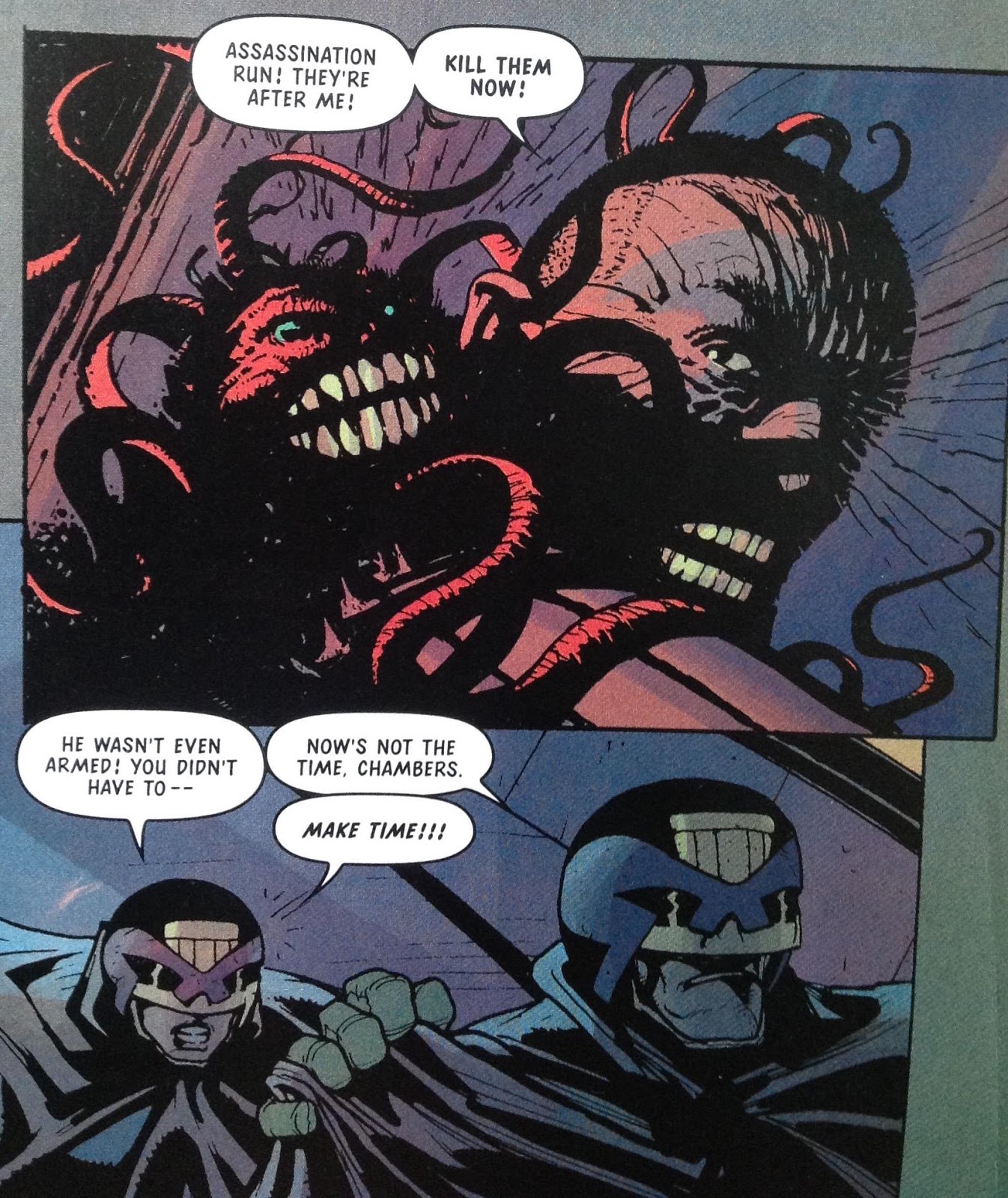
Dredd issuing the death penalty: in character
Dredd being excessive in carrying out the death penalty: pure fan service (or not)
Art by Carlos Ezquerra |
This can work. But it
didn’t. There’s no Spider-Man-esque ‘I must dig deep within myself to find the
strength’ so that you worry for Dredd and root for him to pull through. And
there’s no Wagner-esque well-plotted in-story set up that allows Dredd to find
and use some advantage. He just wins because he wins, because he’s Dredd, and
every time the story is diminished by it. It’s not even bathetic – we don’t get
a sense of ‘sometimes the world is just the way it is, we’re all just ants’.
You may get a smidge of fun at seeing Dredd taking out the bad guy, but when it
doesn’t feel earned it’s a let down.
 |
Sometimes, pure grandiose moments DO achieve a satisfying cool.
Art by Mick Austin |
A real shame, as
Morrison showed later, for example on JLA,
that he is actually very good at coming up with clever plots that allow a hero
to beat an unstoppable foe through earned cleverness. Hell, even in 2000AD his
does this more often than not with Judge
Janus (at least, the ones he wrote without Mark Millar). Perhaps Morrison
is more comfortable in the realm of the mind than the realm of the body, or
maybe he just really hates bullies and doesn’t want them to look good, ever.
 |
Stream of consciousness - a narrative style that feels more Morrisonian than it actually is.
Art by Carlos Ezquerra |
 |
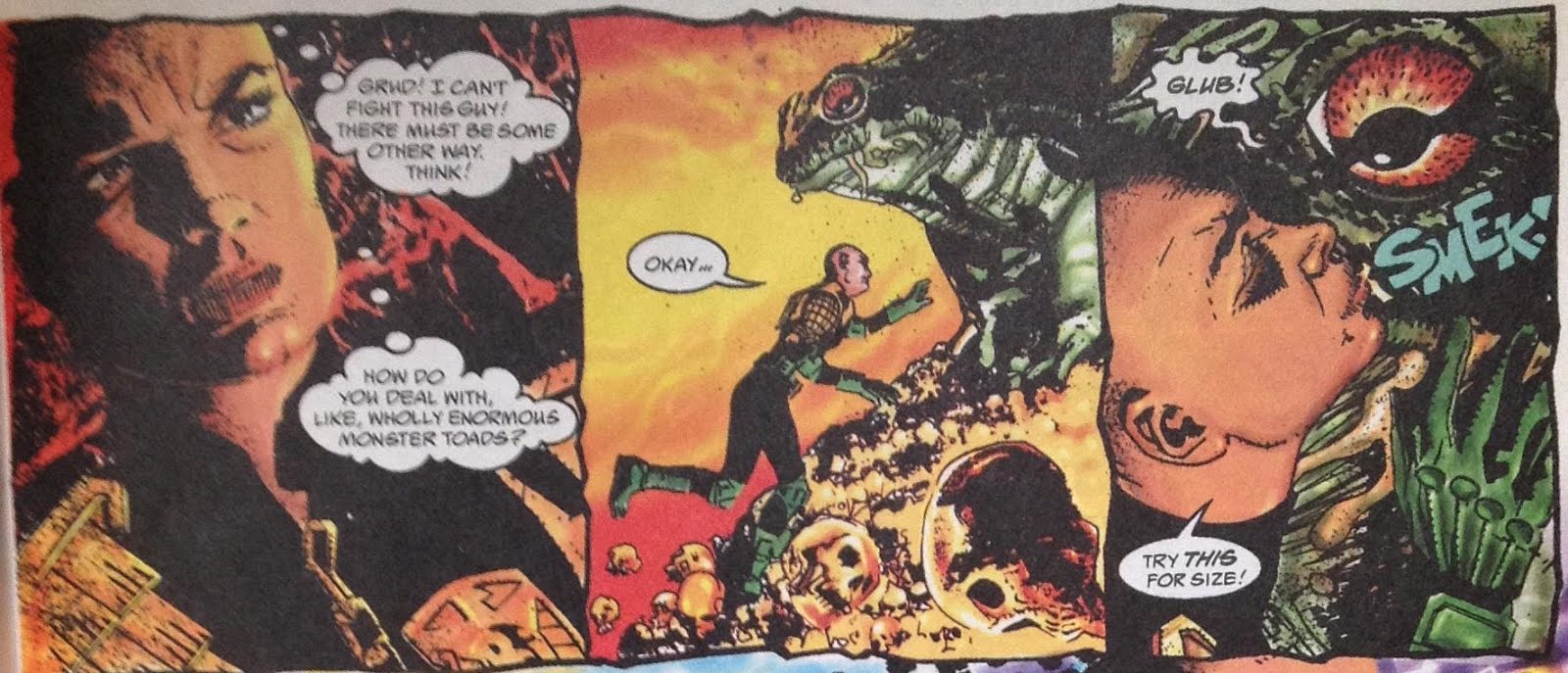
Now this, this is clever and delightful, subverting the expectation of violence with an act of love.
This is a side of Morrison I can get excited about.
Art by Paul Johnson |
Besides fans’ general
love of Zenith, I suspect Morrison’s
most lasting legacy on 2000AD was his very deliberate self-presentation as a
disruptive bad boy. He took a cue from popstars of the era, and the scattering
of interviews and questionnaires that cropped up in Tharg’s Nerve Centre here
and there show him acting the clown. He’d give deliberately obtuse or obscure
answers to questions, and made a point of disrespecting the likes of Pat Mills
and John Wagner.
To some extent, it’s
this attitude that informs Dare, the
generally much-loved series that ran in Revolver (before finishing in Crisis).
If you don’t know it, it’s about Dan Dare as an older man in the 1980s –a
version of the 1980s with Mrs Thatcher as supreme leader of a new British Empire. All delightfully designed and drawn by
Rian Hughes, the king of retro futures.
It has a tight,
exciting plot, and contains some interesting meditations on ageing and the
class struggle - but there’s also an edge of cynicism running through it. It
feels a bit like Morrison is angry about everything the original Dan Dare stood
for. I never read that, and he may well have a point.
Honestly, I can admire
this kind of thing from a certain perspective. It is healthy to try to rail
against what has gone before, especially
in 2000AD, which was founded on the principle of not being like everything else
that was out there. On the other end, it’s also kind of stupid. More to the
point, it’s not as if there were hundreds of 2000AD clones out there to kick
against.
Ironically, Morrison’s
faux (or perhaps genuine?) rudeness and cynicism actually made a certain period
of 2000AD feel more in step with the
zeitgeist of Deadline and Loaded Magazine, rather than reacting
against that. Whereas old hands Pat Mills and Kevin O’Neill were creating Toxic!****, a comic that was to 2000AD
in 1991 what 1977 2000AD had been to IPC boys’ comic of the time. Which is to
say, radically weird and definitely something parents would disapprove of.
Which brings us to the
notorious Summer Offensive of 1993. To be fair to Morrison, he did put his money
where his mouth was, and say ‘if I ran 2000AD, this is what I’d do with it’. I don’t know if he
really was de facto editor for the run of 8 comics from Prog 842-850, or if it
was more of a Thargian publicity stunt, but it felt like a big deal at the time,
and it lingers strong in my memory as a reader, too.
Morrison himself wrote
the Dredd story, the much-hated Inferno. He wrote the none-more-Morrison
lark Really & Truly. He co-wrote
the still controversial Big Dave.
Leaving space for Mark Millar and John Smith to deliver hyper-violent action
thrillers Maniac 5 and Slaughterbowl – which I mention here
because presumably Morrison had some hand in approving the idea of these
stories, which boil down to hyperviolent exploitation yarns.
 |
Really and Truly don't give a toss - they're just out for a good time, and why not?
The tone behind this series was a lot better than the actual story, which I want to love more than I do.
Art by Rian Hughes |
 |
| Morrison is always quick to acknowledge that insights priovided by narcotics can often be pretty feeble. |
It’s pretty much impossible
at this point not to get into a thing about Big Dave. I touched on it very
briefly in Mark Millar’s entry, mostly to say that I never really got the joke.
And of course it’s not fair to lay the blame at either writer alone. I still
struggle with the fact that so many readers at the time seemed to hate it that
I desperately wanted to like it. And the odd bit did make me laugh, e.g. Terry
Waite as a brawler.
 |
A rare spot-on, actually clever and funny sequience from Big Dave.
Art by Steve Parkhouse |
My guess is that the
main thrust was to develop a new, overtly British hero. And then the joke is
that, by following the sorts of things celebrated in the most popular media
outlets of the early 1990s, that kind of hero would be horrible. He'd be a body-building,
beer-swilling, sexist, xenophobic homophobe from a council estate in Manchester (nothing wrong with that last bit, mind). The dead
opposite of a noble, intellectual working class New York superhero role model. And then they stick him in a version of the
world in which his repellant views are actually based on truth. In Big Dave's Universe, foreigners are all vile, corrupt
imbeciles. Women are all fat slags. Poofs are fodder for being beaten up.
And maybe if 2000AD
was actually being read by people who read the Sun and the Daily Mail (either then or now, I suspect not a vast overlap), this
would be rather clever. Maybe. I mean, it’s obvious that the creators don’t
condone Dave as a role model – and that they don’t view the real world to be the way
it’s presented. But I’m not sure the joke goes anywhere beyond that, so it works as a one-off, but didn’t
really work as a series.
There is something
telling in the fact that if Big Dave were invented today, the strip could be
pretty much exactly the same, except that on the plus side, the true-blue Brit
hero would no longer be a gay basher, but on the minus side, he definitely
wouldn’t be proud to be on benefits either.
Hid Dredd work aside, I
applaud Morrison for filling 2000AD with characters and stories that were
absolutely unlike anything that had gone before.
Personal favourites:
Candy & the Catchman
Fruitcake & Veg!
Zenith: Phase II and IV
Janus, Psi Division: House of Sighs
(and, for the record,
I also like his Kill Your Boyfriend, bits
of Animal Man and Doom Patrol, JLA, parts of the Invisibles,
the middle bit of his New X-Men run,
all of the Filth; Batman and Robin (but
not especially his other Batman stuff)).
 |
This is me using Morrison's work to make my own meta-commentary about the blog...
Art by Steve Yeowell |
More on Grant Morrison
I almost don't dare to search for specific links, as there will be so many!
His official website has a section on 2000AD.
I haven't gone into any of the controversy about the ownership of Zenith, but if you're interested, you could do worse than read Laura Sneddon's slog through the whole thing.
For a seriously in depth look at his Zenith work, I'd recommend Tim Callahan's book: Grant Morrison: the Early Years, (which was originally serialised on the web over at Sequart, a site that worships at the altar of Grant Morrison, and why not? He's written a ton of great and influential comics).
*And not because I had
long assumed, in the 90s at any rate, that both men were gay. My thinking
nowadays would be that Cruise is largely nuts, while Morrison is, I imagine,
not in favour of labelling people according to sexuality or indeed anything
else. Both men have been, and continue to be, married to women.
**While acknowledging
that this could very easily describe me…
***This feels like
telling tales out of school, but I understand that Morrison helped out his
friend and, at the time, up-and-coming writer Mark Millar on a bunch of stories
in the 1990s. Two of the three Dredds
here are explicitly co-written by the pair, but Morrison may well have helped
on various ‘solo’ Millar efforts. Given that Millar has long suffered from
crippling health problems, this is, I think, a big point in Morrison’s credit.
Helping people is always good, no? But it makes it harder to know which aspects
of a story to attribute to which author.
****The only problem being
that Toxic! was one gets the
impression, very poorly managed from a production / financial point of view.
And also it had some very divisive art and utterly incomprehensible stories…