Tuesday, April 28, 2015

Interlude: the Dreddcount part 1

Writers

Who has written the most episodes of Judge Dredd? Everyone knows the answer to that, it’s the character’s co-creator, John Wagner! 

For a character who has been in print every week for the last 38 years, and at least once a month for the last 25, not to mention the star of his own semi-regular annuals, mega-specials and a long-running newspaper strip, the real wonder is that not only has one writer been in control for so long, but so few others have had to step in to help out.

Art by Ian Gibson; words by Wagner & Grant

Here’s the breakdown of all the scribes who have written multiple Dredd stories for the house of Tharg. This covers the Progs, Megs, Annuals, Mega-Specials, Poster Progs and all that guff. I’m also listing, in brackets, episodes of the Daily Star and Metro Dredd stories (which is definitely the same Dredd, but a subtly different storytelling medium).

But I haven’t included: any Dredd novels and audio dramas – same Dredd, different medium. Nor indeed the ill-fated run of comics that were released to tie in with the 1995 film (Lawman of the Future; Judge Dredd; Legends of the Law – on the grounds that all of them feature a slightly different Dredd), nor indeed the rather better fated recent IDW series (is this the same Dredd? Is it?), and, I hope not too controversially, the Dredd stories that are explicitly about the movie Dredd, more obviously a separate character in his own version of Mega City 1.

Art by Jason Brashill; words by John Wagner

The top two names on the list are entirely uncontroversial. Just to inject a little fun I’ve listed a collaboration as a separate entity. Beyond that there’s a bit of a mess around who has written more stories vs who has written more episodes, and how much weight one likes to ascribe to the newspaper strips.

Art by Ron Smith; Words by Wagner & Grant

No commentary this time around! Let the stats speak for themselves. With one exception, I'm only listing people who have written more than 1 episode.

Name
Separate stories
Individual episodes
John Wagner (solo)
478
1107
Wagner/Grant
206 (+492)
427 (+1832)
Alan Grant (solo)
102
124
Gordon Rennie
78 (+13)
143 (+242)
Garth Ennis
48
137
Robbie Morrison
43 (+4)
65 (+167)
Al Ewing
30
54
Michael Carroll
26
59
Rob Williams
21
37
Pat Mills
17
49
Mark Millar
17 (+33)
39 (+1349)
John Smith
15
47
Si Spurrier
14 (+5)
18 (+5)
Ian Edginton
8
12
Malcolm Shaw
6
6
John Tomlinson
5
10
Alan McKenzie
5 (+10)
9 (+390)
Jim Alexander
5
6
Paul Neal / Marc Wigmore
5
6
Si Spencer
5
5
TC Eglington
4
8
Dan Abnett
4
5
Chris Standley
4
4
Grant Morrison
3
30
Emma Beeby
3
9
AlecWorley
3
3
Arthur Wyatt
2
3
Kelvin Gosnell
2
2
Alan Barnes
2
2
Peter Harris
1*
1


Art by Mike McMahon; Words by John Wagner

*Plenty of people have written a single Judge Dredd tale; I’ve singled out Peter Harris as he wrote the very first one that saw print, often praised by Pat Mills, the editor and co-creator who judged his story to be the best available kick-off to the new character.

Thursday, April 23, 2015

No. 14 Robbie Morrison


First Prog: 927
Latest Prog: 1815, a surprisingly long time ago, but surely there’s more to come.

First Meg: 2.12 (or #32 if you prefer)
Latest Meg: 341. Again, I’d imagine he’s got things cooking, between regular Dredd work and Hondo City exploits still to explore.

Total appearances: 525
-including the three issues of Blackheart that were reprinted in the Megazine, but not including his run on the Daily Star Dredd strip, or on ‘Lawman of the Future’.

Creator credits:
Nikolai Dante, Shimura, Blackheart, Maelstrom, Wynter, Brit-Cit Brute, Vanguard, Shakara, the Bendatti Vendetta, Marauder

Other writing credits:
Judge Dredd – and quite a few tales, too. In fact, Morrison is in the top five for most Dredd episodes as writer*
Judge Hershey – one of a handful of writers to have a go at making Hershey a workable star with stories that couldn’t be ‘Judge Dredd’ stories. No one has quite nailed this, for whatever reason.
DeMarco, PI – specifically, Morrison was the first to move the character out of Dredd and into her own series as a private investigator. It was a good move.
Hondo City Justice – spinning off largely from his own work on Shimura / Inaba, but making some use of Wagner/Grant’s early forays into the world of Hondo City, too. Not sure how one credits this kind of creation, frankly!
Various one offs.

Notable character creations:
Inspector Inaba, who span out of Shimura and went on to her own solo series.
DeMarco’s ape assistant, Travis Perkins
Shakara, the first post-Year 2000 icon from the comic.
Some Russian dude and his girlfriend. (And a big chunk of their supporting cast, too.)

Notable characteristics:
Incredibly thorough background concepts; lead characters trying to escape/repay a sad past; narrative captions with florid prose; dense plotting; emotional manipulation (which I take to be a good thing – stories should actively try to make readers feel stuff, you know?). 

Art by Simon Fraser


Writing female characters with the same attendant strengths and flaws as his male characters. Obviously most if not all 2000 AD writers have done this, and perfectly well, but Morrison seems to make more of a point of it. And it’s worth applauding that, I think.

Art by John Burns
She's a bad 'un.

Art by John Burns
She's talking about his mother. She's a good 'un.
Art by Steve Yeowell
Art by Colin MacNeil.
She's a curious one.
On Robbie:
Morrison will forever be associated with, and celebrated for, his 12-year epic saga the Adventures of Nikolai Dante. It’s bloody marvellous, isn’t it. 
 
Art by John Burns

But he’s had plenty of other hits to his name, and has been one of Tharg’s go-to creators for at least 20 years now. Morrison emerged in the early 90s as part of David Bishop’s drive to get new talent into the Megazine. His opening salvo, Shimura, remains the longest-lasting ‘Judge story in a different city’ trick that seemed to be the initial remit of the Megazine’s line-up. The one-two art punch of Frank Quitely and Colin MacNeil on the opening stories for Shimura helped a lot, but the essence of the story is strong enough by itself. Judge-Inspector Shimura, a Dredd-style hardman, finds himself working for a much more obviously corrupt system than MegaCity 1. As well as fighting that system, he also trains up an even more noble-minded new Judge (Inaba). Tons of conflict – and, as the series progressed, no shortage of villains with interesting abilities (machine-men and fire-breathers come to mind). 

Art by Frank Quitely
Turns out he's a bad guy.
 
Art by Simon Fraser
This is definitely a bad guy.
If there’s a problem, it’s that Morrison’s wider stories are often so well thought-out that there’s an awful lot to explain even in a single episode, never mind across a multi-part story. Lovely as they are to look at, the first couple of Shimura stories were a little confusing. Maelstrom, I think, was the biggest victim of this tendency – really, it’s a fantastic story, but it’s bloody hard work. Vanguard, on the other hand, perhaps went too far the other way. The space epic that never happened, it was perfectly good but just maybe not too straightforward in its basic plot and characterisation to enthuse the readers.

Art by Colin MacNeil
You know your story's complicated when one character has to mutate twice!
Art by Colin MacNeil.
This was the end of book 1. It didn't return for Book 2.

The Adventures of Nikolai Dante, of course, is where it all came together (which is an odd thing to say, since it’s pretty much the first thing he did for 2000 AD!). A saga that really needed, and made use of, its sprawling page count. Mixing up long and sometimes plot-heavy epics with fun little one-offs was a great tactical move. Of course the star is the hero himself, a hero genuinely not like any other – he’s both arrogant and self-deprecating, ridiculously good at the derring-do business, but also perfectly defeatable. He’s essentially a good person, but constantly given over to betrayal and even cowardice, sometimes for noble reasons but often for selfish ones. And of course it’s important to celebrate Dante the series for being one of the few comics that celebrates human sexuality at all. That it makes sex something funny and childish and grown up and delightful all at once is even better. Dante is a unique part of 2000 AD history, and one of British comics’ very finest artistic achievements.

 
Art by Charlie Adlard


Art by John Burns
This one's more of a Carry On kind of sexuality...

Art by Steve Yeowell
How about Morrison’s Dredd? I don’t know that I’ve seen it discussed much, but he’s sort of the quintessential ‘caring, sharing’ Dredd scribe. Morrison, I think, is interested in pushing the hero to see what kind of reaction he can get – what situations will see Dredd having some sympathy for a perp, and what situations will make the reader hate Dredd when he is unsympathetic. 

Art by Tom Carney
The crazy-eyed man is a Judge guarding the West Wall from mutants.
Will Dredd side with the law or with the oppressed?
As this epsiode was written by Robbie Morrison, not Alan Grant, you can guess.
 Morrison’s justice system is pure evil in the Alan Grant mode, but the citizens he writes about are, on the whole, nobler than the schmucks and weirdoes most writers choose to focus on. And Dredd himself, more often than not, gets to be ‘nice’. I wouldn’t want to read this kind of Dredd all the time, but the character benefits from it. However, when the fiocus moves away from Dredd an onto the citizens in question, we end up with Marauder, one of several rather good 'vigilatnes in Mega City 1' stories.

Every now and then Morrison decides to go full 'rocket fuel' and let his silly side hang out. There's always room for some OTT high-end silliness in the Prog and Meg.** 

Art by Stuart Mac

Art by Ben Willsher
Desire to kill a lot of people by R. Morrison


And this leads neatly into the odd beast out in Morrison’s catalogue: the mighty Shakara

Art by Henry Flint

Morrison doesn’t get enough credit, I think, for being a great facilitator for artists. He’s been well served by the likes of Colin MacNeil, Simon Fraser and John Burns, who spare no expense at building up the world around their characters as well as the characters themselves – but this is surely because Morrison gives them the information to work from.

Art by Henry Flint
But with Shakara, there’s no doubt that Morrison wanted to let Henry Flint off the hook (especially after seeing what he could do in the first series). Famously, the last human in the galaxy dies in episode 1, and from there it's giant eyeballs, spaceship-sized weapons and all manner of thrill-powered alien goodness. Described by Morrison, rendered by Flint. If there’s a theme, it’s about reader joy at seeing horrible people getting their comeuppance – and, in later series, there’s the puzzle-solving fun of ‘just how can these horrible people find a way to stop an unstoppable foe’? Morrison is a good a dealer of mayhem as Tharg has unleashed, but he's got the wit to make it intersting, too.

Art by Henry Flint

Robbie Morrison, a modern legend.

Personal favourites:
Nikolai Dante, obviously the whole thing, but, because much of the epic series worked as individual stories, I’ll single some out:
  • The original 12 prog run (aka Nikolai Dante / The Romanov Dynasty)
  • The Great Game
  • The Rudinshtein Irregulars
  • How could you believe me…?
  • Sword of the Tsar
  • Amerika
Judge Dredd: the Face of Justice; the Incident; Word of the Law (the tale that later spawned Marauder)
Maelstrom (I struggled with it at first but on a re-read it holds up amazingly well, and is filled with characters and situations that linger in my mind)
Shakara – all of it, but the first book especially was a real standout at the time it first ran, and it remains a concentrated blast of thrill-power.
Shimura: Dragonfire; The harder they come
More on Robbie Morrison

You can see him on YouTube talking about a non-2000AD project, White Death, a rather splendid if deep[ly sad tale of the War.
He talks to comics journalist and my near-namesake Alex Fitch about his career more generally here.


*Hmm, I feel a new stats project coming on...

**And whatever 'Havok' was - a mysterious pull-out mini-comic that came sporadically with Progs 1024-1036 and featured crazy space war death written by Morrison and drawn by Rob McCallum. I have included in the count, by the way.

Monday, April 20, 2015

No. 13 Richard Burton


First First Prog (as assistant editor): 175
First Final Prog (as assistant editor): 349

Second First Prog (as assistant editor): 501
(as editor): 520
Final Final Prog: 872

Total appearances: 547

Creator credits:
A single Future Shock – notably, long before he got the job as assistant editor.

On Burt:
Richard Burton served two stints as editorial assistant (first taking over the slot vacated by Alan Grant, I guess?) before becoming the main editor for a 7-year stretch covering the late 80s to mid 90s. That’s a lot of behind-the-scenes work making sure the weekly Prog is put together on time and in the right order, filled with top content.

But, in truth, the man’s legacy is surely always going to be as Tharg’s hapless droid assistant Burt, the supporting player in many of Tharg’s occasional one-off tales. I haven’t counted, but I wouldn’t be surprised to learn that the droid incarnation of Richard Burton has appeared in the comic more times than any other ‘real’ person (Judge Logan, maybe?).
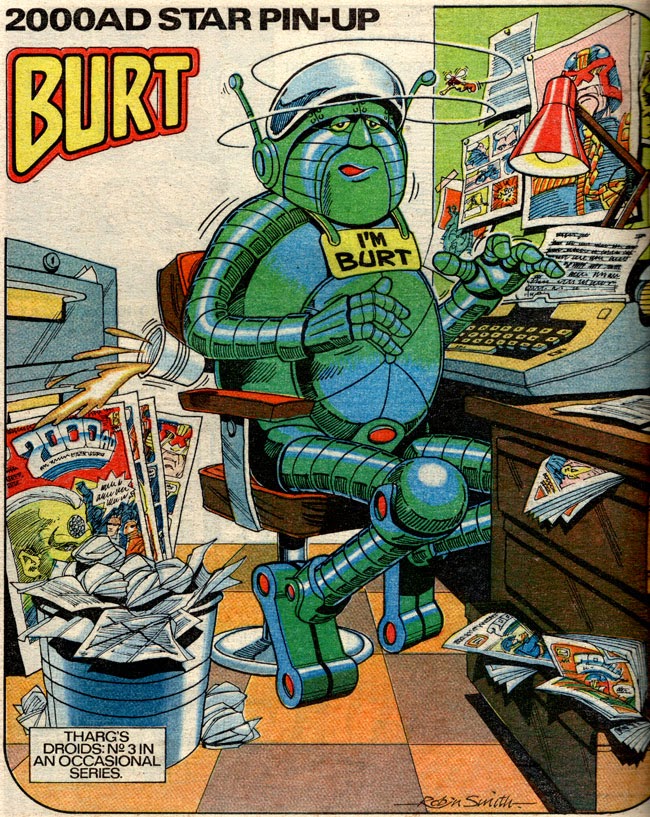
Art by Robin Smith
Burt the character is an excellent comic foil to Tharg the character, but it does have the unfortunate knock-on effect of making one assume that the actual Mr Burton was something of a mumbler, a ditherer and certainly not a go-getter. (I imagine he did look a little like a human version of this, and also that he had the ‘er… umm…’ speech tic. Although, to be fair to him, this is something a lot of people do.*)

With few avenues to assess the man himself (I must say it was a nice surprise to see him writing the intro to the latest ‘Daily Dredds’ collection, which he was clearly involved in organising to some degree), let’s look at the Prog during his two tenures:

1) Progs 175-349: by almost any reader’s assessment, this is the great Golden Age of 2000 AD. No longer tied down by the forced merger with Tornado (as of Prog 178), the comic was able to concentrate on delivering readers established and unadulterated hits: Judge Dredd, Strontium Dog, Nemesis the Warlock, and RoboHunter; meanwhile, development work lead to the start of many beloved, and long-running, series: Rogue Trooper, Ace Trucking Co and Slaine; all while making space for a solid helping of long-form stories that really hit the spot: Meltdown Man, Return to Armageddon, Harry 20, Skizz. And, capping it all off, it was absolutely the best era for Future Shocks.

The writers and artists at this time deserve most of the credit, of course, but however much or little Burton had to do with this lot, one can’t deny the level of quality thrills. This is about as much as I can glean he was responsible for on a day-to-day basis...


Art by Carlos Ezquerra; text probably by Steve MacManus
In case you're curious, 'Grover' and 'Howard' are both John Wagner
(presumably why one cubicle is empty!);
'Gaunt' is Alan Grant and Kelvin Gosnell combined.

2) Progs 501-872: there’s popular consensus on this era, too – it covers the period when the comic first got a bit pretentious and then got a bit bad. At this time, Burton was the man largely in charge of the weekly Prog, while assistant Alan McKenzie took care of things such as Tharg's intro script and the reader letters stuff mentioned in the excerpt above (and submitting his own scripts). It’s also the era of 2000 AD when I started reading and was at my most avid as a fan, so I’m biased about it and tend to rate it a lot higher than many who’ve read from Prog 1. I’ll even fight the corner for Progs 700-950, when the comic was at its most juvenile.**

New Thrills brought to you by Richard Burton (with tacit approval from Mac-1)

The later round of all-new thrills from Burt, perhaps this time with less Mac intervention? Who knows.
But, you know, there's more gold than muck in there.
Once again, the talent behind the stories is a key part of all this. Aside from Messrs Wagner, Grant and Mills, there were a lot of new writers making their mark here. On the art side, Carlos Ezquerra, Steve Dillon and Massimo Belardinelli were amongst the few old hands who kept going while a host of new talents jostled for space in the weekly Prog. And perhaps this is where an editor’s whip can be felt most obviously.

Rather than simply trusting that any given script / artwork from the likes of a Wagner, Grant and Ezquerra will be fit for publication (because you just know it will be), the editor needs to invite submissions from untried droids, and then steer the results in the right direction. All within various time constraints, and the infamous management diktat that any material paid for absolutely must be published, or else - although as David Bishop later explained, much of the worst of this stuff was hidden in drawers for as long as possible...

Nonetheless, really rather a lot of talented people were nurtured through 2000 AD at this time, so let’s be grateful, in part, to Richard Burton for the likes of:
Steve Yeowell, John Smith, Paul Marshall, Anthony Williams, Colin MacNeil, Alan McKenzie, David Roach, Simon Bisley, Chris Weston, Mike Hadley, Will Simpson, Hilary Robinson, Nigel Dobbyn, Kevin Walker, Kev Hopgood, Simon Coleby, Simon Jacob, John Tomlinson, Mark Millar, Greg Staples…

(Recognising that some of these fine folk may have first found favour through Crisis and/or The Judge Dredd Megazine, which I’m led to believe were more closely managed by editor in chief Steve MacManus, and then of course Mr Bishop.)

This may seem a strange thing to assign credit for here, but presumably it was Burton who okayed the ‘Summer Offensive’ project, allowing brash young(ish) things Grant Morrison, Mark Millar and John Smith to fill the Prog with stories of their own devising for a couple of months. Dredd micro-epic Inferno aside, that was a good time to be a reader, and it felt like a true kick up the arse; a lasting effort to push the Prog forward as a vehicle for intelligent exploitation fare***. Arguably things then got worse before they got better (i.e. after Burton had left 2000AD to create Sonic the Comic, something I didn't read but is clearly much beloved by many, and I confess I'm dying to read some of the McMahon and Elson drawn strips), but editorial willingness to give things a go is always welcome.

It’s easy to disparage the 2000 AD of this era, but it’s worth remembering that no Prog was a total stinker, and there’s plenty of gold and silver nuggets to find, not all of it from the pens of Wagner, Grant and Mills, either. While I wouldn’t pay for a reprint of plenty of the thrills from this time, I don’t begrudge them the part they played in shaping my tween/teen brain, either.

Art by Massimo Belardinelli
Sarcasm by MacManus again?

Update November 2016:
I've just finished listening to an epic 3-part interview with the man, organised by podcasting legends Everything Comes Back to 2000AD.
I'd like to think it confirms rather than denies everything I've written above, but then, I managed to spend a lot of words not saying very much, so perhaps it doesn't matter. One of the biggest takeaways for me was that Burton in fact takes credit for a trio of major art finds, all during his tenure as assistant editor - Steve Dillon (RIP), Alan Davis and Barry Kitson. And for that, I'll be forever grateful!

Part 1 (an overview of his career)
Part 2 (an in-depth look at his time on 2000AD)
Part 3 (answering questions, including some direct challenges that he wasn't 'up to the job')

There are hints of a book to come...

More on Richard Burton
(and yes, if you're going to type his name into Google, do remember to filter out the actor of the same name...)
This YouTube clip is fun; thanks to the thrill-powered blog Everything Comes Back to 2000AD for providing the link in the first place. Burton doesn't say much in it, but it's a lovely bit of 1990s history.
If you can get hold of a copy, there's a interview with him in Beyond 2000AD from Hibernia press - but it's so out of stock I could only find a listing for it here.
His story of meeting Steve Dillon and giving him work for the first time is on the Steve Dillon tribute episode of the Thrillcast.


*In fact, this turned out not to be the case!

**In both senses of the word juvenile. Sometimes, the comic felt aimed at children, which, being a child, I enjoyed (see: a fair amount of Michael Fleisher’s Friday and the new Harlem Heroes, also Peter Hogan's delightful TimeHouse). And sometimes, the comic felt as if it were behaving like a child – over the top violence with not enough wit to make it work (see: the new RoboHunter; a number of Dredd tales from certain writers). I suspect Burton felt his basic remit was to make a comic for children that many grown-ups also liked, which pulled the Prog in awkward directions ironed out by later editors. 

-updated to add: Yes, Burton reports that he deliberately wanted to include some stories for 11 year-olds (me), as well as some for the 20-30 age group (most readers). He resolutely maintained the comic as a mainstream publication; something I think it was when he started, but wasn't by the time he left - which says more about the demise of British newsstand comics than it does about his editorial choices.

***Yes, in the end, the intelligent half of this was not much born out of the Summer Offensive - but I believe Morrison and Millar really thought Big Dave was meant to be intelligent, so points for trying. More on this another time.