First Prog: 569
Latest Prog: 1935, on
the cover (and surely there’s a third series of Ulysses Sweet to come on the
insides, too?)
First Meg: 3.09
Latest Meg: 335 (and
more Samizdat Squad in future, perhaps?)
Total appearances: 202
Creator credits:
Firekind, the Corps,
Leatherjack, Samizdat Squad
Other art credits:
Judge Dredd
Tyranny Rex
Durham Red
Nikolai Dante
Sinister Dexter
Mean Machine
The Streets of Dan Francisco
Ulysses Sweet
Plenty of Future Shocks and
other one-offs
Notable character creations:
All manner of Smithian
heroes and villains
Emmanuel Chekov, the
aristocratic vampire from Nikolai Dante, I think?
 |
| John Smith hired torturer No. 1 |
Notable characteristics:
Comedy; face work;
child-friendly gore
 |
His literally having his intestines kicked out, but it's kinda sweet, dontcha think?
Words by Guy Adams |
 |
It's a little gorier in colour, but I'd happily let my 5 year-olds look at this.
Context by John Smith |
On Paul:
Like his near contemporary
Steve Yeowell, Paul Marshall is another of those unsung heroes who has been
working away steadily on the Prog for well over 25 years, without ever
attracting vast amounts of attention. His art tends to be at the cartoonier
end, which seems to mean he’s less likely to attract fan favourite status. He’s
worked with John Smith on a couple of his better-loved one-off tales, Firekind and Leatherjack, to such memorable effect that I think of him as a
Smith artist – but in fact, they haven’t worked together especially often, and
if anything, Paul Marshall is a Judge
Dredd artist who occasionally dabbles in other stuff.
 |
The very definition of 'other stuff'.
Words by John Murphy |
As such, he’s been
picked to draw a wide variety of Dredd
stories. There’s the one-off funny episodes, including It still pays to be Mental or Incident
at Rowdy Yates (one of those very occasional treats that explore Dredd’s
character when he’s not at work).
 |
Dredd when he's not busting heads.
Words by John Wagner |
There are the darker tales, such as Rotten Manners, about ultra-corrupt
Judge Manners.* Long-form action-based mini-epics, such as Darkside** or The Ecstasy.
 |
That's not Judge Dredd riffing on Psycho, is it? Read Case Files 25 to find out...
Words by John Smith |
 |
That definitely is Dredd smashing teeth.
words by John Smith (I think) |
And of course the all-out weird ones that trade on Marshall’s ability to have fun with character
design, the obvious examples being the Si Spurrier-penned Neoweirdies. Somehow this work
doesn’t stand out in the memory, but in fact it’s all spot-on character
observation. I think Marshall
is one of the best in the biz at getting people’s expressions just right to
convey their moods, without needing to exaggerate. And, like Ron Smith or Cam
Kennedy, he’s got a real eye for an idiot in idiot’s clothing, vital for
depicting your average Mega Citizen.
 |
Fun 'n games in the no-grav pool!
I cannot for the life of me remember where this comes from but it's definitely Dredd and it's definitely gorgeous. |
Now let’s turn to what
I believe is Marshall’s
most celebrated turn, as the man who dreamed up the anthropologically detailed
world of Firekind. As well as
designing dragons, humanoid aliens, retro-fashioned heroes and villains, Marshall embraces the
poetic flights of fancy that Smith threw into the script, chiefly to illustrate
Larsen’s mental state.
 |
Pretentious art to match pretentious prose. I love it.
Words by John Smith |
 |
Fantastical, delirious.
Words by John Smith |
 |
A weirdly erotic scene
Words by John Smith |
He used an especially
clean, crisp style that really stuck out at the time for being bright and
cheerful in a time when too many others were being brown and moody.
 |
Of course, this style doesn't have to depict bright and cheerful things!
Words by Kek-W (I think) |
In the immediate
aftermath, Marshall
was kept busy teamed with Smith again for a Tyranny
Rex tale that he took over from Mark Buckingham, including a cracking
cover.
He was then asked to
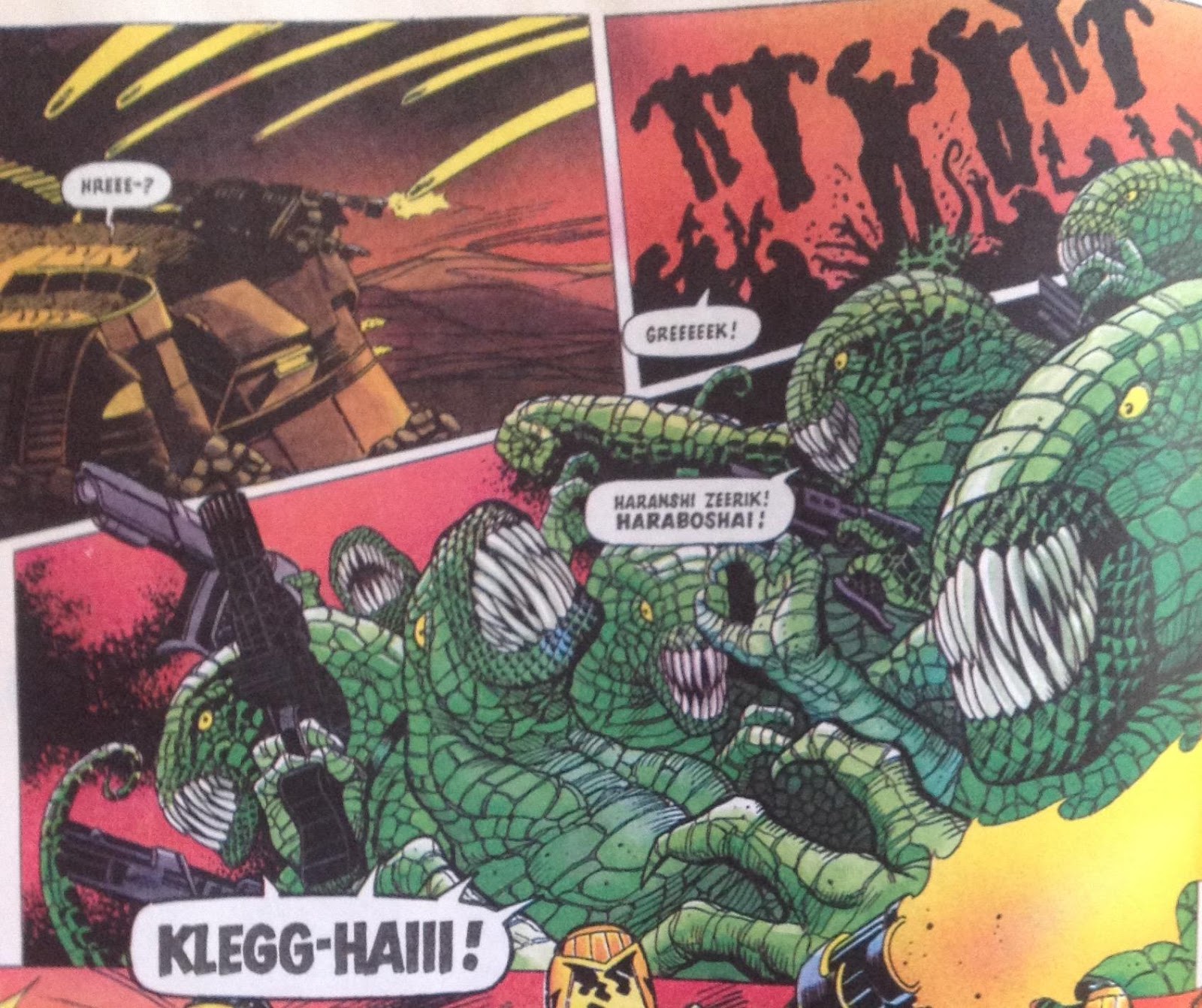
tackle Garth Ennis’s the Corps. His first episode included a pretty radical,
but also I think delightful redesign of alien lizards the Kleggs.
 |
Marshall's Kleggs - scalier and scarier.
Words by Garth Ennis |
But after
that Colin MacNeil was drafted in to help, I think on pencilling/layout duties,
with Marshall
fleshing it out. And ever since, for reasons that may have as much to do with
how bloody hard his clear-line look was to produce, he’s seemed to switch to
working in a looser style, with a thicker brush – but no less thought to the
posing and costuming.
 |
Capturing Finnigan Sinsiter in mid-flow.
Words by Dan Abnett |
 |
Leatherjack is starting to work out what's going on.
Words by John Smith |
 |
| As vamp-themed covers go, this one's hard to top. |
 |
| A daringinly unusual cover here - but by God it makes you want to know what the story is about. |
Sticking in the world
of Dredd, Marshall
has, relatively recently, been hard at work in the Megazine with Arthur Wyatt,
bringing his monsters and wilderness skills to Samizdat Squad, and his exquisite cityscapes to the Streets of Dan Francisco.
 |
Attack of the mental mud men!
Words by Arthur Wyatt |
 |
Mega City 1 was born to be used for Will Eisner homages.
Words by Arthur Wyatt |
He manages to tread a
fine line with that particular character, who has his roots in reality TV and
the attendant Mega
City citizen tomfoolery,
but is also a straight –up action hero, and, in this series especially, a man
with a heavy backstory as the ex-Chief Judge. An artist like Marshall makes it look much easier than it is
to put a man like that through his emotional/character paces.

Most recently, Marshall has been paired
up with new writer Guy Adams to produce two series of utter lunacy in the form
of Ulysses Sweet: Maniac for Hire. Honestly, I think it’s some of his most
inspired work in ages. Comedy series tend to divide audiences (or just be plain
bad). This one I really rather like, and a lot of that is down to Marshall’s playfulness. Here he is playing around with the film editing technique known as the Kuleshov effect. In this, one actor maintains a steady, blank expression while the editor cuts in a series of unrelated images. The viewer cannot help but confer emotions on the blank actor. Marshall may or may not have heard of the Kuleshov effect, but he's clearly achieving the same sort of thing in this short sequence by contrasting bland popstar 1 with bratty popstar 2.
 |
They're both in awe of Ulysses Sweet.
Words by Guy Adams |
Central character
Sweet is the kind of maniac that Marvel’s Deadpool claims to be, but often
can’t actually be because he’s in a
Marvel comic (even a Marvel Max comic, sometimes). 2000 AD doesn’t have those
qualms. In Marshall,
it also has someone who can draw extreme ultranastiness and violence and, in
this context, make it feel as if it’d be perfectly at home in the Beano. It’s
oddly comforting.
 |
Good catch, there.
Words by Guy Adams |
Rather quiet of late, Marshall has delivered a slightly mellower style in a recent Future Shock:
 |
Loving the grey wash, and the Ron Smith undertones going on here. And who doesn't want more panels showing exposed brains? More of this, please, Mr Marshall!
Words by David Baillie |
Here’s hoping for more
sombre atmospherics, more high comedy Sweet, and it’s long past time that Marshall reminded readers why he’s has been
a staple Dredd artist for so many years.
 |
| That's definitve Helmet right there. |
More on Paul Marshall
He has his own Tumblr page stuffed with art
…but, sad to say, I
can’t find any other online links for the man.
Best bet is to dig out
your copy of Megazine 335, where he's interviewed in print.
Personal favourites:
Judge Dredd: It still pays to be Mental; Escape from Kurt Russell; Darkside; Incident
at Rowdy Yates; Escape from Atlantis; Trial by Dury; The Ecstasy; Cascade
Firekind
Tyranny Rex: Deus ex Machina
Leatherjack
Ulysses Sweet: Centred; Psycho Therapist
*who immediately
sounds like he’d be a great foil for Dirty Frank
**A story that is
generally forgotten but is getting some play right around now as it’s in the
recently-published Case Files 25.