First Prog: 682 (cover artist); 717 (strip artist); 1082 (colourist)
Latest Prog: 1899?
First Meg: 3.52
(aka 155), as cover artist
Latest Meg: 330, as
cover artist
- curiously, he’s only
provided one piece of strip work for the Meg, an episode of Durham Red: the Scarlet Apocrypha in
issue 4.18.
Total appearances: 191 and counting

Creator credits:
Glimmer Rats; The
Ten-Seconders – and arguably also Durham Red counts, not as a new character but
as a dramatically new re-imagining of her look and situation.
Other art credits:
Judge Dredd
Strontium Dogs
Damnation Station
Grey Area
Plenty of Future Shocks and
other one-offs
Notable character creations:
The hell dimension of
the Glimmer is something of a memorable character…
If not for Durham Red
herself, Harrison certainly gets credit for her new supporting cast, chiefly
Judas Harrow and Matteus Godolkin (I’m pretty sure I’ve not quite got those
names right…)
Molloy and Harris from
Ten Seconders, and a handful of the Gods, although the two I can easily bring
to mind are Reed Richards parody the Scientist and Ben Grimm analogue Damage
The evolution of Durham Red...
 |
| Hanging out with the Gronk, still a Strontium Dog, still mostly in red. Words by Peter Hogan |
 |
| Now twice as gothic, and almost all in black. Words by Dan Abnett (or maybe it's Alan Smithee..?) |
 |
| Those clothes are rapidly disappearing... Words by Dan Abnett |
 |
| Almost entirely naked, and now almost completely feral. Words by Dan Abnett |
Notable characteristics:
background noise;
working with computers a lot; vast space vistas; incomprehensible crowd scenes;
dense detail; space opera; future war; guns’n’splosions – see also bombs,
energy weapons and violent, gooey death.
 |
| It's a safe bet that Harrison likes James Cameron's Aliens. Words by Dan Abnett |
On Mark:
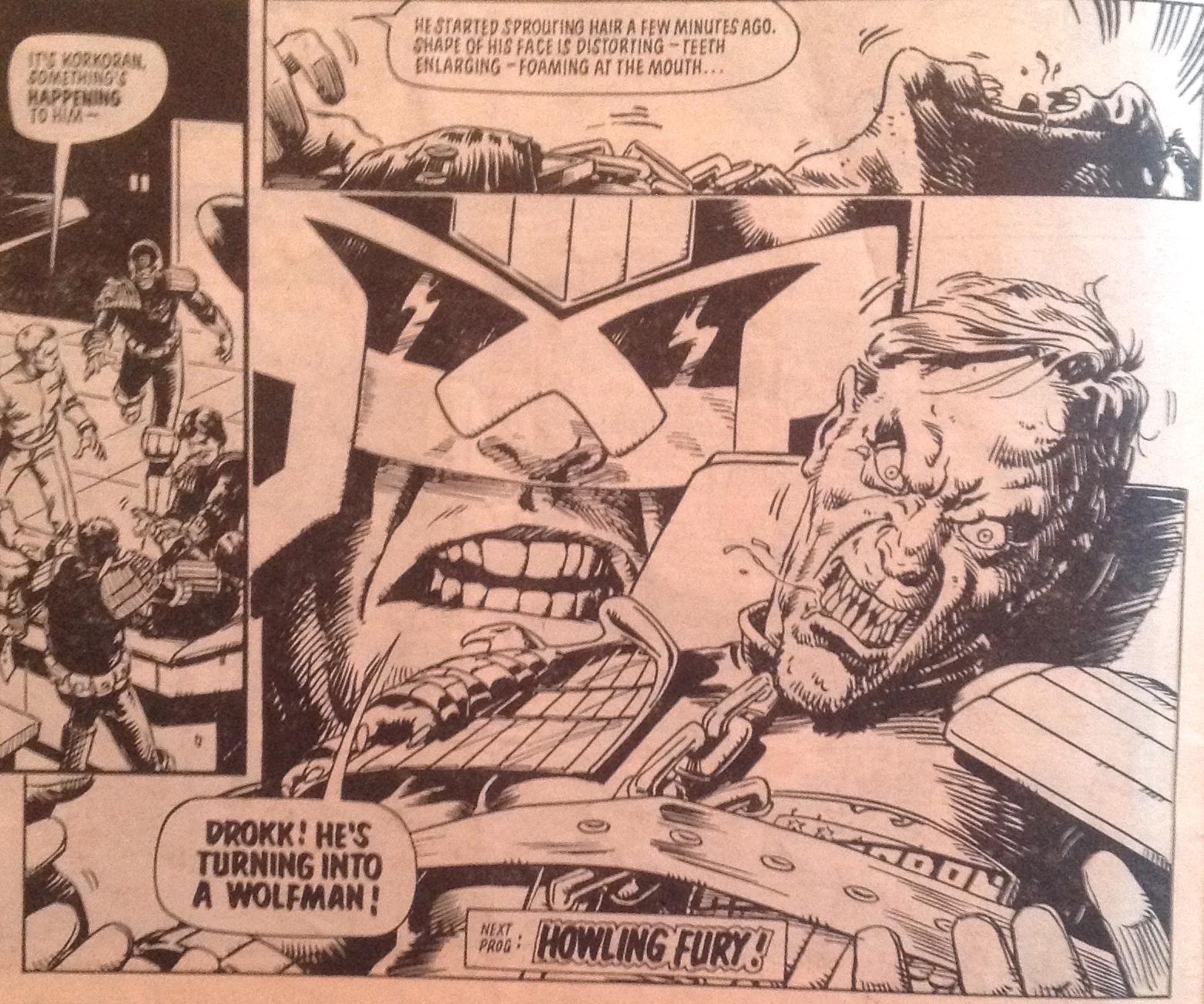
Harrison launched into 2000AD helping to set the scene
for one of the biggest Dredd epics in years. Wilderlands, ultimately, didn’t go down as an all-time classic. But
the set-up, which began with the Mechanismo
storyline, was a big deal. Harrison’s chapter,
Conspiracy of Silence, was perhaps
the biggest deal of all. In the story, Dredd discovers that Chief Judge
McGruder has been lying to him. She, in turn, discovers that Dredd also lied.
It’s a pretty major part of Dredd history, and his relationship to the whole
system of Justice in Mega
City has been simmering
away ever since.*
Harrison’s art, at that time, was kind of ropey. But it
brought something new to the comic and especially to Dredd’s world that really
grounded the story, making it feel real. Partly it’s the digitalesque painting
(I don’t know if he was already using just computers at the time. I guess
probably?), but a lot is his immediate and effective use of hurling around
background noises every which way. Yes, a city is a living, noisy place. Yes,
in the future, there will be a lot more electronic humming and robotic / pre-recorded
safety announcements. Also, insects still exist, especially when they’re
functioning as metaphors.
 |
| Harrison's debut for Tharg was full of mood and menace. Words by John Wagner |
Given that a big part
of Dredd’s world is that robots do so much of the work that most people are
unemployed, it’s a shame that Harrison hasn’t
put in more episodes. A single story and a handful of covers since his debut.
 |
| Harrison's Mega City 1 is a lived-in place, full of background goings-on. Words by Rob Williams |

But maybe this is
because he was soon tapped for another series – Strontium Dogs. He arrived during a troubled time when Ennis had
quit the series, replaced by Peter Hogan, who evidently wanted to tell a story
that Tharg wasn’t especially keen on. I wouldn’t like to guess at the exact
whys and wherefores of it all, but someone got the idea of bringing Durham Red
back into focus, and then got the idea that Harrison drew her rather well, and
then that the character really ought to be in a spacewar setting. Which in
turns suggested noted Warhammer 40,000
writer Dan Abnett. Maybe it was the other way around, and Abnett got the
character first, then chose to push her into the future?

Whatever the chain of
events, Harrison got to pay his dues drawing some arguably plodding adventures
of Durham Red, the Gronk, Feral and the Wandering Lady before launching into a
series that was one of the biggest deals at 2000 AD as it neared the Year 2000:
Durham Red. Yes, she was the same character as
invented by Wagner, Grant and Ezquerra, but what she looked like and what she
got up to was really an entirely new series. And boy, did Harrison
ever put his all into it. Also, Tharg and the higher ups knew a marketing
opportunity when they saw one, and sexy redhead vampire ladies were not far
from covers and publicity materials for a while there.**
 |
| Why yes Mr Bishop, I think that cover will shift a few extra copies of the Prog. |
Again, I have no idea
what techniques he used for each book of the three-book Durham Red in space
saga, but it was obviously a lot of work. It may even be the case that he
created 3D versions of various spaceships so he could spin them around to find
the perfect angle to shown them from in any given panel. It’s that sort of
level of crazed detail. Astonishing stuff.
Harrison put a lot of effort into the characters, too -
arguably a little too much. Like many
comics artists before and since, Harrison used
likenesses of actors for his cast, although he fiddled them a bit. Nothing
wrong with this, and I’m all for more Julian Sands in comics, but I do think
this decision made it a lot harder for Harrison to draw the same character from
different angles and keep them recognisable. At times, it is not immediately
obvious which character is which in certain scenes. On the other hand, when a
panel is great, it’s gorgeous.
I’m getting ahead of
myself a bit, but it’s well worth saying here that this is an issue that
Harrison has completely ironed out in his present work – certainly since Damnation Station.
Durham Red overall is something of a flawed masterpiece.
It shifts around in tone from gun action to space opera to snide comedy to
family drama, with a rather neat through-line in religion and the problems of
being a messiah. The ideas are great, the characters fun, but the episodic
narrative not always matching. Harrison’s art,
meanwhile, stays fairly consistent, and I wonder if it’s this that upsets the
tone a bit. The gunplay is exciting but not always clear; the space opera is
beyond magnificent, and the messianic stuff is pretty great, too – but
sometimes it was all a bit too murky. To be fair, a lot of this is a question of print. On computer, his art is far shinier, as a rule.
 |
| A Durham Red moodboard, lifted from Barney |
In between Durham Red
books, Harrison poured equal amounts of
digital ink into the Glimmer Rats. As
other reviewers have noted, the very fact that it’s sometimes hard to see
what’s going on actually suits this series down to the ground. A team of
prisoners/soldiers are sent through a portal to wage war in hell against
largely unbeatable spooks and spectres. If it was a film, it’d be the most
18-rated action film you could imagine, only with more gooey explodey death. I
didn’t care for it that much first time around, but it had lingered in my head
for more than 10 years now, and a recent re-read was much more favourable.
Seriously grim, seriously moody.
 |
| I think what's happening is that a man is possessed by some sort of phantasm and then implodes gorily. Just go with it. Words by Gordon Rennie |
 |
| When someone makes a mistake in the Glimmer, they will get gunned down AND exploded. It's the only way to be sure. Words still by Gordon Rennie. |
Around this time, Harrison wrote and drew a handful of Pulp Sci-Fi stories. It’s probably not the case but I can imagine
then-Tharg (Andy Diggle, I think?) invented the series largely as a vehicle for
Harrison. His stories don’t have traditional
twists like Future Shocks, but they are proper 2000AD, with hard Sci-Fi and
violence and a hint of weirdness.

 |
| Some fine laser guns right there. |
In a complete change
of pace, Harrison provided a single episode of
the Scarlet Apocrypha for the
Megazine, in which Durham Red is re-imagined in a number of different vampire
contexts. His version sees her as 60/70s horror icon on the convention circuit,
and he unleashed a caricature Mort Drucker style, unlike anything he’d done
before, and an utter delight. So much glorious background detail.
 |
| References to the Twin Towers and Rebellion taking over 2000AD were well soon after the facts... Words by Dan Abnett (and is that actually a caricature of Abnett on the far left?) |
To Harrison’s
enormous credit, he went on to channel this sort of creativity in future work. The Ten Seconders is much lighter than
his earlier work, the characters less openly (if at all) based on photo
reference, and generally the storytelling is clearer. And yet, there was room
for improvement, as if he was playing around with new techniques that weren’t quite
gelling yet.
 |
| A mix of draightsmanship and digital manipulation really sells the action of boarding a plane in mid-air. Words by Rob Williams |
 |
| Damage: part Mongrol, part the Thing. Words by Rob Williams |
But gel they did, when
Harrison emerged after years doing mostly
covers (especially for Rebellion’s novel imprint, Abaddon), to tackle the
latest Space War saga, Damnation Station.
To my mind, it’s the perfect synthesis of his cartoony style and his ultra
high-def space opera goodness.
 |
| That alien is soo delightly gooey and creepy. Love it. Words by Al Ewing |
 |
| Harrison always puts the effort in, here showing the torutred inner-thoughts resulting from PTSD in space. Words by Al Ewing |
The same style is
currently lending itself absolutely perfectly to Grey Area. Harrison appears to
have come full circle, working in tandem with Dan Abnett on a space-spanning
saga involving cynical, sour-faced humans and sexy alien ladies.
 |
| And, as ever, a continuous stream of background noise. Words by Dan Abnett |
More on Mark Harrison:
He has a gallery hosted by Barney here.
Covers Uncovered old(ish) and new.
Thoughts on Durham Red from The Hipster Dad
-haven't found any interviews, though, which is a shame as it seems as if he's a dude who'd have stuff to say.
Covers Uncovered old(ish) and new.
Thoughts on Durham Red from The Hipster Dad
-haven't found any interviews, though, which is a shame as it seems as if he's a dude who'd have stuff to say.
Personal favourites:
Judge Dredd: Conspiracy of Silence
Durham Red: The Scarlet Cantos; The Vermin Stars
Glimmer Rats
Damnation Station: The
ending (technically 5 different stories, but they were presented as a
continuous run of 12 Progs)
Grey Area: Nearer my God to Thee – and everything since then, too.
 |
| Somehow, the crazy alien face is showing empathy. Amazing. |
*It keeps nearly being resolved, especially with Origins and its follow-on saga Tour of Duty, but never really is. I
guess because the only actual ending would be for Dredd to come out against the
system and demand a new style of government in MC-1 (presumably involving
things like Democracy and a return to trial by jury, or at least trials of any
kind!), which would pretty radically re-write the rules for how to tell a basic
one-off Judge Dredd story. Not gonna happen.
**See also the
computer game BloodRayne, which
officially did not appropriate*** Harrison’s
redesign of Durham Red.
***Not that 2000AD as
an institution has much of a moral leg to stand on when it comes to borrowing existing designs every now and then.